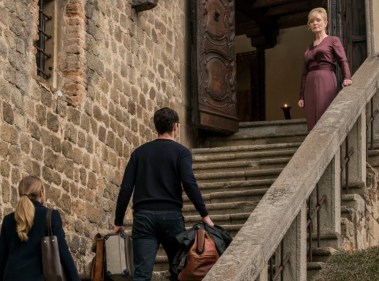
In this episode, Jen and Cait discuss epsiode 1×04 of A Discovery of Witches the TV show. Join us as we talk about dialogue, relationships, grief, and jumpsuits.
If you’d like to join the conversation, follow us on Twitter @chamomilenclove or using the hashtag #ccalchemy, or email us at chamomileandclovecast@gmail.com. You can also find us on Facebook as Chamomile & Clove – An All Souls Podcast or join our Facebook group, The Chamomile & Clove Clovers. We can’t wait to hear from you!
Verin de Clermont sat in her Berlin home and stared down at the newspaper in disbelief.
“Verin” derives from the English and German “Verena” or may have Slavic origins. It means either “Faith” or “Truthful.”
“What is it, Schatz?” Ernst Neumann put a glass of wine in front of his wife. She looked far too serious for a Monday night.
Schatz is a German term of endearment meaning “gem, jewel, or treasure.” You could also call your beloved Schatzen or or Schatzi, both of which mean “little treasure.” If you want to branch out, you can use Mauschen/Mausi (little mouse), Haschen/Hasi (little bunny), Barchen (little bear), or my personal favorite (and oft-heard in my house), Schecke or Schnecken (little snail).
“Where are you, Gallowglass?” Her nephew was a drifter. In the past he’d sent postcards with nothing but a phone number on them from whatever stretch of road he was traveling at the moment: the autobahn in Germany, Route 66 in the States, Trollstigen in Norway, the Guoliang Tunnel Road in China.
While unregulated sections of the autobahn have no speed limit, there are increased penalties for causing accidents at high speeds and many areas impose speed limits due to hazards like construction or substandard road surfaces.
“The number” had been generated in the earliest years of the telephone. Philippe had picked it: 917, for Ysabeau’s birthday in September.
17 September is a busy day in history: in 1630, it’s the date of the founding of the city of Boston, Massachusetts. In 1787, it’s the day that the US Constitution was signed in Philadelphia. In 1849, it’s the day that Harriet Tubman escaped from slavery. In 1954, it was the publication date for Lord of the Flies. In 2011, it was the day the Occupy Wall Street movement began.
Nyd, the rune for absence and desire. Gallowglass dipped his hand into the bag again to better understand what he wanted the future to hold.
As Deb points out in the Real-Time Reading Companion, Gallowglass has the last word until we re-join Matthew and Diana upon their arrival in Prague in March. Deb thinks of this song, Circa Paleo’s “The Gael” as “Gallowglass’s Theme.”
If you like what we do, please consider supporting us on Patreon. You can also find us on Facebook as the Chamomile & Clove Clovers.
If you’re suffering from #Witchdrawal, consider joining us tomorrow (2 February 2019) as we live-tweet Episode 1×03 of A Discovery of Witches TV at 4:30 PM Pacific/7:30 PM Eastern/12:30 AM GMT using the hashtag #ccalchemy. We’ve had a killer time live-tweeting Episodes 1×01 and 1×02 and we’d love for you to join us. Follow us @chamomilenclove on Twitter for updates. If you have questions, comments, or thoughts, send us a note at chamomileandclovecast@gmail.com. We’d love to hear from you!
After the death of Francis Walsingham, Cecil became the head of Elizabeth’s intricate spy network aimed at discovering (and squashing) Catholic plots against the queen.
The little snippet of Latin Lord Burghley quotes to Diana (Vanitatis vanitatum, omnis vanitas) comes from the Vulgate translation of Ecclesiastes 1:2, a verse which translates as “Vanity, vanity, everything vanity.” It’s a curious bit of verse for a Protestant, as it comes from the official version of the Latin Bible dating from the 4th century.
If you’re interested in Lord Burghley as a spymaster, there’s a current BBC series airing on PBS that looks pretty interesting.
“Because if we are not in the audience chamber at Richmond Palace by two in the afternoon tomorrow, Elizabeth will arrest us both.”
Going to court in Tudor England was no small thing. First of all, the Tudor palaces were explicitly designed to restrict access to the monarchy and channel people of different rank into appropriate spaces. Because only the most important (and affluent) people made it into the presence of the king or queen, it paid to appear in court dressed in the finest clothing money could buy. In Tudor times, proximity to the king or queen was the quickest way to attain favor–and thereby improve your title and fortune. However, if Elizabeth I felt that you slighted, betrayed, or otherwise disobeyed her, the consequences could be brutal. Court was complicated, political, and highly performative.
In Shadow of Night, Elizabeth I’s court is located at Richmond Palace, the lost palace of the Tudor monarchy. Henry VII died in the palace and it became Elizabeth I’s favorite — she died there in 1603 and her body made the journey to Westminister Abbey from its gates. In the mid-seventeenth century, after the execution of Charles I, Oliver Cromwell and his administration systematically stripped the palace until only a few bits and pieces remained. You can still visit the site of Richmond Palace in southwest London today.
“And silver and black are the queen’s colors. That’s why Walter is always wearing them,” Mary explained, smoothing the puffed sleeves.
Elizabeth I had a vast and impressive wardrobe. As she grew older, she apparently leaned into the image of herself as the Virgin Queen and preferred to dress in black, white, and silver — colors she believed represented purity and virginity. Throughout Elizabeth’s reign, England remained under strict sumptuary laws — Elizabeth I believed that her courtiers should dress according to (but not exceeding) their rank. This is why Elizabeth has a bit of a fit when she notices Diana’s borrowed ostrich feather fan — a luxury restricted to gentlemen and above by the sumptuary laws. Fans in particular were a symbol of wealth, and fixed fans were a bit of A THING for Elizabeth I (you can see all of her fixed fans in her portraits here). Ostrich feathers came into fashion in England in 1552 and remained popular for the rest of the sixteenth century.
Three days later on the feast of St. Brigid, we set sail on our long journey to see the Holy Roman Emperor, find a treacherous English daemon, and, at long last, catch a glimpse of Ashmole 782.
We hope you’re enjoying the Real-Time Reading of Shadow of Night. If you like what we do, consider supporting us on Patreon or joining our Facebook group, the Chamomile & Clove Clovers. As always, you can find us on Twitter @chamomilenclove or e-mail us at chamomileandclovecast@gmail.com. We talked about this chapter and the end of Section III in Episode 31 — Full Elizabethan.
Until we see Verin in Berlin, take care of yourselves.
In this episode, it’s time to talk about middles of endings and endings of middles and middles muddles endings schmendings. You get the picture. When we return to the books in two weeks, we’ll give you our first wrap of this remarkable, complicated book.
Thanks so much for all of your great feedback on our TV coverage — we’re having the best time recording these episodes, discussing the show on Facebook, and hosting live tweets. Y’all are the best listeners in the world.
If you like what we do, consider supporting us on Patreon! In the meantime, you can always find us on Twitter @chamomilenclove or e-mail us at chamomileandclovecast@gmail.com. Until next time!
In this episode, Jen and Cait discuss 1×02 of A Discovery of Witches the television show. We’ve got antagonists, coats, best friends, and a budding romance on our hands!
If you’d like to join the conversation, follow us on Twitter @chamomilenclove or using the hashtag #ccalchemy, or email us at chamomileandclovecast@gmail.com. You can also find us on Facebook as Chamomile & Clove – An All Souls Podcast or join our Facebook group, The Chamomile & Clove Clovers. We can’t wait to hear from you!








 Chamomile & Clove