The wait is finally over! A Discovery of Witches TV is LIVE in the United States and Canada! Thank you to everyone who joined us for our inaugural live tweet — we’re so excited to have shared the premiere with you tonight.
Because we know you CAN’T WAIT to talk about this phenomenal episode, we’re giving you our first episode of TV coverage RIGHT THIS MINUTE.
Finally, if you’re interested, you can support us on Patreon for $1 a month. As a Clover, you’ll receive a personalized postcard from us and access to any special content we produce in the coming months. We’re so incredibly grateful for your support and can’t wait to keep talking about these incredible characters in the weeks to come.
Okay. This is the part where I admit that the calendar for the #RealTimeReading2018 (er, 2019?) of Shadow of Night confused me a bit — this chapter should have posted on 7 January, but I thought it was 12 January. That’s Chapter 20, and I am technically behind. Mea culpa.
Anyways. It’s time to meet Annie and Susanna and ask some big questions about Diana’s magic. Are you ready?
“I wish his good humor was more reliable. Matthew is mercurial these days. He’s possessive one moment and ignores me as if I were a piece of furniture the next.”
The etymology of the word “mercurial” indicates that it came into usage in the 14th century and derives form the Latin Mercurialis, “pertaining to the god Mercury, or having the form or qualities attributed to Mercury.” It means, “lively, volatile, or prone to quick changes of mood.” Interestingly, Diana’s modern use of the word to describe Matthew as “highly changeable” is slightly anachronistic — the English language apparently didn’t regularly apply the word to people until the 17th century.
Liquid mercury
Mercury (Hermes) was the messenger of the gods and the god of trade, merchants, commerce, roads, and thieves. Based on our enlightened and fascinating conversation about 16th century venereal diseases, you might recall that we used to treat all kinds of naughty-part nasty things with mercury (Hg). Mercury is highly mobile and very shiny and it takes its name from the planet Mercury, the fastest moving planet in the solar system. It’s highly toxic, but also really useful for its ability to conduct electricity. Would you like to know where we get mercury? Cinnabar. Hm. More on that later.
Mary and I had been deep in conversation about the images in a collection of alchemical texts known as the Pretiosa Margarita Novella — the New Pearl of Great Price.
Last summer, when we attended All Souls Con at the Science History Institute in Philadelphia, I wish I’d known that they keep a copy of Pretiosa Margarita Novella in their rare book room. There are only six known complete manuscripts of this alchemical treatise surviving in the present day and, lucky for us, two of them are digitized: the Science History Institute copy and the copy belonging to the Getty Alchemy Collection.
The Pretiosa Margarita Novella presents arguments for and against alchemy and cites to a number of classical sources. If you wanted your own copy, you could purchase it from AbeBooks.com for $5,926.03 (used).
“An ancient specimen,” Henry said proudly. “It was among my curiosities, and I wanted you to have it. The intaglio is of the goddess Diana, you see.”
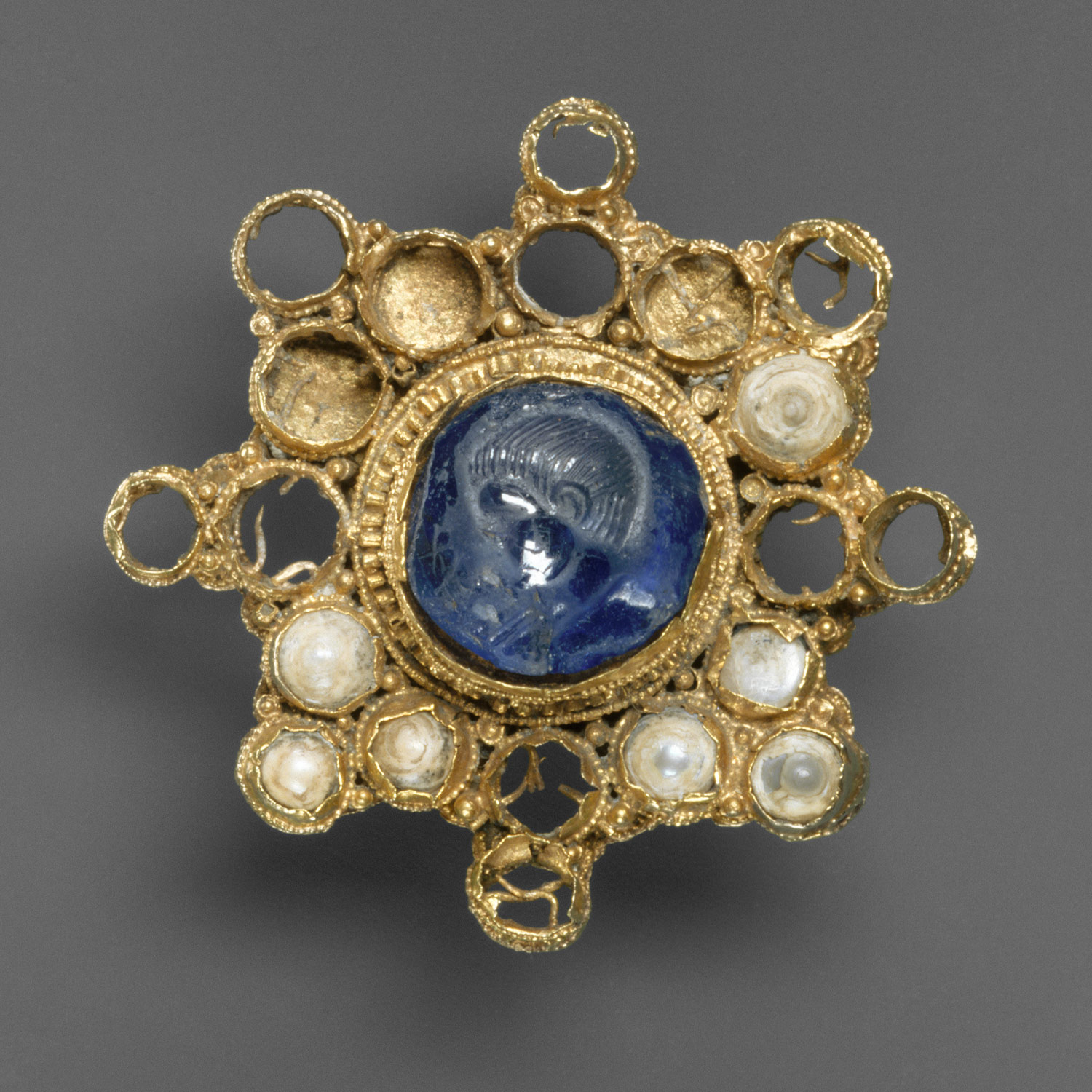
The All Souls Trilogy is rich with descriptions of the decorative arts–from furniture to portraits to jewelry–and Henry’s miniatures are no exception. We’ll skip the Hilliard bits, which we’ve already discussed, and move into a quick talk about intaglio jewelry. Intaglio refers to a decorative technique that is the opposite of cameo work — rather than creating a raised image on a decorative surface, the artist creates a recessed design, like a mold. Intaglio designs often appear on precious gems — they were a popular luxury art form in ancient times and experienced a renaissance during, well, the Renaissance.
Intaglio brooch from the Met Museum
The iconography of intaglio carvings often depicts gods, goddesses, and mythological scenes, so Henry’s Diana intaglio makes sense. There is a lovely example of a Diana intaglio in carnelian at The Jewellery Editor.
“I didn’t get the egg into the bowl, Mistress Norman,” I apologized. “The spells didn’t work.”
The still-wet chick set up a protest, one indignant peep after another.”
This is neither magical, nor directly on point, but I thought it was interesting — the “chicken and egg” causality dilemma first arose in Plutarch’s 1st century CE essay, “The Symposiacs.” The dilemma poses the question of origins and infinite sequences and has been solved, at least scientifically, by evolutionary biology. The answer is that the egg came first, laid by a not-quite-chicken. A dinosaur laid an egg that hatched a very ugly, toothy chicken. Then that toothy chicken laid another egg, which eventually laid its own eggs, and on and on. Forbes makes the following highly-philosophical point:
At what point did it become a chicken? It still isn’t a chicken, remember? There is no such thing as a chicken.
The eggs you buy at the store come from a small dinosaur that is still in the process of becoming what it will eventually become. It is the first of its kind. It is the last of its kind. Its children will not be chickens, any more than it is.
You heard it here, folks. There’s no such thing as a chicken. Only small dinosaurs capable of producing the base ingredient in custards, souffles, and omelettes.
If you like what we do, you can support us on Patreon to off-set our podcast hosting costs. You can also join our Facebook group, the Chamomile & Clove Clovers, or e-mail us at chamomileandclovecast@gmail.com. If you’re anxious for the premiere of A Discovery of Witches TV, please consider yourselves invited to our live tweet on 1/17 at 9pm. Use the hashtag #ccalchemy and make merry.
We’re a mere month away from the premiere of A Discovery of Witches TV in the U.S. and Canada. With only thirty days to go, we’re pleased to announce our inaugural C&C live tweet of ADOWTV 1×01 on 17 January 2019 at 9pm EST/6pm PST. We know you might have questions — this blog post is here to answer them.
What’s a live tweet?
A live tweet (LT) is a very fun and goofy way to enjoy a movie or an episode of television with your internet friends. At the same moment, we all press PLAY and watch the film together while supplying commentary and talking to one another via Twitter. It’s easy, it’s free, and it’s a great way to bond over the premiere together when we can’t be together in person. Consider it a long-distance watch party.
How do you participate?
All you have to do to participate in a LT is log on to Twitter and follow our hashtag, #ccalchemy. Every tweet tagged with #ccalchemy will appear together while we watch. Jen and I will monitor the hashtag and retweet our favorites so that everyone can benefit from your insights and excitement. That’s it. Tweet to us, tweet to each other, tweet using the hashtag, and we’ll find you. We’ll spend a delightful hour cackling and gushing over witches and vampires together — through the wonders of modern technology.
I can’t make the date and time you set. Will there be other chances to play along?
Absolutely! We just haven’t scheduled them yet. You can expect that we will live tweet all eight episodes of Season 1 — probably more than once — while we wait for Season 2. There’s free fun for everyone.
If you have other questions, feel free to e-mail us at chamomileandclovecast@gmail.com or tweet to us at @chamomilenclove. We can’t wait to see you on 17 January 2019.
Diana and Matthew spend the first ten days of their THIRD AND MOST EFFECTIVE MARRIAGE in a sort of honeymoon. The “honeymoon” apparently originated in Britain as a way of visiting relatives and friends who couldn’t make it to your actual ceremony. The word “honeymoon” may refer to an old tradition (5th century or earlier) of drinking honeyed wine a month after your wedding to aid in conception. In the absence of contraceptives, that gesture seems a bit… belated.
In some cultures, the honeymoon period refers to the time between when grooms kidnapped and captured their brides and (1) the point at which the bride became pregnant and couldn’t be returned to her family, or (2) the point at which the family gave up hope of finding her. As this tradition appears to be vaguely Norse in origin, we should probably have a long talk with Gallowglass. For the record, this also makes a great deal of sense considering the real reason why bridesmaids all wear the same dress — to act as decoys for the real bride. Your only job as a bridesmaid is either to distract would-be kidnappers from the actual bride or lure evil spirits. Your call.
There are hundreds of Auvergnat euphemisms for making love, but I don’t believe that’s one of them. I’ll ask Chef if he’s familiar with it.”
While I couldn’t find any Auvergnat euphemisms in particular, I figured I would favor you with a few very saucy French ones. Allons-y.
Faire boum boum – Literally, to make the boom boom. As in, naughty time so loud you can hear it.
S’envoyer en l’air – “To be sent into the air” – casual, no-strings-attached whoopie.
Avoir du monde au balcon – Er, “to have people on the balcony.” It means that your lady-friend fills out her top.
Tremper son biscuit – “To dip the biscuit” – a person who likes to get naughty with everyone.
Hey, girl. You wanna play topsy-turvy? *wink wink*
It’s no coincidence that the Christian feast of Christmas falls on 25 December: as the Bible does not give a particular date for celebrating the birth of Christ, churches settled on combining the Christmas celebration with that of Saturnalia somewhere in the 4th century C.E. Pope Julius I apparently believed that combining celebrations would encourage more converts to Christianity.
The clock was unlike any I’d ever seen before. A carved and gilded cabinet surrounded a water barrel. A long copper pipe stretched up from the barrel and dropped water into the hull of a splendid model ship suspended by a rope wound around a cylinder.
In the Real-Time Reading Companion, Deb indicates that Philippe’s clock is the missing water clock of mathematician and cartographer Oronce Fine. The water clock, or clepsydra, dates back to 1500 BCE. Sadly, I couldn’t find an image of a water clock from the same era, but you can read about the evolution and function of water clocks here.
Friday marked the shortest day of the year and the celebration of Yule.
If you’re interested in celebrating some Yuletide traditions in your own home, consider taking a solstice walk to gather a Yule log for burning in your hearth. You could create a Yule altar filled with “solar-related botanicals” such as cinnamon, star anise, and cloves. You could incorporate gratitude for the return of the sun in your meditation or yoga practice. Give the gift of seeds to those you love to celebrate the coming spring. If you’re feeling super festive, you might make something special, like this wassail, to share with your friends. If you’d like alcoholic wassail (*raises hand*), you might try this version.
We covered this chapter of Shadow of Night in Episode 25 – Partyfamilias. Until next time, we hope that you and your loved ones celebrate a healthy and happy Saturnalia, a blessed solstice, and a merry Yule. Feel free to join our Facebook group, or shoot us an e-mail at chamomileandclovecast@gmail.com. You can also follow us on Twitter @chamomilenclove.
If you’re so inclined, Food52 has suggestions for a medieval dinner party prepared in a modern kitchen: chickpea stew, roast chicken, garlic confit, roasted potatoes, and an almond cake. You can also find a rather extensive list of medieval recipes here. I wish you particular luck with the dish called “Garbage.”
Artemis Agrotere, renowned huntress, Alcides Leontothymos beseeches you to hold this child Diana in your hand. Artemis Lykeie, lady of the wolves, protect her in every way. Artemis Patroia, goddess of my ancestors, bless her with children so that my lineage continues. Artemis Phosphoros, bring the light of your wisdom when she is in darkness. Artemis Upis, watch over your namesake during her journey in this world.”
In his incantation, Philippe refers to a number of “epithets” of Artemis. Epithets could be used for literary or ritualistic emphasis to identify the deity (or the aspect of the deity) to whom one prayed.
At the height of the classical period, one could find those worshiping Greek deities from Spain to Afghanistan. Without a standardized image of a deity and without established worship practices, the various cults of Greek gods and goddesses developed different forms of address that reflected both the desire to avoid addressing the divine directly (HEY DEMETER, ARE YOU LISTENING? v. “I beseech you, great lady of the hearth.”).
Philippe’s incantation lists several of Artemis’s epithets, but there are dozens of others, including:
Brauronia – protector and keeper of girls
Parthenos – “virgin”
Hegemone – ruler of nymphs
Limenia – protector of harbors
Limnatis – goddess of transition, goddess of the marsh
Lokhea, Genetyllis – protector of women in childbirth
Aeginaea – wielder of the javelin
Coryphaea – goddess who inhabits the summit of the mountain
Daphnaea – “of the laurel”
Heurippe – finder of horses
See here and here. There is a Roman temple near Clermont-Ferrand in France that may have served as the inspiration for Philippe’s temple in Shadow of Night.
A hero with dark hair and green eyes named Peleus left his home to seek his fortune.”
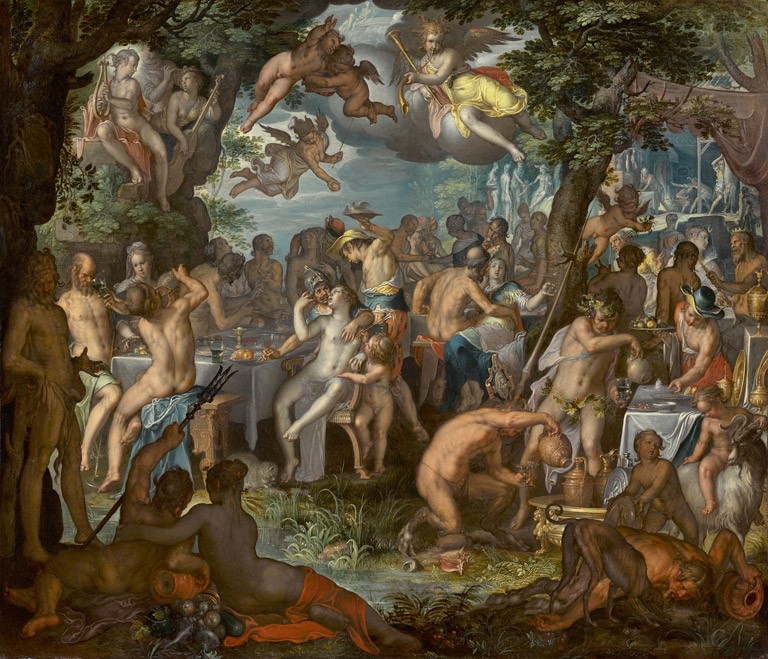
As we discussed in Episode 25 – Partyfamilias, Philippe uses the wedding banquet as an opportunity to tell the story of Peleus and Thetis, the sea nymph, parents of Achilles. The myth of Peleus and Thetis is a complicated one, but it’s useful to know that their wedding is the one that started the Trojan War. P&T failed to invite Eris, goddess of strife, to the wedding and so she sent the golden apple inscribed with the words, “To the fairest.” Chaos ensued. Many died.
The part we haven’t talked about yet is the potential connection between Philippe — Alcides Leontothymus, or maybe Heracles–and Peleus. See, Peleus was a friend of Heracles who served with the great hero in his expedition against the Amazons. Philippe sings the invocation to the heroes from Catullus at Matthew and Diana’s wedding banquet. Catullus wrote that the Fates sang a magic song–this magic song–at the wedding of Peleus and Thetis, much as Philippe does for Matthew and Diana.
The Wedding of Peleus and Thetis, 1612, oil on copper. Joachim Wtewael.
To be fair to Marie, La Robe (I thought of my ensemble only in French, and always in capitals) was spectacular,
Marriages take place at the church door to avoid bloody disputes later over whether or not the ceremony took place as reported. We can thank God there isn’t a blizzard.”
Matthew’s correct — medieval marriages often happened outside to ensure multiple witnesses. In an era where most marriages took place for financial or political reasons, everyone had a rather vested interest in legitimacy — both of the marriage and of any offspring who resulted from the match. This is odd, I think for a period of history in which it was relatively easy to get married by accident. This is the plot of several Hallmark movies and Lauren Willig’s Deception of the Emerald Ring (good fun, would recommend).
To my great surprise, Medieval Times (yes, THAT Medieval Times) has a reasonably-sized article on medieval marriage ceremonies. Around the internet, you can find a wealth of trivia regarding medieval weddings — did you know, for example, that the tradition of throwing the garter (which I detest) comes from the Middle Ages? People used to bundle the bride and groom forcibly into bed and then rip off bits of their clothes as tokens. The garter is a convenient way to do that without, you know, committing assault. Tiered wedding cakes also appear to come from the medieval period, when guests of the bride and groom would bring tiny cakes to stack on top of one another as a part of the marriage feast.
For your entertainment, here’s an unrelated article on weird wedding traditions from Mental Floss. Should you be interested in planning your own medieval or Renaissance wedding, Pinterest has you covered.
We’ll catch up to Matthew and Diana on 17 December at the end of their honeymoon. In the meantime, feel free to join us in our Facebook group, the Chamomile and Clove Clovers, or follow us on Twitter @chamomilenclove. You can also e-mail us at chamomileandclovecast@gmail.com.









 Chamomile & Clove