Real Time Reading, Uncategorized

Real-Time Reading – 7 October – Chapters 19 & 20

jez-timms-138404Jez Timms

Chapter 19

“Here you go, baby,” I said, holding it out on a flat palm. Matthew watched warily as Balthasar extended his neck and reached with delicate lips to pick the fruit from my hand. Once it was in his mouth, he looked at his owner triumphantly.

In Chapter 18, we learned that Matthew and his mother keep horses – specifically, Percherons and Andalusians. Like myself, Deb is a bit horse-crazy. She has a lovely beastie named Romeo who features regularly on her Instagram account. He is a goofball.

As Matthew told Diana, Percherons are large, sturdy animals built for farm work. They originated in Normandy, where it’s thought that breeders crossed the Barb horses of the Moors with Flemish draft horses to produce the first Percherons. French Percherons must be gray, although they may also be black, chestnut, bay, roan, or sorrel. There’s an introductory video about the Percheron breed on YouTube. If you’re fascinated by the breed, you can also visit the website of the Le Pin National Stud, which breeds French Percherons. This fellow could be a stand-in for Balthasar, in my opinion. This handsome bubba is the World Champion for the breed. He’s huge, and lovely:

Rakasa and Fiddat are described as Andalusians, or Pura Raza Española. Andalusian horses are known for their fine heads, arched necks, long manes, deep chests, and rounded hindquarters. Andalusians are athletic animals with a very classical build; they’re especially well-suited to dressage, a complicated and lovely discipline based on anicent cavalry maneuvers. Full disclosure: I ride dressage, and you can hear me gab about it on our other podcast, Queens of All Trades. The episode is called Ride Fancy. You can see Andes at work in the following video:

“What kind of horse is Dahr?” I asked, noticing his equally smooth gait.

“I suppose you’d call him a destrier,” Matthew explained. That was the mount that carried knights to the Crusades. “He was bred for speed and agility.”

If you were so inclined, you could hire the company Destrier to provide cavalry for battle re-enactments. As war horses, destriers had dense bodies, broad backs, strong hindquarters, and long legs.You can watch people joust on destrier-like horses here.

“My muscles will be sore tomorrow,” I said, groaning. “I haven’t been on a horse for years.”

“Nobody would have guessed that from the way that you rode today,” he said.

Prior to getting on Rakasa, Diana dons a great deal of gear, including a protective riding vest. As much as I love Deb–and I do–this is a chapter where I get rather cranky and call a tiny bit of BS. Then, I tell myself that truth is no defense for fiction and if Deb wants a world where riding boots fit immediately (they don’t) and you can bounce right back into excellent riding form (you can’t), then that is all well and good and she’s allowed to do that. After all, it would detract from the romance if Diana was like, “As it turned out, I hadn’t ridden in over ten years and I felt like a sack of potatoes. Matthew laughed at me, returned Rakasa to the stables, and got me a pony upon whom to have a lunge lesson while he schooled my position.”

Deb’s post on Chapter 19 is here.

Chapter 20

In the name of keeping this post light, I’m skipping the Aurora Consurgens and Origins, for now. After reading and studying, Matthew and Diana descend the tower in order to dine with Marthe and Ysabeau.

Over dinner, Matthew tells the story of when Marthe failed to remember not to feed the pigeons before placing them in a live bird pie. Here’s an excerpt from a 16th century recipe for live bird pie:

Make the coffin of a great pie or pastry, in the bottome thereof make a hole as big as your fist, or bigger if you will, let the sides of the coffin bee somewhat higher then ordinary pies, which done put it full of flower and bake it, and being baked, open the hole in the bottome, and take out the flower. Then having a pie of the bigness of the hole in the bottome of the coffin aforesaid, you shal put it into the coffin, withall put into the said coffin round about the aforesaid pie as many small live birds as the empty coffin will hold, besides the pie aforesaid. And this is to be done at such time as you send the pie to the table, and set before the guests: where uncovering or cutting up the lid of the great pie, all the birds will flie out, which is to delight and pleasure shew to the company. And because they shall not bee altogether mocked, you shall cut open the small pie, and in this sort you may make many others, the like you may do with a tart.
(From Epulario, 1598)

It… would not be to my taste.

“What was that?” I asked.

“It started out as a tarantella,” Matthew said, escorting his mother back to her chair, “but Maman never can stick to one dance. So there were elements of the volta in the middle, and we finished with the minuet, didn’t we?”

Tarantella, volta (and another for fun), and a minuet. These guys have a collection of historical dances for you to view, including several I have never heard of in my life.

This is the song that Ysabeau and Marthe sing to Diana:

I tried–in vain–to find a recording of the song Matthew sings to Diana. You’ll have to imagine it.

Tomorrow, we meet Domenico Michele and move more firmly into Act II of the book. If you’d like to hear what the daemons have to say, their episode is here.

xoxo

Cait

Real Time Reading, Uncategorized

Real-Time Reading – 6 October – Chapters 17 and 18

thong-vo-1829.jpgThong Vo

Chapter 17

“Then I don’t suppose you would be interested in seeing my fourteenth-century copy of Aurora Consurgens. It’s French, regrettably.”

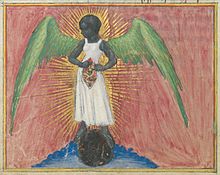
Matthew lures Diana to France by promising her a first crack at a rare manuscript. Aurora_consurgens_zurich_060_f-29v-60_darkangelWe’ll talk more about the Aurora Consurgens later, but it’s worth an introduction now. The Aurora Consurgens is in fact a well-known alchemical treatise of the 15th century.  Though it was once attributed to Thomas Aquinas, it’s now thought to be the work of an author called Pseudo-Aquinas. We’ll return to the manuscript in a few chapters, when Diana begins work on its imagery and poetry. In the meantime, you might be interested in the Easter egg buried in Chapter 18 – the discussion of the female enlumineresse, or illuminator, Bourgot le Noir. Sure enough, Bourgot le Noir was the daughter of the illuminator Jean le Noir, who lived in the 14th century. The Metropolitan Museum of Art has a series of essays relevant to her work linked here. You can see examples of the le Noir family’s work here.
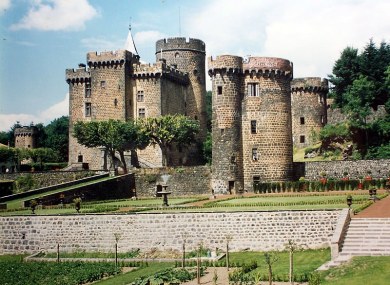
In the center of rolling hills was a flattened peak dominated by a crenellated hunk of buff and rose stone. Seven smaller towers surrounded it, and a turreted gatehouse stood guard in front. This was not a pretty, fairy-tale castle made for moonlit balls.

In the Real-Time Reading Companion, Deb notes that Sept-Tours is based on Chateau Dauphin, a castle in the Puy-de-Dôme département of France. It was initially built in the twelfth century and augmented through the fifteenth. The family who owns the chateau renovated it in the eighteenth century. There are some lovely interior photographs of the chateau on Chateaux Medievaux.

chateau-dauphin-2

Should you find yourself in France, Chateau Dauphin is open to the public. Deb posted a lovely drone video of the chateau in her Real-Time Reading post for 6 October.

Chapter 18

Matthew launched into a volley of something unintelligible that sounded like a cross between French, Spanish, and Latin.

I presume that Matthew gives Ysabeau what-for in Occitan, the language of the troubadours . The Occitan region of France is comprised of Limousine, Languedoc, and the old Aquitaine, the southern portion of the French Alps.  Occitanie is just south of the Auvergne. 

Occitan Flag
Linguistically, it’s related to Latin, French, and Spanish and it’s similar to Catalan, which is spoken in Barcelona.  If you’d like to hear Occitan spoken by natives, here are a few video links:

Occitan languedocien – une langue parlée à Toulouse et dans le Languedoc

Linguistic Diversity – Occitan #6038

Medieval Occitan Song – Ai Vist Lo Lop

This chapter has tons of little bits and bobs that we could talk about, but I’ll just cover one more before we move on.
“Giordano Bruno. ‘If the thirsty stag runs to the brook, it’s only because he isn’t aware of the cruel bow,” I continued.
Tomorrow, we’ll ride. The Daemons discuss Chapter 17 in Take 17! If you’re hungry for more, you should check out the Tenth Knot, or shoot us an e-mail at chamomileandclovecast@gmail.com.


See you soon!

Cait


Real Time Reading, Uncategorized

Real-Time Reading – 5 October – Chapters 15 and 16

dayne-topkin-40038Dayne Topkin

Chapter 15

On Monday morning the air had that magically still quality common in autumn. The whole world felt crisp and bright, and time seemed suspended.

This chapter starts pleasantly enough, but it spirals rapidly downhil. In fact, the plot moves so quickly in this chapter that there’s not a ton of threads to pull for Real-Time Reading goodies.

When Matthew angers Diana after she fails to pull the manuscript from the Bodleian, her fingers begin to emit blue sparks and he advises her not to get them near water. While most people know not to put water on an electrical fire, they might not know why. The main risk is electrocution – water conducts electricity and will simply spread the current, which can result in severe electrical damage. What remains an open question for me is why Diana’s power–which we learn is partially elemental–presents in electrical surges. I don’t know that we ever get a very good explanation for that over the course of the book. I am open to suggestions.

Chapter 16

She’s a witch, he reminded himself as he watched her sleep. She’s not for you.

The more he said it, the less it seemed to matter.

In Chapter 16, Diana sleeps–though I am rather inclined to believe that Matthew drugged her with his blood–and Matthew stalks angrily around her rooms. It’s not his best moment. When Marcus arrives, he’s in a bit of a state.

And Marcus had never seen his father so coldly furious as he was now. Matthew Clairmont had entered Marcus’s life in 1777 and changed it–forever. He had appeared at the side of an improvised sling that carried the wounded Marquis de Lafayette from the killing fields at the Battle of Brandywine.

First, you wouldn’t be alone if you automatically sing Oui, oui, mon ami, je m’appelle Lafayette/ The Lancelot of the revolutionary set when the Marquis appears in this passage. Hamilton is everywhere. Did you know that the Marquis de Lafayette was born in the Auvergne? Near Chavaniac, to be precise. He was, in fact, wounded at the Battle of the Brandywine – he took a shot in the calf.

Battle of Brandywine
Nation Makers, Howard Pyle – The Brandywine Museum.


If you’re curious, the legend of Dagwanoenyent, the daughter of the wind, is presented here. As near as I can tell, there is no Iroquois, Seneca, or Oneida myth that parallels the European vampire myth. I am, however, open to education about the matter – and curious how any indigeneous readers might react to the reference to Dagwanoenyent.

Deb’s post on Chapters 15 and 16 is here. Her chosen music for Chapter 16 is David Berkeley’s “Fire Sign:”

http://www.youtube.com/watch?v=sz1qfuX24Ak

The Daemons tackle Chapters 15 and 16 in separate episodes – Take 16 and Take 17.

When next we meet, we’ll be in France. Until then!

Best,

Cait


Real Time Reading, Uncategorized

Real-Time Reading – 3 October – Chapter 14

marco-mornati-349230 Marco Mornati

Chapter 14

“We’re dining in college tonight,” he answered, gesturing down toward the Bodelian. I had fully anticipated that he would take me to Woodstock, or an apartment in some Victorian pile in North Oxford. It had never occurred to me that he might actually live in a college.”

“In hall, at high table?” I felt terribly underdressed and pulled at the hem of my silky black top.

Today, in the world of All Souls, Diana follows Matthew home to dine “in college.” This has a very precise meaning in Oxford, where it refers to the tradition of taking a meal with the students and fellows of a college in formal dress and academic robes. It’s a production – if you’d like to read about it, I found accounts here and here.

We rounded the corner and turned toward the Radcliffe Camera. When we passed by the entrance to Hertford College without stopping, I put my hand on his arm. There was one college in Oxford notorious for its exclusivity and rigid attention to protocol.

It was the same college famous for its brilliant fellows.

“You aren’t.”

As it turns out, Matthew’s a member of All Souls, a prestiguous college of graduate and postgraduate fellows established in 1438. The college has extraordinary entrance requirements – you must apply within three years of receiving your bachelor’s degree from Oxford or while studying at Oxford as a postgraduate and pass two examinations. You must sit for two “papers,” or exams, from a general discipline and two from your specific discipline in the humanities and social sciences.

Sample questions include:

  • Should intellectuals tweet?
  • Is vegetarianism the future?
  • ‘Secure people dare.’ Do they?
  • What, if anything, is wrong with using drones in warfare?
  • What are universities for?
  • Is the financial sector larger than it should be?
  • Can we be forced to be free?
  • How can words be beautiful?
  • “Every act you have ever performed since the day you were born was performed because you wanted something.” Do you agree?
  • What, if anything, is wrong with selective schools?
  • Why is a leather jacket more acceptable than a fur coat?

Source: The Independent, The Guardian.

Notice something? This isn’t the exam that Matthew sat for when he became a fellow. That exam no longer exists. True to the text, it required students to write coherently for three hours on a single word – “innocence,” for example.  All Souls dropped this requirement in 2010. If you pass the exam, you might be invited to present a viva – that is, a live explanation of your answers. If you do, expect the rest of the college to attend.

Diana gives a rather extensive description of Matthew’s rooms–methinks Deb has a bit of a thing for interior design–which includes an Aubusson rug and William Morris furniture. If you pay less attention to home goods than Deb does and cannot bring them immediately to mind (I couldn’t), I gathered some examples of those items.

The next course was a stew, with chunks of meat in a fragrant sauce. My first bite told me it was veal, fixed with apples and a bit of cream, served atop rice. Matthew watched me eat, and he smiled as I tasted the tartness of the apple for the first time. “It’s an old recipe from Normany,” he said.

Jacques Pepin, one of the fathers of modern French cooking, has a recipe for veal scaloppine with cream, calvados (apple brandy), and apples that sounds just about right. The cuisine of Normandy is heavy on apples and the region is famous for its cider. In Normandy, you’d also expect to dine on seafood and excellent cheeses, like Camembert and Neufchâtel. As we learn later in this book, Matthew is from the Auvergne–so I rather wonder how he chose a dish from Normandy to feed Diana. The cuisine of the Auvergne, by contrast, has a lot of pork, cabbage, game meat, cheese, and river fish. Perhaps it’s not as amorous as veal and apples? Then again, I can’t find “veal” or “apple” on any list of aphrodesiac foods.

“Are you going to tell me what it is?” I asked around the flavors in my mouth.

“Malmsey,” he replied with a grin. “Old, old malmsey.”

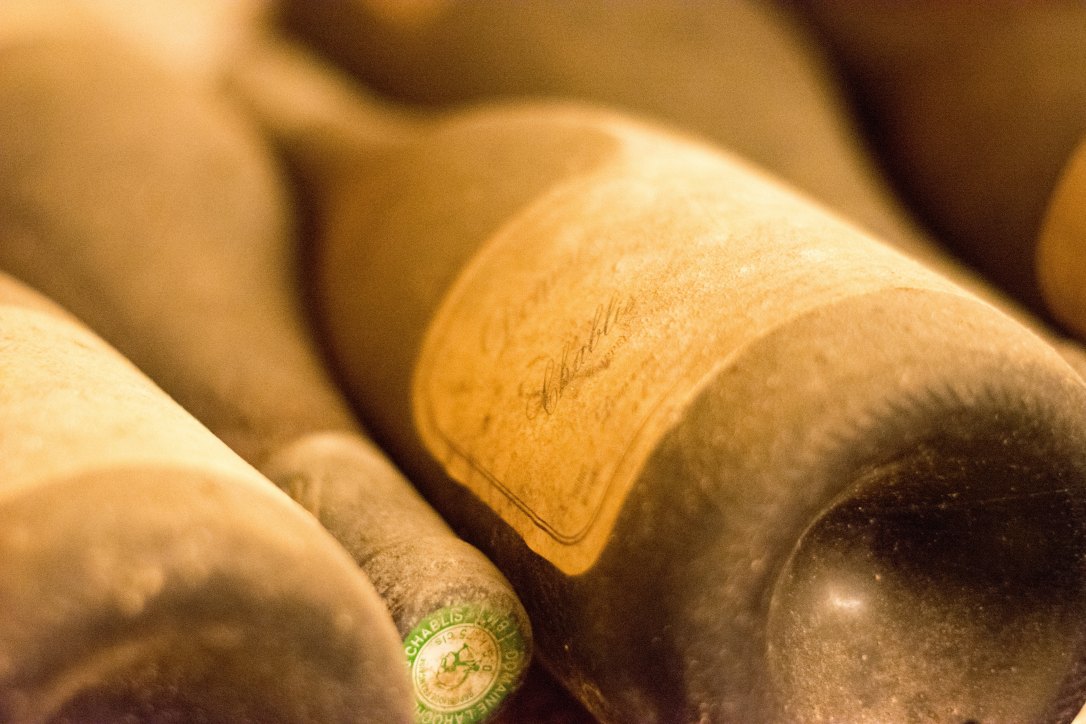
Your last tidbit for today is about malmsey, a varietal of wine grown in Madeira. The grape–Malvasia–is white and is one of the four recognized styles of fortified wine.

Deb has a playlist especially for Matthew Clairmont that you can follow here. Deb’s post on 3 October is here. Daemons Discuss covered Chapter 14 in Take 16!

If you have thoughts, comments, or questions, you can find us at @chamomilenclove on Twitter or chamomileandclovecast@gmail.com.

Until Chapter 15,

Cait


Uncategorized

Real-Time Reading – 2 October – Chapter 13

neven-krcmarek-152344.jpgNeven Krcmarek

Like Deb, science isn’t my specialty. Accordingly, today’s post–and most of the Book of Life–will glide (gracefully and with great dignity) past things I can’t possibly explain. The second we start talking about evolution in anything more than basic terms, I bat my eyes charmingly and change the subject.

Luckily, as Deb notes in today’s Real-Time Reading entry, she had scientific consultants when writing ADOW. I don’t have a consultant for this blog, so I’m off the charts. I will sum up what little I understand properly and then send you scampering towards more educated corners of the globe. I’d be fascinated to hear from biologists, chemists, and other fans of the AST re: the science of the series and how it holds up.

“These tell us about the mitochondrial DNA of a woman named Benvenguda, which she inherited from her mother, and her mother’s mother, and every female ancestor before her. They tell us the story of her matrilineage.”

Scientists published a paper on “Mitochondrial Eve” in Nature in January of 1987 that challenged our understanding of human evolution. The evidence discovered by Rebecca Cann, Mark Stoneking, and Allan Wilson suggested that all humans carry mitochondrial DNA from the same woman–who lived 200,000 years ago. The discovery essentially killed the multiregional human evolution hypothesis and boosted another model of a single human evolution in Africa between 150,000-200,000 years ago. While you might assume based on her name that Mitochondrial Eve was “the first woman,” that doesn’t appear to be the case–she’s merely the most recent female ancestor whose mtDNA lineage is present in all currently-living humans.

If you’re curious about human origins (and who isn’t), I recommend the Smithsonian Museum of Natural History’s What does it mean to be human? site and associated media as well as Science Daily’s frequently-updated page on Human Evolution.

“Date of birth?” Miriam asked crisply, pen poised above the test tube.

“August thirteenth, 1976.”

Miriam stared. “August thirteenth?”

“Yes. Why?”

“Just being sure,” she murmured.

On or about 13 August, the ancient Romans celebrated Nemoralia, the Festival of Torches, in honor of the Goddess Diana.

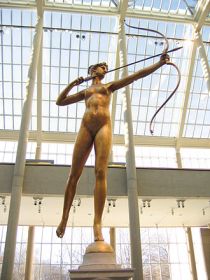
330px-diana_by_augustus_saint-gaudens_01
Diana (1892–93), Augustus Saint-Gaudens. Bronze, Metropolitan Museum of Art, New York City.

This is the only reason I can find that Miriam would stagger over Diana’s birthday. The feast day commemorates the foundation of Diana’s temple on Aventine Hill by Servius Tullius. According to Wikipedia, celebrants of Nemoralia would form a procession of torches over Lake Nemi in Aricia. Later, Christians adopted the holiday as the Feast of the Assumption.

Diana is a triple goddess–Luna in heaven, Diana on earth, and Proserpina in hell. We’ll talk more about Diana’s various incarnations and powers as the series progresses, but you should keep all of that in mind as we move forward.

Until tomorrow, darlings, and our dinner Chez Matthew. You can find the Daemons Discuss episode on Chapter 13 at Take 16!. The All Souls Podcast discusses Chapter 13 in Episode 14: Swab the witch!

See you at Matthew’s!

Best,
Cait