In Episode 2, we discuss rowing, rage, and romance in Chapters 4-6 of A Discovery of Witches by Deborah Harkness.
As you’ll learn at the end of the episode, we plan to handle listener feedback in a separate episode mid-week. Keep your comments coming at @chamomilenclove and chamomileandclovecast@gmail.com. If you like what we do, consider leaving us a review in iTunes!
In Chapter Six, we meet Miriam – whose putative history we’ll leave alone for a bit. To the extent that anyone finds this helpful, the name “Miriam” means rebellious in Hebrew. Miriam was a prophetess of the Hebrew Bible. Specifically, Miriam prophesies the birth of Moses and criticizes her father for divorcing his wife to avoid bringing children into the world. Hm.
The manuscript inside the next box was smaller than the last, but it contained interesting sketches of alchemical apparatus and snippets of chemical procedures that read like some unholy combination of Joy of Cooking and a poisoner’s notebook.
My usual meal consisted of a twenty-minute break in the nearby bookstore’s second-floor cafe. I smiled at the thought of Miriam occupying herself during that time, trapped in Blackwell’s where tourists congregated to look at postcards, smack between the Oxford guidebooks and the true crime section.
In Chapter Four, Diana returns to the library… to find that Matthew Clairmont has taken her preferred seat. She reacts poorly. Matthew is studying the Needham Papers – which he claims to want to consult for Dr. Needham’s observations on morphogenesis. Diana cuts Matthew off before he tells the reader what morphogenesis actually is – but that’s why I’m here. Morphogenesis, for us non-science people, is the process by which biological form and structure are generated. Morphogenesis addresses the question of how tissues are generated and maintained as well as how they decay and regenerate. This Human Biology for Dummies entry gives an overview of what this looks like in a human zygote. I admit – I searched “morphogenesis for dummies” and this was one of the first results. I don’t mean to insult y’all, of course – biology isn’t really in my wheelhouse. I assume that Matthew’s appearance in the library serves two purposes – one, it annoys Diana and allows him to keep an eye on her. Second, the Needham Papers could contribute to his ongoing research on differentiation between creatures and, specifically, how vampires transform genetically at rebirth and maintain their physical integrity over the course of a very, very, very long life.
It always amuses me that Diana notes Matthew’s very expensive mechanical pencil. From the text, it’s not clear whether she’s annoyed because it’s so pricey or because she can hear the lead on the paper. Either way, she’s having A Day.
Then, that witch shows up.
Clairmont moved so quickly I didn’t see him round the desks. In an instant he was standing with one hand on the back of my chair and the other resting on the surface in front of me. His broad shoulders were curved around me like the wings of a falcon shielding his prey.
Diana compares Matthew to a falcon displaying mantling behavior. Mantling is the way that raptor birds protect a recent kill – they put a great deal of energy and effort into each hunt, so protecting their prey from other, more aggressive birds is a necessary survival skill.
Rowing was a religion for me, composed of a set of rituals and movements repeated until they became a meditation.
In Chapter Five, we meet the energetic, brilliant, and intellectually curious Chris Roberts, who became Diana’s friend when he tried to re-create an alchemical experiment for her in his lab. It’s not far-fetched.
Deb’s post about this day in ADOW is here. You can find the Daemon’s Domain episode that talks about this chapter here, or check out the All Souls Podcast here. Our podcast on Chapters 4-5 is Episode 2-Why So Angry?
How is your Real-Time Reading going? Are you enjoying the experience? Let me know what you think of the posts by e-mailing us at chamomileandclovecast@gmail.com or by tweeting us at @chamomilenclove. See you soon!
“Notes and Queries,” the “arcane periodical” that brings Matthew out of the woodwork, was originally published in 1849 as a correspondence magazine for academics and amateurs. It’s still published by the Oxford University Press. You can actually read Volume 19 – yes, THAT volume – here. We have no idea what Diana was looking for based on the text, but I’d be curious to hear if you find something.
Witches aren’t the only creatures sharing the world with humans, however. There are also daemons–creative, artistic creatures who walk the tightrope between madness and genius.
“We’ve not met,” he continued in an oddly accented voice. It was mostly Oxbridge but had a touch of softness that I couldn’t place.
“Oxbridge” is a portmanteau that mashes Oxford and Cambridge together to describe something related to one of the universities, or both. According to the British Library, “Oxford English” is a bit misleading – but you might recognize the accent as “Received Pronunciation,” or the broadcaster’s choice accent in the UK since 1922. It’s based on the pronunciation of the south-east Midlands of England and was chosen by the BBC as their standard accent. Here’s a few examples – of both high and low RP.
The vampire sat in the shadows on the curved expand of the bridge that spanned New College Lane and connected two parts of Hertford College, his back resting against the worn stone of one of the college’s newer buildings and his feet propped up on the bridge’s roof.
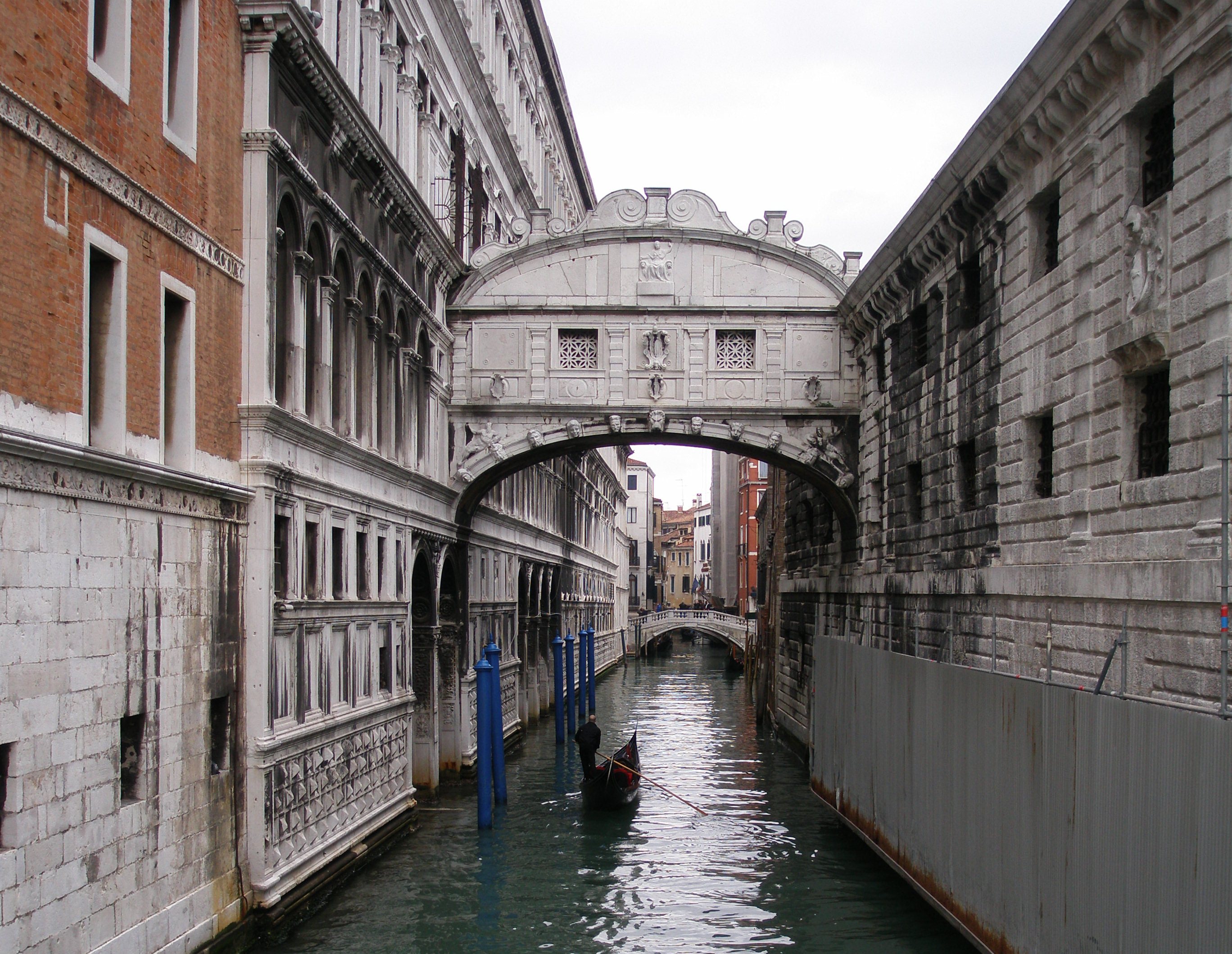
The Bridge of Sighs
Contrary to my assumption, the Oxford Bridge of Sighs – pictured above – is NOT based on the one in Venice.
You can find Deb’s post about 21 September on her website. We covered Chapters 2-3 in our first episode, but you can find the All Souls Podcast and Daemon’s Domain episodes covering the same material here and here.
If you’d like to comment on this post, shoot us a tweet at @chamomilenclove or an e-mail at chamomileandclovecast@gmail.com. See you in Chapter 4!
It’s finally here, y’all! The annual Real-Time Reading for A Discovery of Witches. Today, we meet Diana, the Book, and the Bodleian! We begin today – 18 September – with Chapter 1.
The leather-bound volume was nothing remarkable. To an ordinary historian, it would have looked no different from hundreds of other manuscripts in Oxford’s Bodleian Library, ancient and worn.
Diana
When we meet Diana, the intrepid, willful, intelligent heroine of our story, she’s poring over old manuscripts in the library in order to prepare for an upcoming historical conference. The text tells us that Dr. Bishop is a historian who focuses on the history of science — specifically, on the history of alchemy. In the opening scenes of A Discovery of Witches, Diana confronts a text – Ashmole 782 – which displays curious, magical characteristics. If you’d like to learn more about manuscripts, I
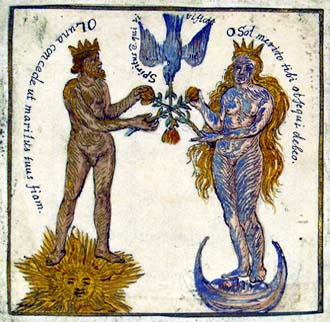
Illustration 3, Rosarium Philosophorum: The King and Queen begin to disrobe and come together. Credit: University of Glasgow Special Collections Department.
In the first chapter, we also learn that Diana comes from a long line of witches in New England.
More important, my life was now my own. No one in my department, not even the historians of early America, connected my last name with that of the first Salem woman executed for witchcraft in 1692.
We get a little more about Diana’s ancestor, Bridget Bishop, later in ADOW, but the text focuses more on her notoreity amongst witches than on her greater historical significance. Bridget Bishop was tried for witchcraft and hanged on June 10, 1692.
Stamped in gilt on the spine was a coat of arms belonging to Elias Ashmole, a seventeenth-century book collector and alchemist whose books and papers had come to the Bodleian from the Ashmolean Museum in the nineteenth century, along with the number 782.
Elias Ashmole (1617-1692) was an English politician, astrologer, and student of alchemy. He both wrote and collected books on alchemy. In his later life, he became a well-known collector of “manuscripts and curiosities.” His collection–bequeathed to the University of Oxford–became the first public museum in England in 1683. Part of the Ashmolean Collection does actually reside in the Bodleian, and you can actually browse some of the manuscripts online. The link will take you to Ashm. 529, Johannes Annius, De futuris Christianorum triumphis in Saracenos. The Ashmolean Museum of Art and Archeology at the University of Oxford has some very fine online collections here.
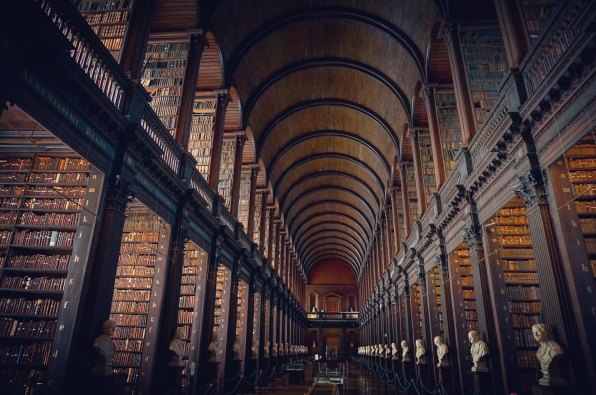
The Bodleian Library is one of the oldest libraries in Europe, and in Britain is second in size only to the British Library with over 12 million printed items. First opened to scholars in 1602, it incorporates an earlier library built by the University in the 15th century to house books donated by Humfrey, Duke of Gloucester. Since 1602 it has expanded, slowly at first but with increasing momentum over the last 150 years, to keep pace with the ever-growing accumulation of books, papers and other materials, but the core of the old buildings has remained intact.
In her Real-Time Reading Post for 18 September, Deb reveals that she first walked into the Duke Humphrey’s reading room in 1985. Apparently, it made quite the impression on her. The library was built between 1450 and 1480 in order to contain the collection of manuscripts collected by Humphrey of Lancaster, 1st Duke of Gloucester, during his life. You can find more detailed photographs of the interior here.
Duke Humphrey’s Library, as photographed by the Bodleian Blog
You can catch our discussion of Chapters 1-3 of ADOW in our first episode, Vampire Boyfriend, but you should also check out episodes from our fellow podcasters covering the same material:
Chapter 1 was incorporated into Episode 1×01 of A Discovery of Witches TV, which we covered here.
Don’t forget to follow Deb on social media (@DebHarkness on Twitter and Instagram) for more real-time reading updates. In the meantime, you can find us at @chamomilenclove on Twitter or chamomileandclovecast@gmail.com.



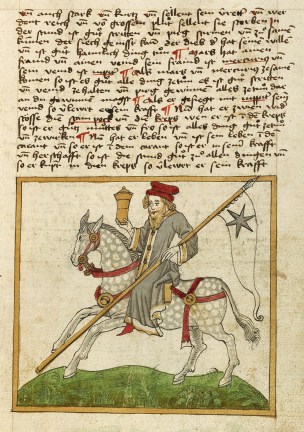
 Mantling is the way that raptor birds protect a recent kill – they put a great deal of energy and effort into each hunt, so protecting their prey from other, more aggressive birds is a necessary survival skill.
 As for the wolves, there was an uproar a few years ago when Norway proposed




 Chamomile & Clove