Real Time Reading

Shadow of Night Real-Time Reading – 26-29 December – Chapter 16

Jenny Marvin

First off, darlings, you have my sincere apologies — the holidays caught up to me and this entry is a day later than I would like. I hope you can forgive me. I also hope your holiday was restful and that you have time for yourself between now and the new year.

“Women do have babies in the sixteenth century,” I said mildly. “Besides, I don’t feel any different. I can’t be more than a few weeks pregnant.”

As you might know from our episode on this chapter, this argument between Matthew and Diana is really difficult to stomach. They’re both a little bit right and a little bit wrong, but the effect is painful for anyone who loves them and wants their relationship to succeed.

Matthew isn’t wrong to be worried about Diana carrying the child to term in Tudor England — at that time, approximately one in three women died during their child-bearing years. At the time of Queen Elizabeth I’s birth in 1533, women were encouraged to write wills before delivering children.  Bearing healthy children was difficult for women of all classes, but aristocratic and noble women (like Diana) were often blamed for their perceived inability to produce viable male children. Patriarchy being, well, especially virile during Tudor times, the leading medical treatises viewed women as “incomplete” men and the popular advice on childbirth was accordingly… compromised. 

Unlike modern women, women in Tudor England lacked reliable pregnancy tests and prenatal care. Women generally realized their pregnancy after several months of missed menstrual cycles — it sounds straightforward enough, but it’s a dodgy thing when your menses are already affected by other factors, such as your age or your access to good nutrition. You could, of course, rely on other methods, such as asking the putative father whether he felt “sucking or drawing” during sex. Oy. 

In an age that placed great stock in the legitimacy and survival of heirs, noble and aristocratic families often went to great pains to prepare for childbirth. Society expected women to confine themselves to the indoors for the latter part of their pregnancy to avoid diseases that could affect mother and child. This seems reasonable… until you realize that one of the greatest threats to women and children was sepsis and staph infection carried (unwittingly) between new parents by physicians and midwives

For further reading about childbirth and the Renaissance, I recommend the following:

Victoria and Albert Museum – Renaissance Childbirth

Mental Floss — The Historical Horror of Childbirth

Pregnancy and Labor in Renaissance England 

“Religious books are popular gifts, and easy to sell. Books about medicine have a smaller audience and are too costly to bind without a commission.” Matthew explained as I fingered the limp covering. He handed me yet another volume. “Luckily, I had already ordered a bound copy of this one. It’s hot off the presses and destined to be a bestseller.”

Matthew presents Diana with a bound copy of Sir Philip Sidney’s Arcadia, a prose romance that the poet dedicated to his sister, Mary Herbert, Countess of Pembroke. 220px-Sir_Philip_Sidney_from_NPGSir Philip Sidney died in 1586 of a leg wound that turned gangrenous after the Battle of Zutphen. Arcadia was incomplete at the time of Sidney’s death — the story apparently left off in the middle of a sword fight — but Fulke Greville published an early version of the story in 1590. You can meander through an early copy of Arcadia via the British Library’s website. 


My initial reluctance to meet Mary Sidney faded as our rendezvous approached. The more I remembered–and discovered–about the Countess of Pembroke, the more excited I became.

Mary Herbert, Countess of Pembroke (1561-1621), made a name for herself as a patron of the arts and a poet in her own right.

According to the Poetry Foundation, she skillfully navigated the strictures against women’s writing “by focusing on religious themes and by confining her work to the genres thought appropriate to women: translation, dedication, elegy, and encomium.”

The Countess of Pembroke’s success was also boosted by her dedication to finishing the work of her brother, Sir Philip Sidney, upon his death. She used her rank and influence to form the Wilton Circle, the “most important literary circle” in the history of England. The Wilton Circle included literary greats such as Edmund Spenser, Michael Drayton, Sir John Davies, and Samuel Daniel. The Countess believed in the power of the English language at a time when many believed that English was inferior to the classics of Italian, French, Latin and Greek. The Countess translated a number of important works into English, including Petrarch’s “The Triumph of Death” and Philippe de Mornay’s “Discours de la vie et de la mort.” In addition to the biography of Mary Sidney in The World of All Souls, I recommend her profile published by the Poetry Foundation.

“Baynard’s Castle was built to be approached from the river, Diana,” Henry said in an apologetic tone as we traveled down another winding lane. “This is the back entrance, and not how visitors are supposed to arrive — but it is a great deal warmer on a day like this.”

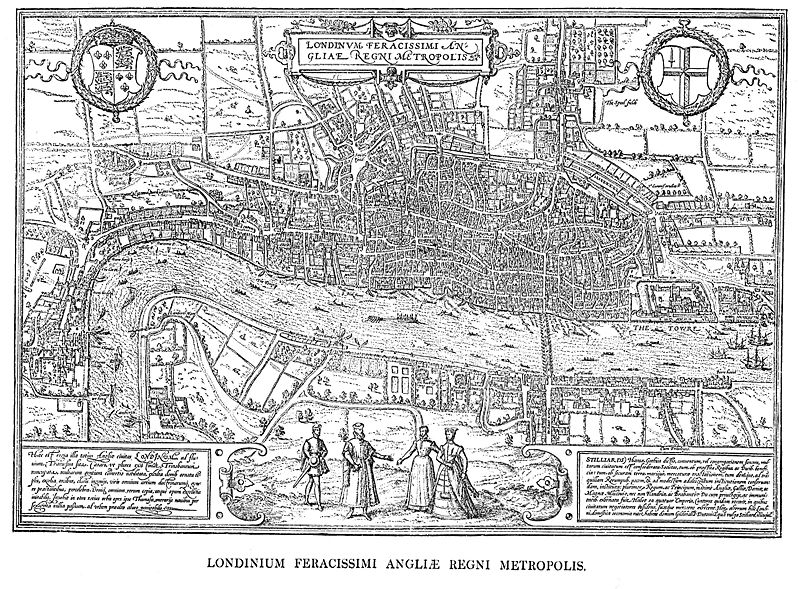
Baynard’s Castle, built in the 11th century on the banks of the Thames, enjoyed a long and glorious history before it was destroyed in the Great Fire of London in 1666. You can see its outlines on the fabulous Agas Map of Early Modern London and see how it dominated the river front between the Blackfriars and Poles Wharf.

Baynard’s Castle from londonist.com

Baynard’s Castle was one of three stone castles built on the River Thames after the Norman conquest. Humphrey, Duke of Gloucester, passed the residence to the Crown upon his death and it became the royal residence of Henry VI. Henry VIII gave the castle to Catherine of Aragon on the eve of their marriage; it later passed to his sixth wife, Catherine Parr, and then to her brother-in-law, the Earl of Pembroke. The property passed to the Earl’s son, Henry, Second Earl of Pembroke, who took Mary Sidney as his third wife in 1577.

A London Inheritance has a fascinating little article on the excavation of the site that once housed Baynard’s Castle. I imagine that it gives you a bit of glimpse into what it was like for Diana to return to modern London in The Book of Life.

“I forget, you have not met my wife. Diana, this is Nicholas Hilliard, the limner.”

Nicholas Hilliard is well-covered in both the Real-Time Reading Companion and The World of All Souls, but it’s worth taking a moment to discuss the art of limning. Limning refers to the execution of portraits in miniature on vellum, card, copper, or ivory. The name of the art form derives from the use of “minium,” or red lead, common in medieval illumination. Artists like Hilliard produced miniature portraits in watercolor on small tokens exchanged by friends and family. In the age before photography, miniatures were sometimes used in marriage negotiations to showcase the beauty and character of a potential bride.

Hilliard’s self-portrait.

Miniature portraits are extremely complex — painters used tiny brushes and minuscule amounts of paint to produce highly-detailed, personalized works of art for private collection and display. For especially complicated portraits, Hilliard used to have the clothing of the sitter brought to his studio separately so that he could study its textures and materials — he believed that long portrait sessions were tiring and that limning was extremely delicate, demanding work for the artist.

“Well, well, well,” Matthew interrupted with a chuckle. “My wife has arrived.” I looked at him in confusion. “Mary’s most treasured project is not alchemical but a new rendition of the Psalms for English Protestants. Her brother Philip began it and died before it was complete.”

Here is Psalm 51, by Mary Sidney, Countess of Pembroke:

O Lord, whose grace no limits comprehend;
         Sweet Lord, whose mercies stand from measure free;
To me that grace, to me that mercy send,
         And wipe, O Lord, my sins from sinful me.
         Oh, cleanse, oh, wash, my foul iniquity;
               Cleanse still my spots, still wash away my stainings,
               Till stains and spots in me leave no remainings.

For I, alas, acknowledging do know
         My filthy fault, my faulty filthiness
To my soul’s eye incessantly doth show,
         Which done to thee, to thee I do confess,
         Just judge, true witness, that for righteousness
               Thy doom may pass against my guilt awarded,
               Thy evidence for truth may be regarded.

My mother, lo, when I began to be,
         Conceiving me, with me did sin conceive:
And as with living heat she cherished me,
         Corruption did like cherishing receive.
         But, lo, thy love to purest good doth cleave,
               And inward truth: which, hardly else discerned,
               My truant soul in thy hid school hath learned.

Then as thyself to lepers hast assigned,
         With hyssop, Lord, thy hyssop, purge me so:
And that shall cleanse the lepry of my mind.
         Make over me thy mercy’s streams to flow,
         So shall my whiteness scorn the whitest snow.
               To ear and heart send sounds and thoughts of gladness,
               That bruised bones may dance away their sadness.

Thy ill-pleased eye from my misdeeds avert:
         Cancel the registers my sins contain:
Create in me a pure, clean, spotless heart;
         Inspire a sprite where love of right may reign
         Ah, cast me not from thee; take not again
               Thy breathing grace; again thy comfort send me,
               And let the guard of thy free sprite attend me.

So I to them a guiding hand will be,
         Whose faulty feet have wandered from thy way,
And turned from sin will make return to thee,
         Whom turned from thee sin erst had led astray.
         O God, God of my health, oh, do away
               My bloody crime: so shall my tongue be raised
               To praise thy truth, enough cannot be praised.

Unlock my lips, shut up with sinful shame:
         Then shall my mouth, O Lord, thy honor sing.
For bleeding fuel for thy altar’s flame,
         To gain thy grace what boots it me to bring?
         Burt-off’rings are to thee no pleasant thing.
               The sacrifice that God will hold respected,
               Is the heart-broken soul, the sprite dejected.

Lastly, O Lord, how so I stand or fall,
         Leave not thy loved Zion to embrace;
But with thy favor build up Salem’s wall,
         And still in peace, maintain that peaceful place.
         Then shalt thou turn a well-accepting face
               To sacred fires with offered gifts perfumed:
               Till ev’n whole calves on altars be consumed.

We’ll continue our real-time reading tomorrow as Diana runs errands in Tudor London. In the meantime, we hope you’re taking advantage of the sneak peek of Episodes 1 and 2 of A Discovery of Witches TV on Sundance Now and Shudder. We’d love if you popped by our Facebook group to share your excitement or sent us an e-mail at chamomileandclovecast@gmail.com. We hope to see you there!

xox

Cait and Jen

Real Time Reading

Shadow of Night Real-Time Reading – 25 December – Chapter 14

unsplash-logoRoman Kraft

“Time is tricky. Even if everything went according to plan and Diana took Matthew back to the first day of November in 1590, it may still be too soon to look for a message from your husband. And you wouldn’t have found a message before, because Philippe hadn’t met my niece yet.” Sarah paused. “I think Tabitha’s eating that book.”

I agree with Sarah — time is tricky.

In this chapter, we flash forward to the library with Ysabeau. As I mentioned yesterday, the calendar gets funky as Diana and Matthew travel back to London after their time at Sept-Tours. Lucky for us, we get to spend Christmas back at the chateau. The chapter is short and doesn’t have much for us to puzzle out, so I am going to leave you with a wee tidbit from another chapter and get back to celebrating the holiday.

Philippe went to the shelves and picked out a volume in a worn leather binding. “This is one of our favorite stories, The Song of Armouris. Ysabeau and I have simple tastes and enjoy stories of adventure. We are always hiding messages in this.” He stuffed a scroll of paper down the spine between the binding and the gatherings of vellum. A folded rectangle fell out of the bottom as he worked it into the tight space.

Okay, I cheated. This quote is from Chapter 13, but I love the note passing so much that I absolutely can’t help myself.

The Song of Armouris is a Byzantine story loosely based on the Byzantine-Arab conflict. The story follows a young man – Armouris – as he completes feats of strength and secures peace between his people and the Saracens. The poem probably dates from the 11th century — only two full copies of the manuscript survive. One can be found in St. Petersburg and one in Istanbul. I love to think of Philippe and Ysabeau reading this story to one another by the fire.

“Anomalies,” Ysabeau murmured. “Philippe was always looking for anomalies in the world. It is why I still read all the newspapers. It became our habit to look through them each morning.” Her eyes closed against the memory. “He loved the sports section, of course, and read the education columns as well. Philippe was worried about what children would learn in the future. He established fellowships for the study of Greek and philosophy, and he endowed colleges for women. I always thought it strange.”

“He was looking for Diana,” Emily said with the certainty of someone blessed with second sight.

Philippe and Emily aren’t the only ones who believe that anomalies reveal time travelers in our midst. There’s a whole spate of them in history, including blips in Charlie Chaplin films showing people using cell phones and a hipster in a photo from 1941.

Lucky for you, we all got to be time travelers today. Have you checked out Episodes 1 and 2 of A Discovery of Witches TV on Shudder and Sundance Now. You can stream both channels on Google Play, Apple TV, Roku, and Amazon FireTV. Tell us what you think about the episodes in our Facebook group or send us an e-mail at chamomileandclovecast@gmail.com.

We wish you and yours a merry merry holiday and can’t wait to catch up with you (and Matthew and Diana) tomorrow.

Xoxo

Cait and Jen

Uncategorized

Shadow of Night – Real-Time Reading – 24 December – Chapter 15

Kieran White

Matthew and Diana’s return to England causes a bit of a ruckus in the calendar — we’re actually going to return to London and celebrate Christmas Eve in 1590 (Chapter 15) before we spend Christmas with Ysabeau, Sarah, and Em in the present day (Chapter 14).

I had never imagined that Old St. Paul’s would be so big. I gave myself another pinch. I had been administering them since spotting the Tower (it, too, looked enormous without skyscrapers all around) and London Bridge (which functioned as a suspended shopping mall). Many sights and sounds had impressed me since our arrival in the past, but nothing had taken my breath away like my first glimpses of London.

As Deb notes in both the Real-Time Reading Companion and The World of All Souls, modern London an Elizabethan London are two very different creatures.

Between 1520 and 1600, London nearly doubled in size. Tudor London began to take shape in 1529 when Henry VIII began the process of transforming Cardinal Wolsey’s York Place into the palace at Whitehall. This influenced the growth of both London and the City of Westminster. Despite the fact that the two cities are known collectively as “London,” they’ve never merged.

Hoefnagel’s Map of London circa 1570

Diana and Matthew arrive in London a mere two and a half decades after an outbreak of the plague in 1664 and the Great Fire of 1666. The Great Fire burned for three days and destroyed some five-sixths of the City. The fire began in the King’s bakery near the London Bridge and swept through a city that was unusually dry after a very hot summer. The city began to re-build almost immediately — Sir Christopher Wren submitted “ambitious” plans to Charles II that would have widened London’s streets and made London look more like Paris. Many of his plans were never realized, in part because Londoners insisted on keeping the original sites of their homes and businesses and partially because his ideas were rather expensive. Wren was eventually responsible for the construction of approximately 50 new churches, including the grand new design of St. Paul’s Cathedral.

“At last,” Henry Percy appeared, beaming. “We’ve been waiting for hours. My good lady mother sent you a goose. She heard reports that no fowl are to be had in the city and became alarmed that you would go hungry.”

As usual, Deb doesn’t do throwaway lines. In 1590, Christmas goose would have been a big deal in Elizabethan England — after her victory over the Spanish Armada, Elizabeth I declared that everyone should eat goose for Christmas dinner because she happened to be eating goose when she learned of the rout. In Tudor times, all work stopped between Christmas Day and Epiphany (or Twelfth Night). Workers returned to their labors on the Monday after Twelfth Night, known as Plough Monday.

People in the Tudor era took Christmas quite seriously — they enforced the “no work” rule by threading spinning wheels with flowers and kept a Yule log burning for the full twelve days of Christmas. The English carol tradition began during Tudor times — if you’ve sung “We Wish You a Merry Christmas,” “The First Noel,” or “Good King Wenceslas” this season, you’re keeping the tradition alive. You can find out more about Tudor Christmas traditions here.

“Is this your doing, Henry?” I looked from the entrance hall into our main living quarters. Someone had tucked holly, ivy, and fir around the fireplace and the window frames and mounded them in the center of an oak table.

The Tudors decorated their homes with evergreen foliage as a gesture of welcome and goodwill. If you’re inclined to do some last-minute decorating, English Heritage has a fun video on how to make a Tudor kissing bough:

Jen and I hope you have a wonderful Christmas Eve with your loved ones. We’ll see you again tomorrow for a (brief) Christmas entry to celebrate the preview of A Discovery of Witches TV on Sundance and Shudder. We can’t wait to hear what you have to say about Episodes 1 and 2 on our Twitter feed or via our Facebook group.

Merry merry, darlings!

xox

Cait

Schedule, TV Show News

A Discovery of Witches 1×01 Livetweet – 17 January 2019

Photo courtesy of Sundance Now

Y’all.

We’re a mere month away from the premiere of A Discovery of Witches TV in the U.S. and Canada. With only thirty days to go, we’re pleased to announce our inaugural C&C live tweet of ADOWTV 1×01 on 17 January 2019 at 9pm EST/6pm PST. We know you might have questions — this blog post is here to answer them.

What’s a live tweet?

A live tweet (LT) is a very fun and goofy way to enjoy a movie or an episode of television with your internet friends. At the same moment, we all press PLAY and watch the film together while supplying commentary and talking to one another via Twitter. It’s easy, it’s free, and it’s a great way to bond over the premiere together when we can’t be together in person. Consider it a long-distance watch party.

How do you participate?

All you have to do to participate in a LT is log on to Twitter and follow our hashtag, #ccalchemy. Every tweet tagged with #ccalchemy will appear together while we watch. Jen and I will monitor the hashtag and retweet our favorites so that everyone can benefit from your insights and excitement. That’s it. Tweet to us, tweet to each other, tweet using the hashtag, and we’ll find you. We’ll spend a delightful hour cackling and gushing over witches and vampires together — through the wonders of modern technology.

I can’t make the date and time you set. Will there be other chances to play along?

Absolutely! We just haven’t scheduled them yet. You can expect that we will live tweet all eight episodes of Season 1 — probably more than once — while we wait for Season 2. There’s free fun for everyone.

If you have other questions, feel free to e-mail us at chamomileandclovecast@gmail.com or tweet to us at @chamomilenclove. We can’t wait to see you on 17 January 2019.

Xoxo

Cait

Real Time Reading, Uncategorized

Shadow of Night Real-Time Reading – 17 December – Chapter 13

unsplash-logoAnnie Spratt

I like being married,” I said drowsily.

Diana and Matthew spend the first ten days of their THIRD AND MOST EFFECTIVE MARRIAGE in a sort of honeymoon. The “honeymoon” apparently originated in Britain as a way of visiting relatives and friends who couldn’t make it to your actual ceremony. The word “honeymoon” may refer to an old tradition (5th century or earlier) of drinking honeyed wine a month after your wedding to aid in conception. In the absence of contraceptives, that gesture seems a bit… belated. 

In some cultures, the honeymoon period refers to the time between when grooms kidnapped and captured their brides and (1) the point at which the bride became pregnant and couldn’t be returned to her family, or (2) the point at which the family gave up hope of finding her. As this tradition appears to be vaguely Norse in origin, we should probably have a long talk with Gallowglass. For the record, this also makes a great deal of sense considering the real reason why bridesmaids all wear the same dress — to act as decoys for the real bride. Your only job as a bridesmaid is either to distract would-be kidnappers from the actual bride or lure evil spirits. Your call. 

There are hundreds of Auvergnat euphemisms for making love, but I don’t believe that’s one of them. I’ll ask Chef if he’s familiar with it.”

While I couldn’t find any Auvergnat euphemisms in particular, I figured I would favor you with a few very saucy French ones. Allons-y.

  • Faire boum boum – Literally, to make the boom boom. As in, naughty time so loud you can hear it. 
  • S’envoyer en l’air – “To be sent into the air” – casual, no-strings-attached whoopie. 
  • Avoir du monde au balcon – Er, “to have people on the balcony.” It means that your lady-friend fills out her top. 
  • Tremper son biscuit – “To dip the biscuit” – a person who likes to get naughty with everyone. 

Here are more, for fun:

Tonight was Saturnalia, the official beginning of the holiday season at the chateau. 

Saturnalia, which celebrates the agricultural god Saturn, traditionally fell on 17 December and lasted until the Julian solstice on 25 December. Celebrants observed Saturnalia much the way Deb depicts the holiday in Shadow of Night — feasting, dancing, gambling, singing, music, and gift-giving. There was also a strong tradition of role reversal — by some accounts, masters served their slaves, in others, slaves were allowed the rights and privileges of ordinary citizens

Hey, girl. You wanna play topsy-turvy? *wink wink*

It’s no coincidence that the Christian feast of Christmas falls on 25 December: as the Bible does not give a particular date for celebrating the birth of Christ, churches settled on combining the Christmas celebration with that of Saturnalia somewhere in the 4th century C.E. Pope Julius I apparently believed that combining celebrations would encourage more converts to Christianity. 

If you’re looking to celebrate Saturnalia, take a page out of Philippe’s book — decorate outdoor trees with stars, suns, and moons, drape greenery over doors, windows, and people, and throw a party. If you can do so safely, cause a festive ruckus in your street and organize a parade. 

The clock was unlike any I’d ever seen before. A carved and gilded cabinet surrounded a water barrel. A long copper pipe stretched up from the barrel and dropped water into the hull of a splendid model ship suspended by a rope wound around a cylinder. 

In the Real-Time Reading Companion, Deb indicates that Philippe’s clock is the missing water clock of mathematician and cartographer Oronce Fine. The water clock, or clepsydra, dates back to 1500 BCE. Sadly, I couldn’t find an image of a water clock from the same era, but you can read about the evolution and function of water clocks here

Friday marked the shortest day of the year and the celebration of Yule.

The pre-Christian Scandinavian festival of Yule lasts for twelve days and celebrated the “re-birth” of the sun at the winter solstice. Yule celebrants lit bonfires, toasted trees, fields, and crops with wassail (spiced cider), and went between houses with pomanders and other fragrant gifts. The European pagan tradition also recognizes and celebrates Yule and gave us the Yule log — the burning of the log banished evil spirits and brought luck for the coming year. The pagan rituals also celebrate the return of the Oak King, who presides over the warmer half of the year, and the retreat of the Holly King, who rules in the dark winter months. 

If you’re interested in celebrating some Yuletide traditions in your own home, consider taking a solstice walk to gather a Yule log for burning in your hearth. You could create a Yule altar filled with “solar-related botanicals” such as cinnamon, star anise, and cloves. You could incorporate gratitude for the return of the sun in your meditation or yoga practice. Give the gift of seeds to those you love to celebrate the coming spring. If you’re feeling super festive, you might make something special, like this wassail, to share with your friends. If you’d like alcoholic wassail (*raises hand*), you might try this version. 

We covered this chapter of Shadow of Night in Episode 25 – Partyfamilias. Until next time, we hope that you and your loved ones celebrate a healthy and happy Saturnalia, a blessed solstice, and a merry Yule. Feel free to join our Facebook group, or shoot us an e-mail at chamomileandclovecast@gmail.com. You can also follow us on Twitter @chamomilenclove.

Merry merry,

xoxo

Cait and Jen