Uncategorized

Shadow of Night Real-Time Reading – 24 March – 4 April – Chapters 28 and 29

It’s springtime in Prague, y’all — time for golems and hunts, puppies and weird gifts from your royal admirers. What, that’s only Diana? My bad.


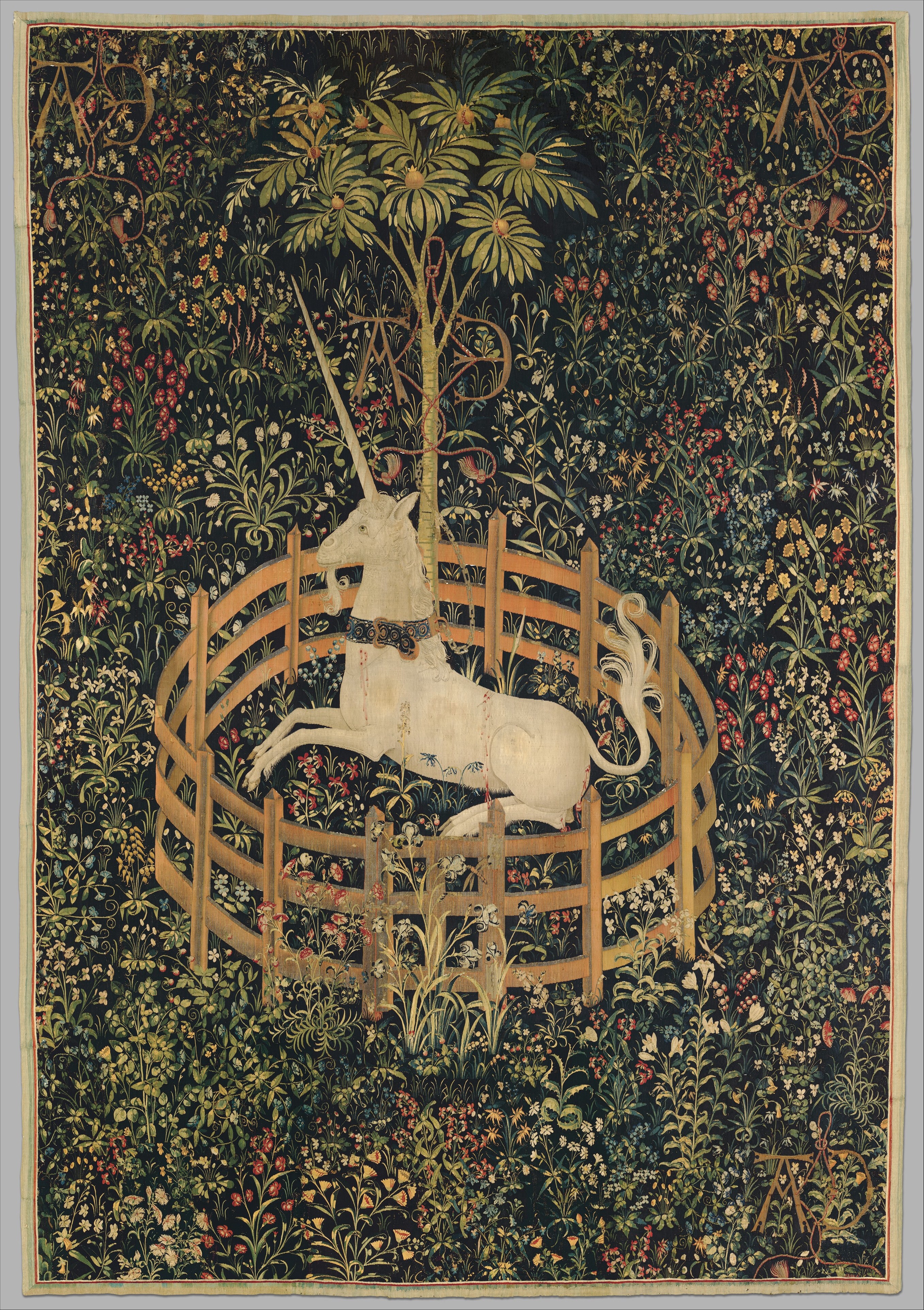
“Tell us again about the unicorn’s horn. It is supposed to have miraculous curative powers.”

Writing for The Pharmaceutical Journal, William Jackson reports that the myth of the unicorn may have arisen from Alexander the Great, who adorned his war horse with golden horns for battle.
37.80.6
http://www.metmuseum.org/art/collection/search/467642

Other stories suggest that the myth of the unicorn arose from early reports of the rhinoceros, although, as Jackson reports, belief in the unicorn lasted well into the Renaissance. The belief in the medicinal properties of the unicorn horn likely began in the fifth century and persisted into Emperor Rudolf’s day — the unicorn horn allegedly neutralized poison, a tantalizing property for royals fearful of assassination attempts. 

The most common medicinal use of the “unicorn horn” was either as a cup that removed poisons and toxins or as a powder to be mixed with other ingredients (pearl! Ivory! Whale bone! Here, royals! Have a drink full of rocky things!) to purify the body.

Because “unicorn horn” was so precious, there were lots of counterfeit items–the blog Early Modern Medicine reports that, in order to test the authenticity of a suspect horn, one should pass a spider over it. If the spider survived, you’d been had. If the spider exploded, you had the real thing. Good to know.

It’s an automaton, Jack,” Matthew said, picking the thing up. When he did, the stag’s head sprang open, revealing the hollow chamber within. “This one is meant to run down the emperor’s dinner table. When it stops, the person closest must drink from the stag’s neck.

In the Real-Time Reading Companion, Deb notes that the automaton Rudolf sends Diana is based on this one, which you can see on display at the Metropolitan Museum of Art in New York City.
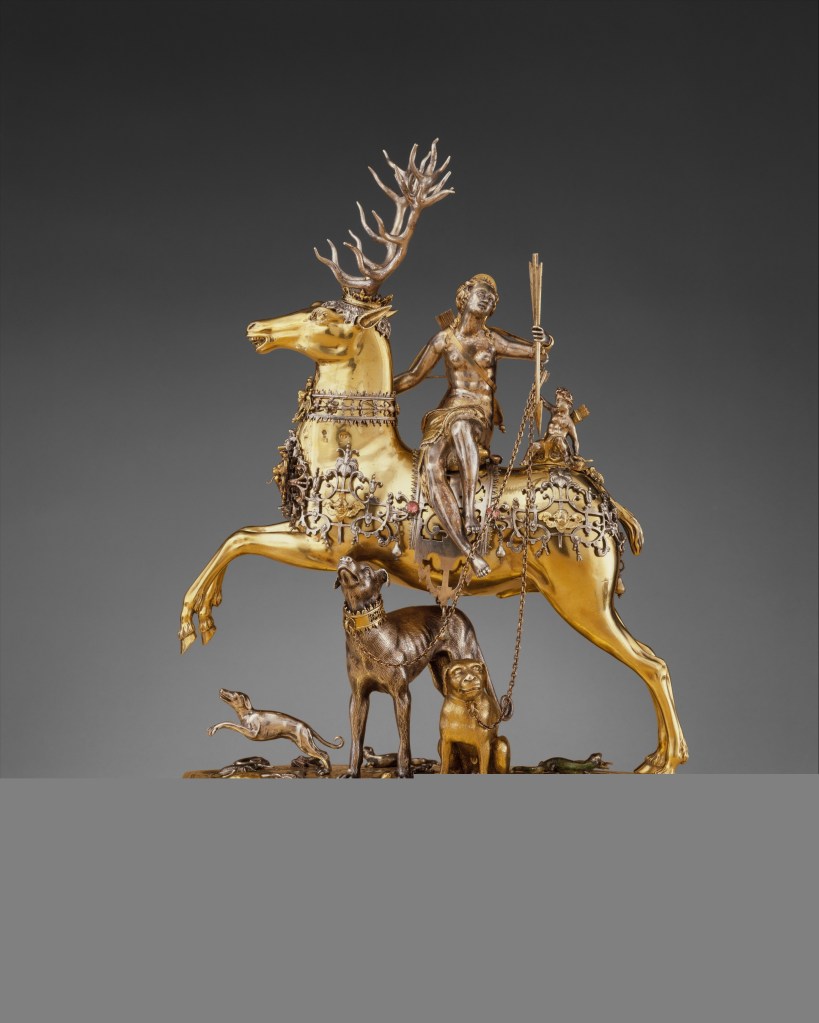
While the automaton on display at the Met was made around 1620, it’s likely that Rudolf II would have had something similar in his collection — his Kunstkammer, or Cabinet of Wonders, contained many fantastical and ingenious items. In fact, the Kunst Historiches Museum in Vienna boasts an automaton of Diana astride a centaur once owned by Rudolf II.

Rudolf’s collection survived the Thirty Years’ War by virtue of the fact that part of it was moved to Vienna, where it’s still on display.

“There goes Sigismund,” Gallowglass said, bending close to my ear. The noise from the bells was deafening, and I could barely hear him. When I looked at him in confusion, he pointed up, to a golden grille on the adjacent steeple. “Sigismund. The big bell. That’s how you know you’re in Prague.”

The Sigismund Bell hangs at the top of St. Vitus’ Cathedral in Prague. The church took over 600 years to complete—the last section was only finished in the 20th century. The construction of the Gothic cathedral ceased as a consequence of the Hussite Wars and the project was not completed until the millennial anniversary of Wenceslas I, Duke of Bohemia, in the 1930s. The popular history tells us that when the bell Sigismund was finished, no one knew how to lift the massive bell into the tower. Naturally, the princess devised a solution—by making a pulley of her own hair to lift the bell into place. Ouch. You can hear Sigismund’s peals in the video below. You can learn more about the architecture of St. Vitus (and the work of one Matthew of Arras, French architect (hmmm)) here.

Kelley nodded. “He came when Dee was still in Prague, asking questions about the book and nosing about in my business. Rudolf let him enjoy one of the witches from the Old Town—a seventeen-year-old girl and very pretty, with rosy hair and blue eyes just like your wife. No one has seen her since. But there was a very fine fire that Walpurgis Night. Gerbert was given the honor of lighting it.” Kelley shifted his eyes to me.
“I wonder if we will have a fire again this year?”

Walpurgis Night is a Northern European festival celebrating St. Walpurga that takes place on 30 April-1 May. While the festival has its roots in pagan rituals welcoming the spring and summer, St. Walpurga is remembered for denouncing sorcery and witchcraft. Traditionally, people believed that Walpurgis Night was the last night of the year that a witch could cast powerful spells before the autumn. In sixteenth century Ireland, people slaughtered hares on 30 April believing that they were cow-stealing witches in disguise. In Germany, people believed that witches roamed abroad on Walpurgis Night to participate in a great gathering on top of the Blocksberg mountains. Though I tried, I couldn’t find anything on whether people actually engaged in witch-hunting — but they definitely lit bonfires to ward off sorcery and spells.

After days of careful negotiation, Matthew was able to arrange a visit to Rabbi Judah Loew. To make room for it, Gallowglass had to cancel my upcoming appointments at court, citing illness.

Rabbi Judah Loew, “The Maharal,” was the spiritual leader of the Jewish community in Prague in the late sixteenth century. The Maharal was a great intellectual—in addition to establishing his reputation as a formidable Talmudic scholar in his early life, he was a friend of Tycho Brahe and Johannes Kepler and had an expansive knowledge of mathematics and science. His knowledge endeared him to Emperor Rudolf II, who consulted him frequently (in the dead of night)

The name Maharal is a Hebrew acronym for Moreinu ha-Rav Loew, or “Our Teacher Rabbi Loew.” Legend has it that the Maharal used his knowledge of the Kabbala to animate the golem of Prague, a creature raised to protect the Jewish community from harm. According to this article from the New York Times, the symbolism of the golem re-emerges every so often—especially in times of trouble and uncertainty. To this day, people honor the legacy of Rabbi Loew by leaving stones on his grave in the Jewish cemetery of Old Town Prague.

We’ll pick up again with Matthew and Diana as they hunt with Emperor Rudolf on 8 April. In the meantime, be sure to catch A Discovery of Witches TV on BBC America and AMC TV when it premieres at 9pm on Sunday, 7 April! You can also vote in the last couple rounds of A Discovery of Witches TV March Madness between now and Sunday — check out our Twitter profile (@chamomilenclove) or our Facebook page to participate.

If you like what we do, consider leaving us a review on iTunes! We can’t wait to begin our book discussions of Book of Life with you on 14 April 2019!

Xox

Cait and Jen

adowtv, Podcast

ADOWTV Season 1 Wrap with the Pop Culture Theologians – Episode 49 – Witches’ Kiki

Hello, friends!

It’s been a minute; we’ve finished our episode-by-episode analysis of A Discovery of Witches TV and we’re in a brief book episode hiatus to get ready for our chapter discussions of Book of Life (!). I can’t believe we’ve come so far; we’re so incredibly inspired by this fandom and pleased to be a part of the continuing magic that is the All Souls Trilogy.

In today’s episode, we’re joined by some fabulous newcomers to the All Souls fandom — Marci and John of the Pop Culture Theologians! We hope that you’ll find them as smart and funny as we do and that you’ll follow them in their continuing adventures on their podcast. In this episode, we talk about some very serious things (Diana’s POV, the tragedy of Juliette) and some not-so-serious things (Grey’s Anatomy! Made for TV Disney movies! The Marci-Mentions-Harry-Potter Drinking Game!). We hope you enjoy the show!

Download the episode here.

So far, the Pop Culture Theologians have covered The Purge and A Discovery of Witches. Next season, they’re covering Game of Thrones. You can find them on Twitter as @PopTheologians and on any pod-fetching service you like.

Want to stay on top of our news and updates? Follow us on Twitter or find us on Facebook. You can participate in our ongoing A Discovery of Witches TV March Madness polls in either place — it’s been a blast so far! If you’d like to support us further, please consider becoming a Patron. Between now and our next episode, check out our Reading and Release Schedule and our Episode List.

xox

Cait and Jen

adowtv, Schedule, TV Show News

A Discovery of Witches TV March Madness – 19 March-8 April

Photo by Ashton Mullins on Unsplash

Darling Clovers:

I am going to give you a peek into how things sometimes happen at C&C headquarters.

Imagine that you’re Jen, minding your own business on the West Coast (C&C West). It’s getting late on the East Coast (C&C East), so you’re settling down for the night. Then, your phone makes its chirpy text message noise.

*DING*

*DING*

*DINGDINGDINGDINGDING*

You pick up your phone, even though you know it’s not a good sign.

CAIT: I HAVE HAD *AN IDEA*

JEN: …

CAIT: It’s FABULOUS and LOADS OF EFFORT and HORRIBLY SPONTANEOUS.

JEN: …

CAIT: What do you think?

JEN: …

CAIT: I’M GOING IN.

JEN: *THUMBS UP*

As you may have guessed, my lovelies, this is one of those occasions. I’ve been scheming for ways to celebrate the premiere of ADOWTV on network television… and then I remembered that the sports ball tournament starts tomorrow. And that one can make A BRACKET. Well, IT IS DONE.

I present to you the inaugural ADOWTV March Madness. Here’s how it will work:

(1) Every day between now and Monday, 8 April 2019, I’ll post a poll on our Facebook page and our Twitter account.

(2) Vote for your favorite of the two scenes listed for that day. The scene with the least votes will be eliminated from the bracket.

(3) You can join in at any time and you don’t have to be a listener to play. Come join the fun and let’s see what shakes out!

(4) We’ll have the final vote and ranking on 8 April 2019, the day after the network TV premiere.

I know you want to see the bracket, so here it is in all of its glory:

You can download your own copy below, but I’ll post updated copies as we go. The first poll will be up in a matter of hours!

Some quick caveats: (1) I know some characters are underrepresented in this bracket, but anything over 24 scenes became LUDICROUS; (2) if your favorite scene isn’t represented, let me know! I’ll make a separate poll for the scenes I overlooked; (3) I’ll count both Twitter and Facebook votes; and (4) this is supposed to be FUN. Invite your friends! Talk to other fans! Enjoy it — I know I will.

In the meantime, join me in thanking Jen for loving me despite my bright ideas.

May your favorite scene win!

xoxox

Cait

adowtv, Podcast, TV Show News

ADOWTV 1×08 – Episode 48 – Does This Pumpkin Spark Joy?

I don’t know how we did it, y’all. Eight episodes went by so fast — I feel like our ADOWTV adventure is just beginning and we’re already at the last episode of Season 1. Never fear — we’ll be here to keep you company during the worst of #Witchdrawal.

In this episode, we talk about what we loved (and didn’t love so much) about the season finale. In fairness, we tried to be Very Serious Proper Podcasters (TM) for the first bit, then it rather gets away from us at the end. On brand, no? Let’s just say that we start talking about death and divinity and end up somewhere in the neighborhood of ruffles and popes. #losientonosiento.

Download the episode here.

If you like what we do, consider joining our Facebook group or supporting us on Patreon. We can’t wait to celebrate with you as ADOWTV comes to BBC America next month and as we start our book discussions for Book of Life!

Enjoy the episode,


xo

Cait

Real Time Reading

Shadow of Night Real-Time Reading – 11 March-22 March – Chapter 27 (Part I)

unsplash-logoAnthony DELANOIX

Hello, darlings! We finally made it to Prague, which means we’re diving headlong into Section IV of the Real-Time Reading of Shadow of Night. This chapter is a monster, so I’m dividing it in two parts between this week and next.

After we’d lived out of saddlebags and a single shared trunk for weeks, our belongings had arrived three days after we did at the tall, narrow house perched on the steep avenue leading to Prague Castle known as Sporrengasse.

Try as I might, I couldn’t find a street in modern Prague called Sporrengasse. I assume that it was likely renamed something lovely and Czech that isn’t mentioned in the pages of Shadow of Night. Nonetheless, I had a very pleasant Google Maps street view wander through the neighborhood of Mala Strana. Mala Strana, or the “Little Side of the River,” is a district in Prague dominated by the city’s German and Italian citizens. The neighborhood has mostly Baroque architecture after a series of fires destroyed the original buildings. Even today, Mala Strana is one of the most popular neighborhoods for tourists because of its “charming” cobbled streets and cluster of cultural sights. After researching, I have marked out Mlýnská Kavárna for my next visit because it boasts Czech beer and freshly-baked bread. Yes, please.

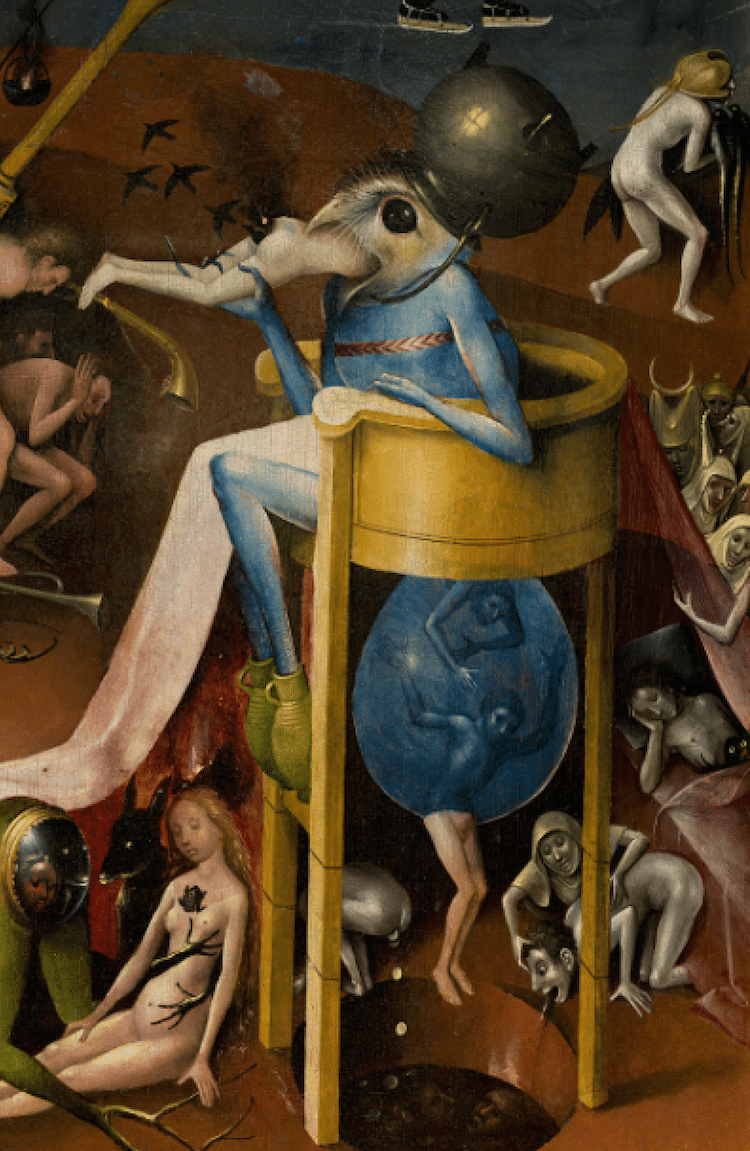
“Is that… a Bosch?”

Oh, Bosch. You were such an odd duck. Hieronymus Bosch (1450-1516) was a Dutch artist famous for his colorful, bizarre, and exquisitely detailed triptychs. Apparently, we know very little about Bosch — he did not leave behind any indication as to the meaning of his work, so we’re essentially left to goggle at it and come to our own conclusions.

Detail, Garden of Earthly Delights

Artstory describes him as a “visionary apocalyptic painter;” it’s the best short description of his work I’ve ever read, so I am keeping it. Bosch was the first painter to introduce surreal and fantastical imagery into his paintings; the rest of Western artwork from this period is either very religious or very realistic.

You can explore Bosch’s oeuvre using this fascinating series of projects by ColourLex, which analyzes works of art by the pigments used to create them. There’s a couple of interesting choices here, including the Audio Experience of Bosch’s Ship of Fools and a close exploration of The Garden of Earthly Delights.

Oh wait. Remember when I told you guys that I went to dance performance based on the Garden of Earthly Delights and there were artists throwing potatoes? I found a video. The potatoes appear at 0:18. You’re welcome.

I bet you thought I made that up.

“Rudolf hasn’t seen me. Rumor has it that Kelley is in the uppermost reaches of the Powder Tower blowing up alembics and God-knows-what-else.”

In the real historical timeline, Matthew and Diana arrive in Prague right as Edward Kelley’s star began to fade in the court of Rudolf II. Kelley first traveled to the Continent from England in the company of John Dee, another famous alchemist. Kelley and Dee made all sorts of mischief together (and people threatened to throw them out of windows) right up until Kelley told Dee that his alchemical spirit guide required them to swap their wives. Right around the spring of 1590, Rudolf II became frustrated that Kelley could not produce the Philosopher’s Stone. He knighted him to encourage his progress, then imprisoned him after a duel to make him work harder. Kelley attempted to escape by jumping out the window — an escapade which required the amputation of his leg. This happened again several years later and Kelley lost the use of his remaining leg, too. I am sensing a pattern. If you want to know more, check out the Alchemy Podcast’s episode on Kelley. On a related note, did you know there was an opera about John Dee? Wonders never cease.

The Powder Tower, or Prašná brána, was built in 1475, is the beginning of the Coronation Route to Prague Castle.

“Why is the handwriting so ornate?” I wondered.

“The Hoefnagels have arrived from Vienna and have nothing to occupy their time. The fancier the handwriting, the better, as far as his Majesty is concerned,” Pierre replied cryptically.

According to the Getty Museum, the invention of the modern printing press made it more common for people to own books, noble collectors like the Holy Roman Emperor turned to hand-made works of calligraphy for their rarity and beauty.

In 1590 or so, Rudolf II commissioned Josef Hoefnagel to illustrate a book of calligraphy written by Georg Bocskay called Mira calligraphiae monumenta. You can visit this work at the Getty, or via their website. The image on the left demonstrates Hoefnagel’s incredible skill for texture and detail in plant and insect life. The calligraphy in the book is stunning, as are the images.

Most impressive of all? The fact that Hoefnagel and Bocskay never met.

“I told you to hook him with Titian’s great canvas of Venus that Grandfather took off King Philip’s hands when his wife objected to it,” Gallowglass observed. “Like his uncle, Rudolf has always been unduly fond of redheads. And saucy pictures.”

Titian painted his famous Venus of Urbino in 1538. The original hangs in the Uffizi in Florence. No wonder Philippe had his hands on it.

“Among my people it’s a great compliment to be likened to a raven. I’ll be Muninn, and Matthew we’ll call Huginn. Your name will be Gondul, Auntie. You’ll make a fine Valkyrie.”

Huginn and Muninn are the two ravens who assist the god Odin. Every morning, the two ravens fly from Odin to gather information about the Norse World and report back to him at night. Gondul, a valkyrie warrior, decided who would dwell with Odin in Valhalla from amongst the fallen on the battlefield. In other myths, she may or may not have started a war.

I’ll see you again next Monday for Part II of Chapter 27 of Shadow of Night. In the meantime, you can find us in our Facebook group or e-mail us at chamomileandclovecast@gmail.com. If you want to find the rest of the Real-Time Reading posts, you can check out our Episode List.

Until next week,

xox

Cait