Real Time Reading, Uncategorized

Real-Time Reading – 15-19 October – Chapter 37

m-wrona-273100 m wrona

Chapter 37

Sarah had discovered this happy coincidence when, during one of her habitual bouts of insomnia, she went downstairs in the middle of the night and found Miriam and Marcus watching Out of the Past.

Out of the Past (1947) tells the story of a man whose life is interrupted when a figure from his shady past reappears and wreaks havoc. It sounds rather like the perfect film to open a chapter that also contains Juliette Durand. img_0181The film has very high ratings on Rotten Tomatoes.

The word “smoor” apparently comes from Scots Gaelic. To smoor a fire is to dampen it so that it does not require tending overnight. There are superstitions associated with smooring, such as that letting the fire go out lets the soul of the house die.

“You must have a very high opinion of me, Miriam, if you think the brotherhood has functioned for all of these years without a seneschal. That position is already occupied.”

According to Wikipedia, a seneschal was a senior court appointment within a royal, ducal, or noble household during the Middle Ages.  In the province of Anjou, the seneschal transformed into a business manager and vice regal.

SOS. Juliette.”

The name Juliet means “youthful,” while Durand means “enduring.” It’s a lovely and fitting name for a vampire–even a crazy one. A little-known fact–the spelling “Juliet” was first used by Shakespeare in Romeo and Juliet in 1596. Before R&J, it was spelled “Juliette” or “Giulietta.” In 2016, it was the 228th most popular name in the US.

“Will you hold me?” he whispered.

My back to the oak tree, I pulled him between my legs.

“I’m cold,” he said with dull amazement. “How strange.”

“You can’t leave me,” I said fiercely. “I won’t have it.” 

In mythology, the oak represents strength and survival. In the Celtic tree calendar, Oak is the seventh month. It is also the seventh consonant in Ogham writing. Celtic mythology provides that the oak protects leaders and warriors, offering hospitality and safety. In Ancient Greek and Roman cultures, the wearing of oak leaves was a sign of special status. Unsurprisingly, the oak is the tree of the Goddess Diana, as well as the Celtic Dagda, Janus, Hecate, and Pan. Very old oak trees often have special meaning for their communities; several famous oaks may be listed here.

Two women were standing inside the barrier of flames. One was young and wore a loose tunic, with sandals on her feet and a quiver of arrows slung across her shoulders. The strap was tangled up in her hair, which was dark and thick. The other was the old lady from the keeping room, her full skirt swaying. 

“Help me,” I begged. 

There will be a price, the young huntress said.

“I will pay it.” 

In Neopaganism, the Goddess often appears in one of her three aspects–Maiden, Mother, or Crone. Each embodiment of the goddess represents a phase of life and a phase of the moon. Throughout mythology, it is not uncommon to find historical goddess triads or triple goddesses.

There is a tradition of Dianic Wicca which adopted a triple goddess named after the Roman Diana. Triple goddesses appear across fantasy, fiction, film, and literary criticism, from Marion Zimmer Bradley to George R. R. Martin to Neil Gaiman.

Deb’s post on October 15-19 may be found here. In the Real-Time Reading Companion, she offers two other musical selections for this chapter: Radiohead’s “The Gloaming” and the Spill Canvas’s “Gold Dust Woman.”

We’ll see you again while Diana convalesces on October 20-21.

Until then,

xox

Cait

Real Time Reading, Uncategorized

Real-Time Reading – 14 October – Chapters 34-36

jaime-spaniol-109084 Jaime Spaniol

Chapters 34-36

“Prana mudra,” Matthew explained. “It encourages the life force and is good for healing.”

Prana mudra is a yoga technique thought to increase vitality and activate the muladhara or root chakra. Yogapedia recommends the posture as a therapeutic mudra and suggests that one practice it in lotus pose. A mudra “controls the flow of energy in the body” and “[unblocks] chakras.”  Ideally, the use of prana mudra reduces fatigue and nervousness and enhances focus and clarity. You can find the steps to perform prana mudra here, or watch the following video:

“You can make a lot of money water witching, you know,” Sarah called as we approached. “Everyone in town needs a well, and old Harry was buried with his dowsing rod when he died last spring.” 

Water dowsing is the practice of using a rod or stick to locate underground water sources. Wikipedia suggests that dowsing as a practice emerged in Germany in the 15th century; Martin Luther apparently wrote that dowsing violated the first commandment. In some places, dowsing is called “doodle bugging,” a charming phrase for which I have no clever commentary. Sadly, darlings, dowsing doesn’t have any basis in science.  Truth being no defense for fiction, however, Diana can dowse away quite happily in the pages of ADOW with little effect on the outside world.

“It is a wedding. The chemical marriage between mercury and sulfur. It’s a crucial step in making the philosopher’s stone.” 

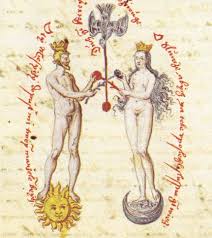
The Chemical Wedding, or the joining of mercury (water and earth/female) and sulfur (fire and air/male), is the coniunctio step of the alchemical process. Alchemists believed in the purifying power of a union of opposites: dark and light, life and death, gold and silver. It features prominently in the Rosarium Philosophorum, an alchemical work of the 16th century. The University of Glasgow wrote a lovely article on the Rosarium that’s available here. There’s also an article on the Holy Wedding and Jungian psychology, which relies heavily on alchemical themes, here. UnknownThe hieros gamos, or holy marriage, is a ritual mating between gods that appears in many cultures–from Wiccans to Greeks to Hindu mythology–and represents the union of the male and female aspects of the divine. In some cultures, it’s purely mythological, however, in others, there are rituals devoted to the actual union of the gods.


“What’s a caulbearer?” I whispered.

“Someone born with the amniotic sac still intact around them. It’s a sign of luck,” Sarah explained.

Wikipedia states that “caulbearers” represent 1 in every 80,000 human births. Caulbearing is harmless and infants born with a caul have it removed immediately upon delivery. “Some Early Modern European traditions linked caul birth to the ability to defend fertility and the harvest against evil.”

“The results do belong to Diana,” Marcus said. “She’s a chimera, Matthew.”

Chimerism is real, and may occur for a number of reasons. There’s the stated reason for Diana’s chimerism–absorption of a fetal twin–but there are other examples, such as people who have received marrow transplants and therefore have blood cells from another individual, or mothers who take on some of the cells of their offspring. This TIME story tells how one man’s unborn twin was the genetic father of his child. 

“Why are you so resistant?” Miriam asked impatiently. “Cross-species breeding is the next evolutionary step.”

The scientific literature–revealed to me by the Great and Powerful Google–suggests that Miriam is onto something:

Cross-species Mating may Be Evolutionarily Important And Lead To Rapid Change, Say Indiana University Researchers

Interspecies Hybrids Play a Vital Role in Evolution

Why do animals interbreed? 

Interspecies Sex: Evolution’s Hidden Secret? 

There’s also evidence that human evolution was shaped by cross-species breeding.

“Marcus is fond of the Pre-Raphaelites, and Miriam knows a lot of mythology. They picked the name,” Matthew said by way of explanation.

“The Pre-Raphaelites loved Lilith. Dante Gabriel Rossetti described her as the witch Adam loved before Eve.” Marcus’s eyes turned dreamy. 

Lilith appears in several ancient sources, including biblical texts and the Epic of Gilgamesh. The name “Lilith” comes from the Sumerian “lilitu,” which means wind spirit or female demon.

Lady-Lilith.jpg

In the Bible, Lilith was created before Eve and wanted to be equal to Adam. The 13th century writings of Isaac ben Jacob ha-Cohen suggest that “Lilith left Adam after she refused to become subservient to him and then would not return to the Garden of Eden.” The painting to which Marcus refers is the “Lady Lilith,” by Dante Gabriel Rossetti.

He used his mistress as the model for Lilith, naturally. The Met has a nice blurb on the painting here, and some thoughtful commentary on the painting can be found on www.victorianweb.org.

“Bertrand was Matthew’s best friend.”

BOOM. That’s why Matthew won’t answer to that name, and why Philippe gave it to him. That’s absolutely heartbreaking.

Honestly, the rest of the chapter speaks for itself. Tomorrow, sadly, we meet Juliette in the woods and spend a few days in and out of consciousness. Be kind to one another and rest up.

The Daemons talk about Chapters 30-34 in Take 22!. They talk about Chapters 35-38 in this episode. Deb’s post is here.

You know where to find us. Be good.

xox,

Cait


Real Time Reading, Uncategorized

Real-Time Reading – 13 October – Chapters 32-33

elke-burgin-195569Elke Bürgin

Chapters 32 and 33

In Chapter 32, Matthew whisks Diana from Sept-Tours to Madison. The timing of this chapter must be aided by a combination of time changes, literary efficiency, and magic, because I frankly don’t buy the time lapse here. I don’t know how everything–from Satu to the oubliette to Diana recovering to getting to Madison–happens in less than 48 hours. However. I am gliding past it because I don’t actually care unless I think about it too long. Accordingly, to Madison we go.

“Do you know what a gambit is, Diana?”

“Vaguely. It’s from chess.”

“That’s right,” he replied. “A gambit lures your opponent into a sense of false safety. You make a deliberate sacrifice in order to gain a greater advantage.”

“Gambit” comes from the ancient Italian “gambetto,” which means “to trip.” There are a series of famous gambits in chess – the King’s Gambit, the Queen’s Gambit, and Evans Gambit, to name a few. If you offer a gambit and your opponent takes your chess piece, it’s said to be “accepted.” If your opponent does not take the bait, it’s “declined.” As Baldwin says, the idea is to lure your opponent into a compromising position by allowing them to think that they’ve gained something from their countermove. If you aren’t paying attention, you can land in big trouble–i.e., lose many pieces and compromise your king–very quickly. I am only a middling chess player, so I cannot go much farther into the discussion of strategy before I am woefully outclassed. If, however, you’re a better player than I am, the Chess Website would be happy to help you.

“You said you wouldn’t obey my orders. After La Pierre, you might have reconsidered.”

Baldwin stared at the white rectangle. His face twisted sourly before falling into lines of resignation. Taking the envelope, he bowed his head and said, “Je suis votre commande, seigneur.”

In ADOW, Deb introduces the idea of the Knights of Lazarus, a (largely) vampiric chivalric order established by Philippe de Clermont at the time of the Crusades. These orders largely developed in order to protect pilgrims; many adopted monastic rules and formed communities to assist the sick and injured. In history, the three most famous chivalric orders are the Knights Templar, the Knights of Saint John of Malta, and the Teutonic Knights. The Knights of Saint John of Malta and the Teutonic Order are still active; the Knights Templar have (theoretically) been resurrected, but it would appear that they spend a great deal of time combating the myth that they are a secret society or that they have any association to the Priory of Scion. Thanks, Dan Brown. Conspiracy theories about chivalric orders are everywhere; so are articles debunking them.

Matthew pulled in to the driveway, which was pitted with ice-crusted potholes. The Range Rover rumbled its way over them, and he parked next to Sarah’s beat-up, once-purple car. A new crop of bumper stickers adorned the back. Image result for farmhouse upstate new york

You, too, can plaster your car with a sticker that reads MY OTHER CAR IS A BROOM, or I’M PAGAN AND I VOTE, or WICCAN ARMY. On the left, we have a farmhouse purportedly located in upstate New York. The village of Madison actually exists–to get there, you could go through Syracuse, or drive west from Albany.

“Lily of the valley,” Matthew commented, his nostrils flaring at all the new scents.

Lily of the valley is a low-growing perennial with a delicate, clean scent. Lilies of the valleyIt’s an antidote to some poisons, but it can also cause death if ingested in large quantities. Lily of the valley signifies chastity, humility, purity, and “the return of happiness.” It is the birth flower for those born in the month of May. If you’d like, you can buy Rebecca Bishop’s perfume, Diorissimo, which has a “gentle” lily of the valley scent that is “like a dewy, spring morning in the woods.”

When next we meet, we’ll breeze through Chapters 33-36 and do a great deal of buzzing about families, present and future.

Until then, you can find us at @chamomilenclove or chamomileandclovecast@gmail.com.

Thanks!

xoxo

Cait


Real Time Reading, Uncategorized

Real-Time Reading – 12 October – Chapters 29, 30, and 31

mathieu-daix-40234

Mathieu Daix

Chapter 29

We descended toward something that looked like a crater set apart from the surrounding countryside by yawning ravines and overgrown forests. It proved to be the ruin of a medieval castle, with high walls and thick foundations that extended deep into the earth. Trees grew inside the husks of long-abandoned buildings huddled in the fortress’s shadow. The castle didn’t have a single graceful line or pleasing feature.

In the Real-Time Reading Companion, Deb says that her inspiration for La Pierre came from Château de Murol in the Auvergne. The castle was built in the twelfth century and remains open for visitors today. I was pleased to note that the castle allows dogs. The castle enjoys a good deal of popularity today because they have ongoing “son et lumière” shows designed to show medieval life. Si tu parlais français, there are numerous videos of these shows available via Youtube.

There is drone footage of the castle and its grounds (edited for your dramatic enjoyment) in this video:

If you prefer a guided tour, and speak French, this episode of Suivez le Guide is excellent. From this video, I learned that the castle offers views of over thirty kilometers over the old roads to Toulouse, Bordeaux, Lyon, and Paris.

I closed my eyes and braced myself for a fall. Instead Satu grabbed my hair and aimed my face into a dark hole. The smell of death rose in a noxious wave, and the ghosts shifted and moaned.

I probably don’t have to tell you that oubliettes are awful; Deb does a fairly thorough job of giving you a fear of them even if you’d never encountered one before. While the primary purpose of an oubliette was psychological torture, some prisons elaborated on the grisly theme of starvation and deprivation with spikes or flooding. The German equivalent is called an angstloch, literally, a “fear hole.” Should you be curious about other horrifying dungeon features, there’s a thorough listicle here.

Chapter 30

“As for Diana,” Ysabeau continued smoothly, though her eyes sparked in warning, “if your father were alive, Lucius Sigéric Benoit Christophe Baldwin de Clermont,” he would be out looking for her, witch or not.”

Ah, Baldwin. I like you, dude, but you make it hard sometimes. As we’ve done with Matthew (and will do later with Ysabeau), we’ll take a moment to explore the meaning of Baldwin’s many names:

Lucius, meaning “light,” was popular in Roman times and is the name given to three different popes.

Sigéric is derived from the Old High German “sigu,” for victory. It’s combined with rîcja, which means “powerful, strong, mighty.” It’s the name given to a fifth century king of the Visigoths.

Benoit means “blessed” in the Old French and is similar to the modern name “Benedict.”

Christophe is the French form of Christopher, for “he who holds Christ in his heart.”

Baldwin is also Germanic, combining “bald/bold” and “wine/friend.” It was once very popular in Normandy and Flanders.

I will skim over the involvement of the Knights of Lazarus in world history for the moment and talk a little about Ysabeau and Matthew.

Then there was Ysabeau. Everyone underestimated her except for Philippe, who had called her either “the general” or “my secret weapon.” She missed nothing and had a longer memory than Mnemosyne.

Mnemosyne was the Greek goddess of memory and the inventor of languages and words. She was the daughter of Uranus and Gaia and mother to the nine Muses: Calliope, Clio, Euterpe, Thalia, Melpomen, Terpsichore, Erato, Polyhymnia, and Urania.

“In the Cantal the witches would have to answer to Gerbert, so they must be somewhere near the border. Think,” Baldwin’s last drop of patience evaporated. “By the gods, Matthew, you built or designed most of them.”

According to Ysabeau, Matthew began life as a carpenter and became a stone mason. Stonemasonry is one of the world’s earliest trades. In the Middle Ages, stonemasonry developed into a profession with a hierarchy wherein apprentices were indentured to their masters until they paid off their training. The BBC wrote a dense little article on the history of medieval stonemasons in England, which sheds a bit of light on the profession that Matthew adopted in his first adult life. Based on Baldwin’s description, Matthew was likely a master mason during the Middle Ages and would have had the ability to design castles.

There’s a lot of plot on Chapter 31 as Baldwin and Matthew rescue Diana from La Pierre. I’ll leave you with the image Diana conjures of Hector and Fallon, guarding the door like the lions at the New York Public Library. Their names are Patience and Fortitude.index

Deb’s post on October 12 is here. The Daemons discuss Chapter 29 in Take 21! and Chapters 30-31 in Take 22!.

See you tomorrow–improbably–in Madison.

xox, Cait


Real Time Reading, Uncategorized

Real-Time Reading – 11 October – Chapters 27 and 28

alejandra-quiroz-658Alejandra Quiroz

Chapter 27

Matthew met my eyes with difficulty. They were full of pain and a vulnerability that he’d carefully hidden before now. It broke my heart. 

It’s one thing to feed a vampire dinner. It’s another thing entirely to ask him to feed himself, apparently.

While Matthew and Diana stalk deer, we’ll talk a little about Matthew’s history–things we didn’t cover while Matthew was in Oxford. We’ll start with his names. Ysabeau says that Matthew’s full name is Matthew Gabriel Philippe Bertrand Sebastien de Clermont. Unsurprisingly, each of those names has a name and a history:

Matthew comes from Matthaios, the Greek form of the Hebrew name Mattityahu. It means “gift of Yahweh” and became common in English in the Middle Ages.

Gabriel also comes from the Hebrew Gavr’iel, meaning “God is my strong man.” Gabriel appears in both the Hebrew and Muslim traditions as an interpreter for the prophets.

Philippe is the French form of Philip, from the Greek Philippos. It means “lover of horses” and was the name of five kings of Macedonia.

Bertrand is the French form of an ancient Germanic name combining “beraht,” meaning “bright,” and “rand,” meaning “the rim of a shield” or “raven,” To my knowledge, Ysabeau indicates that Matthew will not answer to Bertrand, but does not indicate why.

Sebastian or Sebastien comes from the Latin Sebastianus, which means “revered.”

While Matthew is in Oxford, Diana engages in a bit of a rummage around his study and discovers an old toy belonging to Lucas. There are several good examples of medieval children’s toys on the internet, including here and here.

Dieu. Will you never stop surprising me?” Matthew’s head lifted, and he stared into the distance. His attention was caught by a young stag on the crest of the hill. The stag was cropping the grass, and the wind was blowing towards us, so he hadn’t yet picked up our scent.

Thank you, I breathed silently. It was a gift from the gods for the stag to appear like that. 

The deer, the bow, the hounds, the moon, and the hunt are all traditional symbols of the Goddess Diana. Traditionally, worshippers left offerings for Diana at the crossroads. In ancient mythology, Diana ruled over the open sky and fields and was associated with fertility. As previously mentioned, there are legends of the threefold Diana, a tripartite goddess similar to the maiden, mother, and crone of Celtic mythology. Throughout the AST, it’s clear that Diana has a relationship with the threefold goddess, and with deer in particular – if you’ve noticed, she can’t stand the taste of venison.

Chapter 28

“Gerbert. From Aurillac?” The Gerbert of Aurilac, the tenth century pope who reputedly owned a brass head that spoke oracles?”

Pope Silvester II, Gerbert of Aurillac, began his papacy in 999. An English monk–William of Malmesbury–wrote a pamphlet accusing Pope Silvester II of learning and using sorcery. In addition to the brass head, he was supposedly in possession of a book of spells stolen from a Spanish sorcerer. He is also associated with the legend of a demon named Meridiana, who foretold that the Devil would come for Gerbert if he ever said mass in Jerusalem.  The legend of Gerbert and Meridiana is recounted (…dodgily) here.

“I’m not a child, Diana, and my mother needn’t protect me from my own wife.”

Oh, kids. This is about the time that I want to take Matthew and shake him. Hard.

I cannot actually find much support for Matthew’s assertion that vampires mate like wolves. He makes it sound much more romantic than wolf mating, in which the male and female alpha animals bond and copulate. For the time being, I’ll say that, to the extent that this is true, it would have been REALLY IMPORTANT for Diana to know and, in my opinion, Matthew not telling her that beforehand is pretty unforgivable. We’ll talk about it more, I’m sure.

We skate rather quickly away from that to a bath and bundling, which rather obscures the erasure of Diana’s agency in the beginning of Matthew and Diana’s “marriage.” It’s actually a part of the book that I hope the TV adaptation significantly re-works.

“Speaking of the past,” Matthew drew the back of his hand down my arm, “what does the distinguished historian know about bundling?”

62a10b5bdd8cb3a1ae51a7cf52ec0545f3d9e0e2
Bundling Bed

Encyclopedia.com describes bundling as one of several “premarital nonpenetrative sex customs” in Western culture. History.org describes it as “a practice run at marital compatibility” that took place under the family roof. Unsurprisingly, the “non-penetrative part” wasn’t always observed. 

Tomorrow, we leave Sept-Tours against our will and head to La Pierre. If you have questions, thoughts, or comments, you can find us at @chamomilenclove on Twitter or at chamomileandclovecast@gmail.com.

xo

Cait