
Real Time Reading, Uncategorized

SON Real-Time Reading – 2 November – Chapter 3

jakub-kriz-134358-unsplashunsplash-logoJakub Kriz

Chapter 3

My handwriting was a disaster. It looked nothing like what I’d seen of the chemist Robert Boyle’s neat, rounded script or that of his brilliant sister, Katherine. I hoped that women’s handwriting in the 1590’s was far messier than it was in the 1690’s.

Poor Diana.

The most common calligraphy style used in 16th century England was the secretary hand, a “more legible and universally recognizable” style than the book hand of the High Middle Ages. You may compare the two below. Educated people also used the “italic” hand, which developed in Italy during the Renaissance.
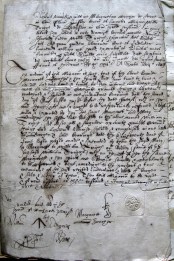
Secretary_hand_bond_1623
Secretary Hand.

As you might imagine, students of history often have to learn to decipher different writing styles in order access primary resources. The study of historical writing styles is called paleography.

There are a number of great resources for those interested in increasing their knowledge of old writing styles. First, you might like to check out Muriel St. Clare Byrne’s article, “Elizabethan Handwriting for Beginners.” You could also check out St. Andrews’ Read Me! tutorials on deciphering fourteenth through sixteenth century script. The British National Archives maintains a great series of documents (and a game!) to try your hand at reading old manuscripts.
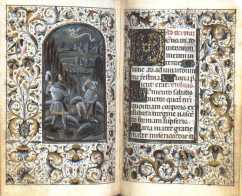
MilanBTCod470BookOfHours2FoliosAnnuncShepherdsDecortatedInit2
Book hand.

In SON, Diana uses a quill and ink to inscribe her name in her new book. Quills are specially-prepared feathers from large birds, such as geese or swans. Quills must be shaped and sharpened in order to write properly; an unprepared feather won’t hold sufficient ink, nor will its point deliver the kind of precise, well-shaped letters necessary to write in secretary or italic hand. If you felt inspired, you could buy yourself a quill and ink set and learn to write in secretary hand. This will prepare you either for a sixteenth century timewalk or for a new career in forging  manuscripts. Very useful indeed.

Discussions with Francoise about my wardrobe revealed my ignorance of common names for ordinary colors. “Goose-turd green” was familiar to me, but the peculiar shade of grizzled brown known as “rat hair” was not.

As we discussed yesterday, the strict observance of England’s sumptuary laws meant that only certain people in Tudor England wore certain fabrics, garments, and colors.

For example,

None shall wear any cloth of gold, tissue, nor fur of sables: except duchesses, marquises, and countesses in their gowns, kirtles, partlets, and sleeves; cloth of gold, silver, tinseled satin, silk, or cloth mixed or embroidered with gold or silver or pearl, saving silk mixed with gold or silver in linings of cowls, partlets, and sleeves: except all degrees above viscountesses, and viscountesses, baronesses, and other personages of like degrees in their kirtles and sleeves”

Elizabethan Clothing Laws for Women.

Accordingly, Francoise potentially saved Diana from committing a terrible (and potentially criminal) faux pas. Elizabethans liked to describe color in peculiar ways. Some particular favorites uncovered in my research include:

  • Puke – a dirty brown.
  • Murrey – mulberry.
  • Dead Spaniard – a “pale grayish tan.”
  • Milk and water – bluish white.
  • Maiden hair – bright tan.
  • Lustie-gallant – light red.
  • Maide’s blush – rose color.

For further reference, check out:

Phillips, Kim M. Masculinities and the Medieval English Sumptuary Laws. Gender & History. Vol. 19, no. 1 (2007). 

A Caudle for pains in the head

Set your water to boil. Beat two egge yolkes. Add white wine and beat some more. When the water boils, set it to cool, then add the wine and egge. Stirre as it boils again, adding saffron and honey.

In her commonplace book, Diana makes note of a home remedy meant to banish headache. It sounds foul. It’s also historically appropriate.

Medicine in the 16th century was… basic. Most people tried to manage their health with diet in order not to get sick in the first place; unlike you and me, however, they didn’t necessarily rely on green vegetables and good hydration. Instead, many relied on the humorous theory of body fluids and health. This bizarre theory held that good health required a balance between the four humors — blood, yellow bile, phlegm, and black bile. As you might have noticed, the colors of these humors correspond with the four colors of the stages of alchemy. As the Renaissance thinking went, your temperament was determined by an excess of one humor or another. Accordingly, you were supposed to eat foods that neutralized this humor and encouraged balance. This fascinating article from Shakespeare & Beyond tells you all sorts of things about eating according to the theory of the humors. Notably, the article does not tell you what to feed mischievous, jealous daemons or arrogant vampires.

For further reading, check out:

U.S. National Library of Medicine, Emotions and Disease: The Balance of Passions

Jacques, Jouanna. “Chapter Sixteen: The Legacy of the Hippocratic Treatise the Nature of Man,” Greek Medicine from Hippocrates to Galen: Selected Papers (2012). (JSTOR access). 

We covered Chapters 1-3 of SON in Episode 20, Elizabethan Vacation. Our friends at Daemons Discuss covered Chapters 1-2 in Take 26! The One with the Boys. Chapter 3 is in Take 27! The One with the Hag.

See you on November 4 in Chapter 4 of Shadow of Night!

Enjoying our real-time reading posts? Let us know by e-mailing us at chamomileandcloevcast@gmail.com, by tweeting us @chamomilenclove, or by joining our Facebook group, the Clovers.

Xox

Cait and Jen

Real Time Reading, Uncategorized

SON Real-Time Reading – November 1 – Chapters 1 and 2

dorota-dylka-416538-unsplash

unsplash-logodorota dylka

Welcome to the Real-Time Reading for Shadow of Night! Over the next couple of months, we’ll be sharing tidbits and observations from each chapter of SON as they happen in the book. The RTR is a great opportunity to spend some time musing on the book and its intricate details as they unfold in real time. Without further ado, let’s journey into 1590 with Matthew and Diana!

Chapter 1

We arrived in an undignified heap of witch and vampire.

In Chapter 1, Matthew and Diana step from Sarah and Em’s hop barn in 2010 New York into Matthew home in 1590, the Old Lodge. We first visited the Old Lodge in Chapter X of A Discovery of Witches.

Tipping my head back, I saw the ceiling — thickly plastered, coffered into squares, with a splashy red-and-white Tudor rose picked out in gilt on each recess.

“The roses were obligatory when the house was built,” Matthew commented drily. “I can’t stand them.”

220px-Tudor_Rose.svg

Matthew refers to the red-and-white heraldic emblem of the Tudor family, adopted at the end of the so-called War of the Roses to signify the unity of the royal houses of Lancaster (red rose) and York (white rose). The “War of the Roses” refers to a period of English civil war wherein the Lancaster and York families battled for the English throne. The war ended with the ascension of Henry VII, who married Elizabeth of York and thereby neatly eliminated the best surviving challenger for the English throne. Incorporating the rose into your decor or your livery during this period signaled your loyalty to the crown and the united Tudor dynasty.

At Matthew’s words, the young man dropped the paper to the table and pivoted, joy lighting his face. I’d seen that face before, on my paperback copy of Christopher Marlowe’s The Jew of Malta.

marlowe-possible-portrait-corpuschristi
“Putative Marlowe portrait.” 1585. Held by Corpus Christi College, Cambridge.

Diana likely refers to this alleged portrait of Christopher Marlowe, discovered by workmen in Corpus Christi College in 1953. Those who say that the portrait represents Marlowe point to his putative motto (quod me nutruit me destruit), his attendance at Corpus Christi on or about the date of the work, and the apparent age (21?) of the sitter. Detractors claim that the sitter’s costume is too fancy and would have violated England’s sumptuary laws and that Marlowe–notoriously short on cash–never could have afforded the luxury of a portrait. In the world of All Souls, I simply assume that Matthew paid for both the doublet and the portrait because he couldn’t help but humor Kit.

As a side note, the sumptuary laws of England are a fascinating topic for another time — they played a significant role in maintaining the strict Elizabethan social hierarchy and told every class of society what they could and could not wear. Speaking of class, status, and hierarchy…

“Why no beard? Have you been ill?”

OMG, you guys.

When we recorded our first SON episodes, I hadn’t done the research for these posts and therefore didn’t yet know that beards were a Big Deal in Elizabethan England. Did you know that the lack of a beard was associated with class, masculinity, and virility? The Elizabethan construct of masculinity used the beard as a token of manhood and a sign of strength separating women from men. (See Fisher, Will. The Renaissance Beard: Masculinity in Early Modern England. Renaissance Quarterly, Vol. 54, No. 1 (Spring 2001)). Elizabethan beards came in many shapes, styles, and colors, and there was apparently a market for prosthetic beards. Elizabethans also associated some beard shapes with professions, like the cathedral beard or the glover’s beard.

Elizabethans associated smooth cheeks with “dubious masculinity” and there is a theory that the strict performance of gender in the Elizabethan era stemmed from the existential challenge Elizabeth I’s reign posed to a patriarchal society. (See Dolan, Frances. “Gender and sexuality in early modern England” in Gender, Power, and Privilege in Early Modern Europe, Munns, J., and Richards, P., eds. (2003)). My whole point being that I believe that the beard gag running through the first few chapters of SON is essentially one long challenge to Matthew’s virility and social status and that it’s maybe a really intelligent penis joke that also has layers of meaning for the gender politics of SON and how Diana sharpens and complicates all of these gendered questions by bringing her 2010 sensibilities into the world of 1590.

It’s pretty good, guys.

Chapter 2

I asked Francoise a number of questions during the complicated process. Portraits of the period had led me to expect an unwieldly birdcage called a farthingale that would hold my skirts out at the hips, but Francoise explained that these were for more formal occasions.

Ah, the bum roll.

As you might have gathered from this chapter, Elizabethan women wore many, many layers of clothing. Elizabethan outfits often comprised multiple pieces that could be re-arranged and matched, such as bodices and sleeves. The average Elizabethan woman wore nine separate garments for formal dress, including smock, stockings, corset, farthingale and/or bum roll, petticoat, kirtle, forepart, partlet, gown, and sleeves. Everything under the petticoat gives structure to the outer garments and creates a fashionable silhouette on which to layer the more valuable and decorative outer garments. 

The farthingale Diana expects came to England via Spain, where the same garment is called a verdugado. Made of wood, the farthingale holds the skirts out in a pleasing bell or cone shape. The bum roll achieved a similar effect by using rolls of fabric to hold the skirts away from the body. Historians first found evidence of the bum roll in the accounts of Elizabeth I’s wardrobe from 1580. If you’d like to make a bum roll of your own, you may want to check out these instructions.

We’ll pick up on Chapter 3 of SON tomorrow, November 2. In the meantime, Deb’s post on Chapter 1 of SON can be found here. We covered Chapters 1-3 of SON in Episode 20, Elizabethan Vacation. Our friends at Daemons Discuss covered Chapters 1-2 in Take 26! The One with the Boys.

Follow us on Twitter at @chamomilenclove for real-time reading posts and join our Facebook group, the Clovers, for more in-depth discussion.

Until tomorrow,

Cait

Real Time Reading, Uncategorized

Real-Time Reading – 30-31 October – Chapters 41-43

elijah-o-donell-424398.jpgElijah O’Donell

Chapter 41

“Under Marcus’s leadership.” Matthew raised his half-full wineglass. “To Marcus, Nathaniel, and Hamish. Honor and long life.” 

In the Real-Time Reading Companion, Deb reveals that the soundtrack for Chapter 41 is Emmylou Harris’s “The Pearl.”

The lyrics are as follows:

O the dragons are gonna fly tonight
They’re circling low and inside tonight
It’s another round in the losing fight
Out along the great divide tonight

We are aging soldiers in an ancient war
Seeking out some half remembered shore
We drink our fill and still we thirst for more
Asking if there’s no heaven what is this hunger for?

Our path is worn our feet are poorly shod
We lift up our prayer against the odds
And fear the silence is the voice of God

And we cry Allelujah Allelujah
We cry Allelujah

Sorrow is constant and the joys are brief
The seasons come and bring no sweet relief
Time is a brutal but a careless theif
Who takes our lot but leaves behind the grief

It is the heart that kills us in the end
Just one more old broken bone that cannot mend
As it was now and ever shall be amen

And we cry Allelujah Allelujah
We cry Allelujah

So there’ll be no guiding light for you and me
We are not sailors lost out on the sea
We were always headed toward eternity
Hoping for a glimpse of Gaililee

Like falling stars from the universe we are hurled
Down through the long loneliness of the world
Until we behold the pain become the pearl

Cryin? Allelujah Allelujah
We cry Allelujah

And we cry Allelujah Allelujah
We cry Allelujah

https://www.youtube.com/watch?v=UxsdKrfnM7M

I can’t actually seems to track down the “On This Day” post for 30 October, but I’d be deeply in your debt if you could pass it on.

Chapter 42

“My mother used to wear it all the time,” Matthew said, picking it up between his thumb and index finger. “She called it her scribble ring because she could write on glass with the point of the diamond.” 

In Deb’s post for Chapter 42, she talks about how she doesn’t like to make things up and prefers instead to draw from real-life objects when writing about her characters. She relates that she gets tons of reader questions about Ysabeau’s “scribble” ring. If you’re so inclined, you can buy a copy here.

The ring depicted in the post is a gimmal/gimmel ring from the collection of the Victoria and Albert Museum in London. They are so called because the Latin word for twin is gemellus.

1414770967495

The rings became popular in the 16th and 17th centuries and were often used as betrothal rings: wear one part of the ring at engagement, another after your ceremony. There are several fine specimens of ancient gimme rings in the Zucker collection in Baltimore. Many of the rings have traditional motifs, like hearts and hands, as symbols of love and fidelity.


Another scent–spicy and sweet–joined with the lavender, and I saw a tree laden with heavy, golden fruit. 

Quince is a relative of both the apple and the pear and bears some similarity to both. It’s a hardy tree, flourishing in many climates despite its origins in Afghanistan and Iran. In ancient times, it was associated with the goddess Aphrodite. They’re difficult to eat raw–hard and very tart–but I happen to love them. Image result for quince pictures

Curious about quince? Here’s a few things to get you started using them:

Quince: The Tough Fall Fruit With a Secret Reward 

Martha Stewart.com: Quince Recipes

Chapter 43

She hunters makes; and of that substance hounds

Whose mouths deafe heaven, and furrow earth with wounds,

And marvaile not a Nimphe so rich in grace, 

To hounds rude pursuits should be given in chase.

The verse really does exist – it comes from George Chapman’s “Shadow of Night.” The poem – published in 1594 – is Chapman’s earliest significant work of verse.7386975594_fe86594f39_b It treats the “theme of inspired melancholy,” a state of “deep and searching thought.”


For us, of course, it summons visions of Diana, the Goddess, and   Matthew’s chess set.

With Matthew and Diana safely in the 16th century, our 2017 Real-Time Reading of A Discovery of Witches comes to a close. The Daemons cover Chapters 39-43 in Take 24!; they’ll start their chapter discussions for Shadow of Night very, very soon.

Thank you for joining me for this incredible journey; it’s been great fun and I can’t wait to see what you all have to say about the chapters as we approach them again during our discussions.

If you have comments, questions, concerns, etc., please feel free to get in touch via @chamomilenclove on Twitter or by e-mail at chamomileandclovecast@gmail.com. We couldn’t ask for a better, kinder, smarter, more enthusiastic audience; you make this little podcaster’s heart sing.

Happy Halloween, happy Samhain, and thank you for playing along with this year’s real-time reading.

xoxo

Cait


Real Time Reading, Uncategorized

Real-Time Reading – 29 October – Chapter 40

aaron-burden-36648Aaron Burden

Chapter 40

“What do you think?” Sophie asked, turning the pumpkin. It had the hollow eyes, arched eyebrows, and gaping mouth of all Halloween pumpkins, but she had transformed the usual features into something remarkable. 

Once upon a time, when the tradition of carving vegetables on All Hallow’s Eve began, the ancient Celts cut up turnips rather than pumpkins. The tradition wards off evil spirits. There’s an old Irish story about Stingy Jack, a man who tricked the Devil and wasn’t allowed into either heaven or hell upon death. Instead, he roamed the earth forever with an ember burning in a carved-out turnip. He thus became Jack o’ the Lantern.

“Smallpox?” They’d stopped giving smallpox vaccines to schoolchildren a few years before I was born. That meant Sophie and Nathanial hadn’t been immunized, either.

Smallpox is an ancient disease–there are apparently traces of a smallpox-like rash on mummies who died 3000 years ago–which spread across the globe with human trade and travel. Three out of every ten people who contracted the disease died; those who survived had severe scars.

As Matthew tells Diana, the vaccine for smallpox was developed by Edward Jenner, who noted that milkmaids who had been exposed to cowpox did not get smallpox after being exposed to the disease. In 1959, the World Health Organization began a global campaign to eradicate smallpox. It didn’t succeed until 1977; it required thousands of high-quality, free vaccines and the cooperation of thousands of communities. The CDC profiled the two last sufferers of smallpox, one in Asia and one in Africa. If you care to read further, this National Geographic article has excellent historical information on smallpox and a selection of photographs.

The hop barn still held the sweet aroma of long-ago harvests.

Once upon a time, upstate New York had a thriving hops industry. Hops are one of the key ingredients in brewing beer and require very specific growing conditions to thrive. In 1855, New York state grew over three million pounds of hops. Then, a combination of deadly fungus and Prohibition destroyed the industry and left the state’s hop barns standing empty. In the present day, American hops are grown primarily in the Pacific Northwest. LI_Hops_9_15

Proper hop barns have a special shape to encourage the drying of hops, which grow in long vines. There are still a couple of farmers trying to make a go of hop farming in New York; the crop is lucrative, and the world’s supply is limited.

“We’re a proper conventicle now, Sarah,” Sophie observed as she reached for the pyramid of freshly baked cookies on the kitchen island. 

The word “conventicle” emerged in fifteenth and sixteenth century England to describe groups of dissenters who met in secret to protest the acts of Parliament that forced people to attend the Church of England. There are also historical conventicles on Scotland, Finland, Germany, and the United States.

“Tiger, tiger, burning bright / In the forests of the night,” Hamish said, quoting William Blake. 

In 1794, William Blake wrote “The Tyger,” a poem said to represent the “duality between aesthetic beauty and primal ferocity.” Blake’s poetry explores duality and contrast as a means of understanding humanity. Should you be interested, there’s some analysis of the poem here.

You can find Deb’s post on Chapter 40 here. The Daemons’ recently-published episode on Chapters 39-43 is here.

See you tomorrow!

Best,

Cait


Real Time Reading, Uncategorized

Real-Time Reading – 22-28 October – Chapter 39

sam-burriss-412574Sam Burriss

Chapter 39

After my tea, Sarah made me her famous scrambled eggs. They were laden with onions, mushrooms, and cheese and topped with a spoonful of salsa. She put a steaming plate before me.

Because fluffy, shiny scrambled eggs are one of my favorite things, I happily provide you with this How To video from the Kitchn. Much later in the series, I am pretty sure that Amira serves Diana an Indian riff on scrambled eggs similar to Egg Burji, which jazzes up your ordinary eggs with onion, ginger, chiles, tomato, turmeric, and cilantro. Also highly recommended for your near-death-recovery needs.

“The house’s most legendary feats happened around my thirteenth birthday,” I remembered with a grin. “It came up with a record four bedrooms and a Victorian parlor set.”

“And twenty-four place settings of Blue Willow china,” Em recalled.

Deb’s interior design muse strikes again!

Blue_Willow_china,_c._late_1800s,_Lahaina_Heritage_Museum
English Blue Willow

There’s plenty of Blue Willow china available on eBay. The pattern is a distinctive and ornate form of chinoiserie, or faux Chinese, decorative art. It became popular in the 18th century in England when English designers began copying and interpreting the motifs of traditional Chinese ceremics. The Willow pattern in particular may have been created around 1790. It features willow trees, a pavilion or pagoda, a water feature, and sometimes boats or people. According to Wikipedia, there’s a story of–you guessed it–star-crossed lovers associated with the pattern that evolved into a comic opera. Here’s the fable:

Once there was a wealthy Mandarin, who had a beautiful daughter (Koong-se). She had fallen in love with her father’s humble accounting assistant (Chang), angering her father. (It was inappropriate for them to marry due to their difference in social class.) He dismissed the young man and built a high fence around his house to keep the lovers apart. The Mandarin was planning for his daughter to marry a powerful Duke. The Duke arrived by boat to claim his bride, bearing a box of jewels as a gift. The wedding was to take place on the day the blossom fell from the willow tree.

On the eve of the daughter’s wedding to the Duke, the young accountant, disguised as a servant, slipped into the palace unnoticed. As the lovers escaped with the jewels, the alarm was raised.

XLVIII:XI:C.b.n.05.

They ran over a bridge, chased by the Mandarin, whip in hand. They eventually escaped on the Duke’s ship to the safety of a secluded island, where they lived happily for years. But one day, the Duke learned of their refuge. Hungry for revenge, he sent soldiers, who captured the lovers and put them to death. The gods, moved by their plight, transformed the lovers into a pair of doves (possibly a later addition to the tale, since the birds do not appear on the earliest willow pattern plates).

It is now my dream to write a comic opera based on a china pattern.

“It’s not a particular place I have in mind,” Matthew said cryptically. “We’re going to hide Diana in time.”

Aside from offering nearly limitless narrative potential, the idea of time travel is also scientifically fascinating.

Einstein’s special and general theories of relativity suggest that there might be potential for traveling forward in time if we could travel faster than the speed of light. That isn’t likely at all. If, however, time and space bend around mass, there’s a possibility that wormholes “could connect otherwise very distant parts of the universe.” In theory, if there are wormholes, they have probably existed since the Big Bang and would offer only limited opportunities to travel between points in time and space.

This Physics.org article suggests that Kip Thorne of Caltech did some theoretical work on general relativity and quantum physics related to time travel that might eliminate the “grandfather paradox,” i.e., the entire plot of Diana Gabaldon’s Dragonfly in Amber.
This article from Newsweek talks about how one might make the Traversable Acausal Retrograde Domain in Spactime device (Dr. Who’s TARDIS) work. The model researchers used treats the three spatial dimensions and the fourth dimension, time, as one and then bends them in a circle. Then the “box” device just, er, changes the circle. It’s all very mathematical and theoretical and they seem very smart.

“Didn’t you get this off a yellow-fever victim?” Matthew asked, fingering the tooth.

“In New Orleans,” Marcus replied. “The epidemic of 1819.”

New Orleans had a series of yellow fever epidemics from 1817-1905. In that time, more than 41,000 people died. In the first yellow fever epidemic, the mortality rate for Mobile, New Orleans, and Savannah was almost 50%. Yellow fever is carried by mosquitos and results in a viral infection in the liver. The symptoms are foul–headache, muscle soreness, fever, vomiting, dizziness, jaundice, organ failure, internal hemorrhage, delirium, and seizures–and there’s no known cure.  During the worst yellow fever “season” in the history of New Orleans, 29,120 people contracted the disease. Once upon a time, they “vaccinated” people against yellow fever by feeding them mercury. It was… unsuccessful. Now, there’s a real vaccine. You might need it if you travel to certain parts of Africa or South America where the disease hasn’t been eradicated, yet.

“Who knows? But don’t worry. It’s happened to everybody. You drive to work and don’t remember how you got there.”

As it turns out, Sarah isn’t entirely wrong–but it has less to do with time travel than it does how your brain processes information. Apparently, the longer your brain takes to process information (especially new information), the longer time feels. Ordinary, regular things–like your commute–are familiar and your brain essentially fast-forwards through them. In order to fix this and stay present, Lifehacker.com recommends “recalibrating your reality.” Let me know if it works.

In this chapter, we learn that vampires like candied nuts. If you’re looking to try them at home, I collected a few recipes for you:

Cinnamon Vanilla Glazed Walnuts

Roasted Cinnamon Sugar Candied Nuts

Sweet and Spicy Maple Pecans

I will be over here. Eating all of the Vanilla Cardamom Candied Pecans I can possibly make.

“Rue,” I said, recognizing it from Marthe’s tea.

“Clover, broom, knotweed, and slippery elm bark, too, from the smell of it.” Sarah gave the air a good sniff. “That poppet was made to draw someone–Diana, presumably–but it’s got a protection smell on it, too.

We already talked about herbs a bit, but I think it bears re-visiting.

Rue is known as the “herb of grace” and is associated with sorrow, regret, and compassion. Clover is a symbol of vitality. Knotweed symbolises binding and health. Slippery elm reportedly “stops gossip.” I have no idea what this means.

“How the hell did one of my mother’s earrings get into Bridget Bishop’s poppet?” Matthew’s face was back to that pasty gray color.

Earrings are one of the oldest forms of body ornament. Pearls are a symbol of wealth and power; a matched pair like Ysabeau’s would have been nearly priceless in an era before the cultivation of pearls. Image result for pearl earring 16th centuryIn the legend of Antony and Cleopatra, Cleopatra tells Antony that she will serve him the most expensive dinner in history. At table, Cleopatra crushes a pearl earring into a goblet of wine and drinks it. Antony declines to drink the matching pearl and declares that she has won. This story, fittingly, reminds me of Ysabeau.

Deb’s post on 22 October is here.

If you’d like to talk about this chapter–or any others–you can find us at @chamomilenclove on Twitter or at chamomileandclovecast@gmail.com.

xox

Cait