Real Time Reading

Shadow of Night Real-Time Reading – 11 March-22 March – Chapter 27 (Part I)

unsplash-logoAnthony DELANOIX

Hello, darlings! We finally made it to Prague, which means we’re diving headlong into Section IV of the Real-Time Reading of Shadow of Night. This chapter is a monster, so I’m dividing it in two parts between this week and next.

After we’d lived out of saddlebags and a single shared trunk for weeks, our belongings had arrived three days after we did at the tall, narrow house perched on the steep avenue leading to Prague Castle known as Sporrengasse.

Try as I might, I couldn’t find a street in modern Prague called Sporrengasse. I assume that it was likely renamed something lovely and Czech that isn’t mentioned in the pages of Shadow of Night. Nonetheless, I had a very pleasant Google Maps street view wander through the neighborhood of Mala Strana. Mala Strana, or the “Little Side of the River,” is a district in Prague dominated by the city’s German and Italian citizens. The neighborhood has mostly Baroque architecture after a series of fires destroyed the original buildings. Even today, Mala Strana is one of the most popular neighborhoods for tourists because of its “charming” cobbled streets and cluster of cultural sights. After researching, I have marked out Mlýnská Kavárna for my next visit because it boasts Czech beer and freshly-baked bread. Yes, please.

“Is that… a Bosch?”

Oh, Bosch. You were such an odd duck. Hieronymus Bosch (1450-1516) was a Dutch artist famous for his colorful, bizarre, and exquisitely detailed triptychs. Apparently, we know very little about Bosch — he did not leave behind any indication as to the meaning of his work, so we’re essentially left to goggle at it and come to our own conclusions.
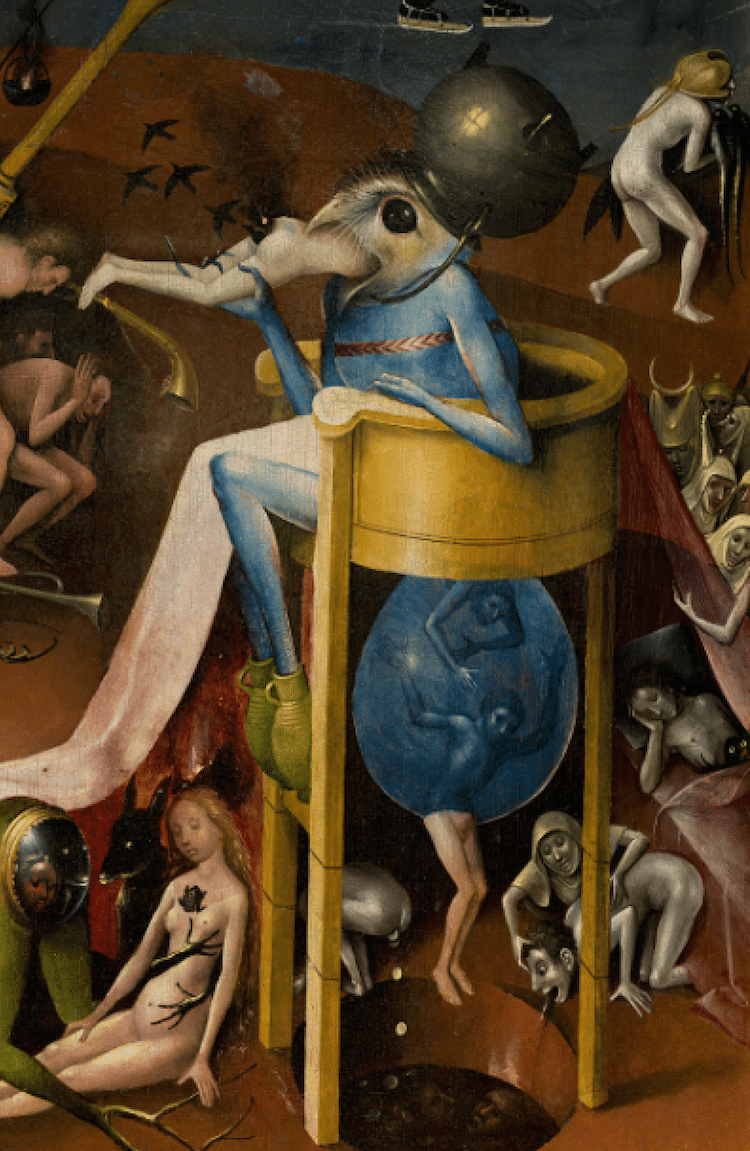
Detail, Garden of Earthly Delights

Artstory describes him as a “visionary apocalyptic painter;” it’s the best short description of his work I’ve ever read, so I am keeping it. Bosch was the first painter to introduce surreal and fantastical imagery into his paintings; the rest of Western artwork from this period is either very religious or very realistic.

You can explore Bosch’s oeuvre using this fascinating series of projects by ColourLex, which analyzes works of art by the pigments used to create them. There’s a couple of interesting choices here, including the Audio Experience of Bosch’s Ship of Fools and a close exploration of The Garden of Earthly Delights.

Oh wait. Remember when I told you guys that I went to dance performance based on the Garden of Earthly Delights and there were artists throwing potatoes? I found a video. The potatoes appear at 0:18. You’re welcome.

I bet you thought I made that up.

“Rudolf hasn’t seen me. Rumor has it that Kelley is in the uppermost reaches of the Powder Tower blowing up alembics and God-knows-what-else.”

In the real historical timeline, Matthew and Diana arrive in Prague right as Edward Kelley’s star began to fade in the court of Rudolf II. Kelley first traveled to the Continent from England in the company of John Dee, another famous alchemist. Kelley and Dee made all sorts of mischief together (and people threatened to throw them out of windows) right up until Kelley told Dee that his alchemical spirit guide required them to swap their wives. Right around the spring of 1590, Rudolf II became frustrated that Kelley could not produce the Philosopher’s Stone. He knighted him to encourage his progress, then imprisoned him after a duel to make him work harder. Kelley attempted to escape by jumping out the window — an escapade which required the amputation of his leg. This happened again several years later and Kelley lost the use of his remaining leg, too. I am sensing a pattern. If you want to know more, check out the Alchemy Podcast’s episode on Kelley. On a related note, did you know there was an opera about John Dee? Wonders never cease.

The Powder Tower, or Prašná brána, was built in 1475, is the beginning of the Coronation Route to Prague Castle.

“Why is the handwriting so ornate?” I wondered.

“The Hoefnagels have arrived from Vienna and have nothing to occupy their time. The fancier the handwriting, the better, as far as his Majesty is concerned,” Pierre replied cryptically.

According to the Getty Museum, the invention of the modern printing press made it more common for people to own books, noble collectors like the Holy Roman Emperor turned to hand-made works of calligraphy for their rarity and beauty.

In 1590 or so, Rudolf II commissioned Josef Hoefnagel to illustrate a book of calligraphy written by Georg Bocskay called Mira calligraphiae monumenta. You can visit this work at the Getty, or via their website. The image on the left demonstrates Hoefnagel’s incredible skill for texture and detail in plant and insect life. The calligraphy in the book is stunning, as are the images.

Most impressive of all? The fact that Hoefnagel and Bocskay never met.

“I told you to hook him with Titian’s great canvas of Venus that Grandfather took off King Philip’s hands when his wife objected to it,” Gallowglass observed. “Like his uncle, Rudolf has always been unduly fond of redheads. And saucy pictures.”

Titian painted his famous Venus of Urbino in 1538. The original hangs in the Uffizi in Florence. No wonder Philippe had his hands on it.

“Among my people it’s a great compliment to be likened to a raven. I’ll be Muninn, and Matthew we’ll call Huginn. Your name will be Gondul, Auntie. You’ll make a fine Valkyrie.”

Huginn and Muninn are the two ravens who assist the god Odin. Every morning, the two ravens fly from Odin to gather information about the Norse World and report back to him at night. Gondul, a valkyrie warrior, decided who would dwell with Odin in Valhalla from amongst the fallen on the battlefield. In other myths, she may or may not have started a war.

I’ll see you again next Monday for Part II of Chapter 27 of Shadow of Night. In the meantime, you can find us in our Facebook group or e-mail us at chamomileandclovecast@gmail.com. If you want to find the rest of the Real-Time Reading posts, you can check out our Episode List.

Until next week,

xox

Cait

Real Time Reading

Shadow of Night Real-Time Reading – 1 February – Chapter 26

unsplash-logoShai Pal

Verin de Clermont sat in her Berlin home and stared down at the newspaper in disbelief.

“Verin” derives from the English and German “Verena” or may have Slavic origins. It means either “Faith” or “Truthful.”

“What is it, Schatz?” Ernst Neumann put a glass of wine in front of his wife. She looked far too serious for a Monday night.

Schatz is a German term of endearment meaning “gem, jewel, or treasure.” You could also call your beloved Schatzen or or Schatzi, both of which mean “little treasure.” If you want to branch out, you can use Mauschen/Mausi (little mouse), Haschen/Hasi (little bunny), Barchen (little bear), or my personal favorite (and oft-heard in my house), Schecke or Schnecken (little snail).

“Where are you, Gallowglass?” Her nephew was a drifter. In the past he’d sent postcards with nothing but a phone number on them from whatever stretch of road he was traveling at the moment: the autobahn in Germany, Route 66 in the States, Trollstigen in Norway, the Guoliang Tunnel Road in China.

The “autobahn” refers to Germany’s controlled-access highway system.

While unregulated sections of the autobahn have no speed limit, there are increased penalties for causing accidents at high speeds and many areas impose speed limits due to hazards like construction or substandard road surfaces.

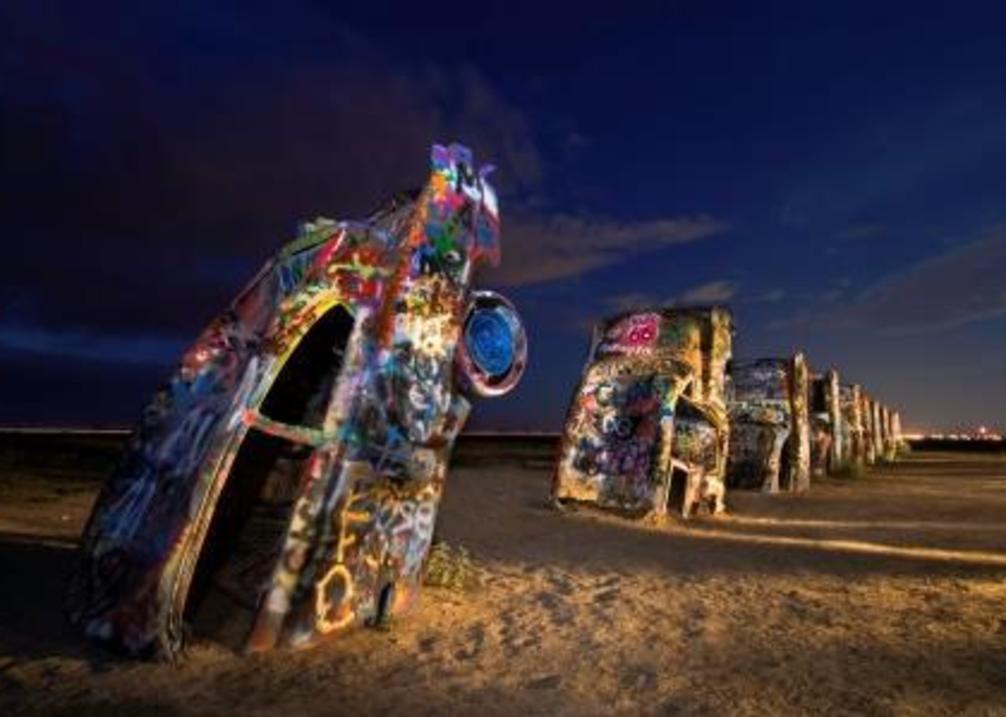
Established 1926, Route 66 is one of the original highways in the US Highway System. The original route of Route 66 stretched from Chicago, Illinois, to Santa Monica, California, passing through Missouri, Kansas, Oklahoma, Texas, New Mexico, and Arizona on the way. The original route no longer exists, but you can still drive many of its sections by following a turn-by-turn map.

Cadillac Ranch, from the Amarillo Visitor’s Council

In 1938, Route 66 became the first US highway to be completely paved. It’s also mostly flat, which made it popular with truckers and tourists heading west. During its heyday, Route 66 had hundreds of points of interest dotting its length — including the Cadillac Ranch (Amarillo, Texas), the town of Santa Fe, New Mexico, Petrified Forest National Park (Holbrook, Arizona), and the Santa Monica Pier (Los Angeles, California). The National Parks Service maintains a very detailed map of Route 66 Historic Sites broken down by groups of states along the way.

The Trollstigen, or Troll’s Road, runs from Geiranger to Stigrora in Northwest Norway. It’s a popular tourist attraction with eleven steep turns up the mountainside and beautiful views.

The mountains surrounding Trollstigen reach an altitude of over 1600m above sea-level. The area is full of stunning hiking opportunities and gorgeous fjords.

The Guoliang Tunnel merits an entry in the Atlas Obscura, so you know it must be odd. The road–dug into the side of a mountain at the cost of several lives–connects the village of Guoliang to the outside world, including the larger municipal area of Zhengzhou. Because the villagers followed the path of least resistance while tunneling the road, it dips and winds its way through the rock and is only wide enough for one car to pass through at a time. The video (embedded below) gives me hives.

“Where in the hell is Warrnambool”? Verin demanded.

“Australia,” Ernst and Gallowglass said at the same time.

Warrnambool is a city along Australia’s Great Ocean Road, which follows the southern coast of Australia and has a number of points of interest, including beaches, whale-watching sites, wineries, fisheries, and Aboriginal cultural landmarks. On this snowy, drizzly day in the national capital region, it sounds AMAZING. Oh, also — Warrnambool has a Cheese and Butter Museum listed on its “things to do” list. I am packing my bags as we speak.

“The number” had been generated in the earliest years of the telephone. Philippe had picked it: 917, for Ysabeau’s birthday in September.

17 September is a busy day in history: in 1630, it’s the date of the founding of the city of Boston, Massachusetts. In 1787, it’s the day that the US Constitution was signed in Philadelphia. In 1849, it’s the day that Harriet Tubman escaped from slavery. In 1954, it was the publication date for Lord of the Flies. In 2011, it was the day the Occupy Wall Street movement began.

Nyd, the rune for absence and desire. Gallowglass dipped his hand into the bag again to better understand what he wanted the future to hold.

“Rune” means “holding a secret.” Viking age civilizations used runes to predict the future or obtain answers from the oracle. In addition to serving as a “magical” system and potential system of divination, runes constituted a writing system in several countries that form part of modern-day Scandinavia. You can now buy rune stones on Amazon, though they may lack the historical and sentimental value of those Gallowglass carries.

As Deb points out in the Real-Time Reading Companion, Gallowglass has the last word until we re-join Matthew and Diana upon their arrival in Prague in March. Deb thinks of this song, Circa Paleo’s “The Gael” as “Gallowglass’s Theme.”

If you like what we do, please consider supporting us on Patreon. You can also find us on Facebook as the Chamomile & Clove Clovers.

If you’re suffering from #Witchdrawal, consider joining us tomorrow (2 February 2019) as we live-tweet Episode 1×03 of A Discovery of Witches TV at 4:30 PM Pacific/7:30 PM Eastern/12:30 AM GMT using the hashtag #ccalchemy. We’ve had a killer time live-tweeting Episodes 1×01 and 1×02 and we’d love for you to join us. Follow us @chamomilenclove on Twitter for updates. If you have questions, comments, or thoughts, send us a note at chamomileandclovecast@gmail.com. We’d love to hear from you!

xoxox

Cait and Jen

Real Time Reading

Shadow of Night Real-Time Reading – 28-30 January – Chapter 25

unsplash-logohowling red

“I believe your husband and his friends call me the Old Fox. I am also, for my sins, the lord high treasurer.”

William Cecil, 1st Baron Burghley, lived from 1520-1598 and served as a primary advisor to Queen Elizabeth I. As a cautious and loyal advisor to the throne, the queen nicknamed Cecil “Spirit.” She had an apparent passion for nicknames and reportedly called one of her French suitors her “frog.”

After the death of Francis Walsingham, Cecil became the head of Elizabeth’s intricate spy network aimed at discovering (and squashing) Catholic plots against the queen.

In the text of Shadow of Night, Diana has every reason to be nervous about the appearance of Lord Burghley — after all, she knows that Matthew is in England as a Catholic spy on behalf of the de Clermonts. Lord Burghley did not believe in religious toleration — he believed that England “could never be in safety where there was a toleration of two religions. For there is no enmity so great as that for religion; and therefore they that differ in the service of their God can never agree in the service of their country.” 

The little snippet of Latin Lord Burghley quotes to Diana (Vanitatis vanitatum, omnis vanitas) comes from the Vulgate translation of Ecclesiastes 1:2, a verse which translates as “Vanity, vanity, everything vanity.” It’s a curious bit of verse for a Protestant, as it comes from the official version of the Latin Bible dating from the 4th century.

If you’re interested in Lord Burghley as a spymaster, there’s a current BBC series airing on PBS that looks pretty interesting.

“Because if we are not in the audience chamber at Richmond Palace by two in the afternoon tomorrow, Elizabeth will arrest us both.”

Going to court in Tudor England was no small thing. First of all, the Tudor palaces were explicitly designed to restrict access to the monarchy and channel people of different rank into appropriate spaces. Because only the most important (and affluent) people made it into the presence of the king or queen, it paid to appear in court dressed in the finest clothing money could buy. In Tudor times, proximity to the king or queen was the quickest way to attain favor–and thereby improve your title and fortune. However, if Elizabeth I felt that you slighted, betrayed, or otherwise disobeyed her, the consequences could be brutal. Court was complicated, political, and highly performative.

In Shadow of Night, Elizabeth I’s court is located at Richmond Palace, the lost palace of the Tudor monarchy. Henry VII died in the palace and it became Elizabeth I’s favorite — she died there in 1603 and her body made the journey to Westminister Abbey from its gates. In the mid-seventeenth century, after the execution of Charles I, Oliver Cromwell and his administration systematically stripped the palace until only a few bits and pieces remained. You can still visit the site of Richmond Palace in southwest London today.

“And silver and black are the queen’s colors. That’s why Walter is always wearing them,” Mary explained, smoothing the puffed sleeves.

Elizabeth I had a vast and impressive wardrobe. As she grew older, she apparently leaned into the image of herself as the Virgin Queen and preferred to dress in black, white, and silver — colors she believed represented purity and virginity. Throughout Elizabeth’s reign, England remained under strict sumptuary laws — Elizabeth I believed that her courtiers should dress according to (but not exceeding) their rank. This is why Elizabeth has a bit of a fit when she notices Diana’s borrowed ostrich feather fan — a luxury restricted to gentlemen and above by the sumptuary laws. Fans in particular were a symbol of wealth, and fixed fans were a bit of A THING for Elizabeth I (you can see all of her fixed fans in her portraits here). Ostrich feathers came into fashion in England in 1552 and remained popular for the rest of the sixteenth century.

Three days later on the feast of St. Brigid, we set sail on our long journey to see the Holy Roman Emperor, find a treacherous English daemon, and, at long last, catch a glimpse of Ashmole 782.

The feast of St. Brigid takes place on 1 February and marks the Celtic festival of Imbolc, the beginning of spring. Brigid is the patron saint of babies, blacksmiths, cattle farmers, midwives, mariners, milkmaids, and poets. After her death, St. Brigid was reportedly buried in the Kildare Cathedral — but many of her relics were destroyed in the sixteenth century during Lord Grey’s deputyship of Ireland. In a funny little historical twist, St. Brigid’s head was presented to the Society of Jesus in Lisbon by none other than our buddy Emperor Rudolf II. We’ll talk about him PLENTY in the coming weeks — don’t you worry.

We hope you’re enjoying the Real-Time Reading of Shadow of Night. If you like what we do, consider supporting us on Patreon or joining our Facebook group, the Chamomile & Clove Clovers. As always, you can find us on Twitter @chamomilenclove or e-mail us at chamomileandclovecast@gmail.com. We talked about this chapter and the end of Section III in Episode 31 — Full Elizabethan.

Until we see Verin in Berlin, take care of yourselves.

xoxo

Cait

Real Time Reading

Shadow of Night Real-Time Reading – Chapter 24 – January 26

unsplash-logoClarisse Meyer

Today, we spend a bit of time with Goody Alsop and take a field trip to Mortlake in search of Ashmole 782. Get your familiars in hand and let’s get moving.

“That your firedrake broke free is merely a symptom of a much more serious problem.” Goody Alsop extended a bunch of brightly colored silken strands, knotted together at the top. The ends flowed free like the ribbons on a maypole and numbered nine in all, in shades of red, white, black, silver, gold, green, brown, blue, and yellow.

As near as I can tell from (admittedly dubious) internet research into witchcraft, the weaver’s cords in the All Souls Trilogy closely resemble the “Witch’s Ladder,” a tool for spell casting that relies on knotted cords to “store” and concentrate a spell’s power. An internet search for color symbolism in modern Wicca suggests the following meanings for the colors in Diana’s cords:

  • White – purity, healing
  • Red – strength, luck, protection, vitality, desire
  • Brown – nature, natural wisdom
  • Yellow – learning, happiness, completeness
  • Green – prosperity, fertility, romance, friendship, harmony
  • Blue – idealism, wealth
  • Black – new beginnings, the afterlife
  • Silver – vision and intuition
  • Gold – integrity, happiness, mental strength

I would be curious to see if any of our pagan listeners have other thoughts — the text certainly suggests that some colors mean something slightly different in the world of All Souls, but I’d be interested to hear what other people think as we go along.

My knot-making skills were still clumsy, but I found this part of weaving oddly soothing. When I practiced the elaborate twisting and crossings with ordinary string, the result was something reminiscent of ancient Celtic knotwork.

Celtic knotwork is a form of stylized graphical representation that relies on interlace patterns to ornament everything from early manuscripts to jewelry. The interlace style of decoration likely came from the Romans during the third and fourth centuries C.E., but the influence of Christianity led the art form from its spirals, step patterns, and key work into elaborate illustrations of plants, animals, and biblical verses. The knotwork we associate with Ireland likely originated in Italy before migrating to the British Isles… and becoming part of popular tattoo designs in the 1970s. If you’re inclined to learn to draw basic knotwork, calligraphy-skills.com has a pretty good tutorial.

Whether for propriety’s sake or to avoid his disorderly brood, Dr. Dee was strolling in his brick-walled garden as it it were high summer and not the end of January. He was wearing the black robes of a scholar, and a tight-fitting hood covered his head and extended down his neck, topped with a flat cap.

Ah, John Dee. A complicated early modern figure whose work contributed to mathematics, astronomy, navigation, and philosophy, John Dee was a noted collector of books and a student of the occult. Did you know that he signed his work 007? This odd detail reportedly inspired Ian Fleming, the creator of James Bond. Although Dr. Dee had one of the largest libraries assembled in 16th century England, his collection scattered after his death — in 2016, the Royal College of Physicians assembled an exhibit that brought 47 of the 100 surviving manuscripts together again for the first time. According to this article, Dee’s 4,000 or so manuscripts were raided after his death — and later owners tried to obscure the origins of their stolen books by bleaching or erasing Dee’s nameplate. You can explore a digital manuscript of the contents of Dr. Dee’s library here.

You know what’s fun about Dr. Dee and her library and this exhibit? Our own Deb gave a talk on Dee in 2016.

If you’ve watched A Discovery of Witches 1×01, the parallels between this presentation and Diana’s opening scene are pretty great. It’s a very good lecture — and I’d say that even if I didn’t love Deb.

We’ll do a bit more historical tourism in London on 28 January before we head to Prague. If you like the Real-Time Reading, consider following us on Twitter @chamomilenclove. You can also e-mail us at chamomileandclovecast@gmail.com or find us on Facebook. If you like what we do, consider becoming one of our Patrons!

See you soon,

Cait

Real Time Reading

Shadow of Night Real-Time Reading – 18-22 January – Chapters 22-23

unsplash-logoJose Llamas

After a brief hiatus, we’re ready to roll right into Chapters 22-23 of Shadow of Night — we meet the Rede, have a run-in with Hubbard, and spend a little time with our good friend Mary Sidney.

“Are there any men among the Rede, Goody Alsop?” I asked, taking her elbow.

“Only a handful remain. All the young wizards have gone off to university to study natural philosophy.”

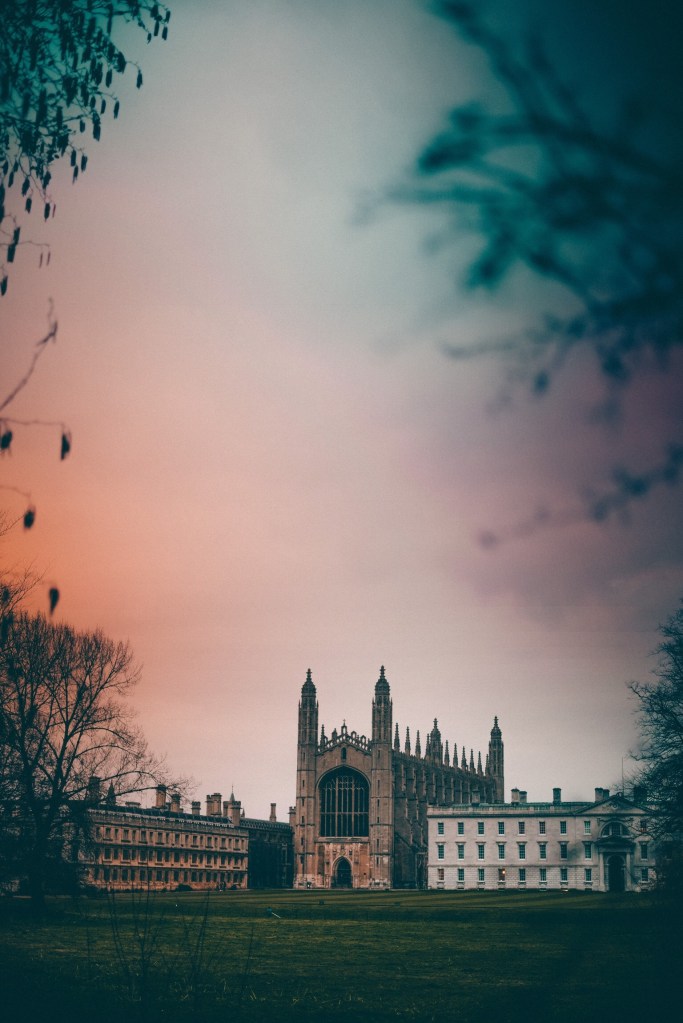
During the Renaissance, “natural philosophy” encompassed much of what we consider the physical sciences–physics, geology, biology, etc.–as well as theological and philosophical questions about the nature of the universe. Often described as the link between Aristotelian models of theoretical science and the experimentation of the seventeenth and eighteenth centuries, the study of natural philosophy in universities arose at a time when society demanded a greater number of educated citizens to fill its bureaucracies and administrative posts. Between 1500 and 1625, the number of universities in Europe nearly doubled. Oxford and Cambridge came into being in the 11th century, but the two universities established new colleges during the Renaissance to cope with the influx of students. Brasenose, Christ Church, Corpus Christi, Jesus, St. John’s, and Trinity Colleges were all established at Oxford in the 16th century. Notably, the Renaissance saw a change in the nature of scholarship at universities — students and professors began to add to the body of literature with commentaries and histories of their own rather than relying on classical texts. Should you be interested in learning more about the Renaissance from Oxford faculty and friends, podcasts.ox.ac.uk has you covered.

“Sex and dominance. It’s what modern humans think vampire relationships are all about,” I said. “Their stories are full of crazed, alpha-male vampires throwing women over their shoulders before dragging them off for dinner and a date.”

While people love to talk about the parallels between A Discovery of Witches and Twilight, our friend Jean at Daemons Discuss is right — the romantic vampire image dates to the 19th century and the height of the Victorian period. While there’s certainly debate about how frank Victorians were (or could be) about their sex lives, much of the evidence we have from the literature of the upper classes suggests that sex was taboo. While the idea of Victorians covering “sexy” table legs is a myth, there is evidence from the testimony of Victorians (letters, diaries, etc.) that people were “emotionally frigid” and “factually uninformed” about sex. The concern over syphilis also led to a bit of paranoia about sexual contact and masturbation and various and sundry desires of the flesh.

Lord Byron, by Richard Westall (1813)

Enter John Polidori’s The Vampyre (1819) and Bram Stoker’s Dracula (1897) — stories that lay the groundwork for the modern vampire myth. Where Stoker’s Dracula is a ghoulish creature of horror, Polidori’s vampire, Lord Ruthven, was a broody, handsome aristocrat based on his friend, Lord Byron. In contrast to Stoker’s feral, skulking predator, Polidori’s vampire is elegant, magnetic, and civilized. The vampire, Lord Ruthven, seduces and plans to wed the sister of the narrator of The Vampyre; he is charming, intelligent, irresistible, and dangerous. The Public Domain Review published this fascinating article on how The Vampyre may represent a fictionalized version of Polidori’s relationship with Lord Byron, which is well worth your time.

There’s some interesting psychological writing on the romantic attraction of the vampire myth and its resurgence in the last twenty years (note, I take issue with the framing of this article as “Why Women Love Vampires.” I will withhold my opinion on the underlying research, but I think it’s fair to say that male-identifying people are pretty into vamps, too). From a literary perspective, I think modern vampires tap into the desire to have conversations about big ideas (eternity, morals, sexuality, identity, the discovery of the self, civilization v. barbarism) in the context of a romantic, idealized partner.

If you haven’t quite quenched your craving for vampire fiction, Barnes and Noble has a list of the 10 Best Vampire Novels No One Has Read. AbeBooks also has a list of vampire books across a range of genres and A Love So True has a great list of vampire films you might like to check out, including the Tom Hiddleston/Tilda Swinton film Only Lovers Left Alive.

“‘Tis a pity she was not here when the Armada came,” Elizabeth said.

“So it’s true? The famous ‘English wind” that blew the Spanish ships away from England’s shores was raised by witches?”

In May 1588, King Philip II of Spain sent 132 vessels to attack Elizabeth I. Despite years of planning, the invasion of England failed — largely because of the weather. The fleet, or Armada, failed to pick up Philip II’s army in the Netherlands and then fled north to avoid a storm. The Spanish fleet attempted to head home via Scotland and the western coast of Ireland, but it hit violent weather that killed some 6,000 sailors. You can learn more about the progress of the Armada from NASA. Sadly, they don’t mention any of the English wind- and waterwitches that helped sink Spain’s hopes.

“Just trying to figure somehting out,” Matthew said, sliding the paper away.

“Something genetic?” The X’s and O’s reminded me of biology and Gregor Mendel’s peas.

Gregor Mendel, an Austrian monk, published his “Experiments on Plant Hybridization” in 1865 after he spent nearly ten years breeding and studying pea plants to track the inheritance of various traits, like seed shape, flower shape, and plant height. Sadly, his work wasn’t widely publicized and his attempts to replicate his experiments with hawkweed failed — apparently, hawkweed genetics are more complicated than those of your average pea plant. Even so, Mendel’s work on genetics was more-or-less correct, if simplistic. You can learn more about Mendel’s method in this TedEd talk.

You could also learn more about genetics from the fabulous lecture Dr. Shelli Carter gave at All Souls Con 2018. The videos are live (and free!) here.

We spent a pleasant afternoon discussing new ways to make the arbor Dianae, but it was over all too soon.

The arbor Dianae is a dendritic amalgam of crystallized silver created when you place silvery and mercury in nitric acid. You can watch one grow in this video. As a part of the alchemical process, Diana’s Tree was thought to advance the pursuit of precious metals derived from non-precious sources. In Mary Sidney’s time, the experiment would require forty days — Deb posted about the correlation between the forty days required to produce Diana’s tree and the forty days between the beginning and end of A Discovery of Witches in her Shadow of Night Real-Time Reading post.

[Marjorie] told me that the herbs were important to her magic — agrimony to break enchantments, lacy feverfew with the white and yellow flowers still attached for protection, the sturdy stems of rosemary with their glaucous leaves for purification and clarity.

We haven’t had an herbal digression for a while, so here goes:

Agrimony: Associated with thankfulness and warding off evil spells.

Feverfew: Used for hay fever, headaches, a relative of chamomile.

Rosemary: Associated with commitment, fidelity, intellect, constancy. Used as an astringent and tonic.

Elm: Inner strength, intuition. Tonic and astringent.

Adder’s tongue: Associated with jealousy, used to treat wounds and skin ulcers.

Boneset: Used as a stimulant and febrifuge (meaning that it induces sweating and thereby breaks fevers).

Groundsel: Symbolic of health and healing, traditionally used to heal illness of the stomach.

We talked about all of the symbolism in Chapter 23 in Episode 30 – The Symbolism Buffet, so I won’t go any farther for now. We’ll pick up with Matthew and Diana when they visit the unfortunate Doctor Dee on Saturday, 26 January. Lucky for you, that’s also when we’ll do our live tweet of Episode 1×02 of A Discovery of Witches TV. Join us at 1pm PST/4pm EST/9pm GMT using the hashtag #ccalchemy — it’ll be great fun.

In the meantime, you can always find us on our Facebook group, the Chamomile & Clove Clovers or via e-mail at chamomileandclovecast@gmail.com. Give us a shout — we love hearing from you.

xoxo

Cait