It was a dirty, deceitful business, but it had to be done, Rima reflected. The library was a small, specialist archive with scant resources. The core of its collection came from a prominent Andalusian family whose members could trace their roots back to the reconquista, when the Christians had taken back the peninsula from Muslim warriors who had claimed it in the eighth century.
The Christian kingdoms of northern Spain slowly conquered the southern territories of Andalusia over the course of 750 years (722-1492). The wars came to an end when the armies of King Ferdinand II and Queen Isabella I conquered Granada, a city in the far south of the Iberian Peninsula. The story is rather fascinating — Ferdinand and Isabella (not exactly known for their religious tolerance) pressured a captured emir of the Muslim territories to attack his own father.The emir, known to the Spanish as Boabdil, capitulated and began waging war. Boabdil later tried to defect and repel the Spanish, but it was too late. Historynet.com reports this uncomfortable anecdote of the surrender of Granada:
Leaving Granada with his family and retainers, Boabdil personally delivered the keys of the city to Ferdinand. Within moments royal bearers raised a great silver cross and the Castilian banner in triumph from the watchtower of the Alhambra, and the victorious royal couple wept for joy. Later that day, as he crossed over the Sierra Nevada, a dejected Boabdil paused for one last look at the city, shedding a tear for all he’d lost, only to be taunted by his own mother. “You do well to weep like a woman,” she scolded, “for what you failed to defend like a man!”
It was the third time this week he’d asked her out. Rima knew that he found her attractive. Her mother’s Berber ancestry appealed to some men.
The Berbers are an ethnic group indigenous to North Africa — Algeria, Morocco, Mauritania, Niger, Tunisia, Libya, and the west of Egypt. The Berbers appear in the great histories of the Greeks and Romans, including Herodotus. While the ethnic group is not homogenous, most members speak in the Berber language, which has between twenty-five and thirty million speakers. The Berber alphabet (Tifinagh) may derive from old Berber script and looks like this:
Want to try Berber? Try this video from Free Morocco:
You can watch a short video on the Berber ethnic group here:
In four hundred years, would the only proof of her existence be a page from her calendar, a shopping list, and a scrap of paper with her grandmother’s recipe for alfajores on it, all placed in a file labeled “Anonymous, of no importance” and stored in an archive no one ever visited?
Putting aside the melancholy commentary on the fleeting nature of human existence for just a moment, now is as good a time as any to make sure that you, too, have a recipe for alfajores handy. Alfajores are chewy sandwich cookies with dulce de leche filling popular in Spain and South America. According to Wikipedia, there are towns in Spain whose alfajor recipes date back centuries. Traditionally, the ingredients include hazelnuts, honey, and cinnamon. I am personally more familiar with the Argentine recipe, frequently dunked in chocolate and served with bitter coffee. You can find a recipe for them from ChowHound here.
Such dark thoughts were bound to be unlucky. Rima shivered and touched the hand-shaped amulet of the Prophet’s daughter, Fatima. It hung around her neck on a leather cord and had been passed down among the women of her family for as long as anyone could remember.
It symbolizes the protecting hand of god and wearers believe that the hand offers its owner peace, happiness, and prosperity. The hamsa may be worn with the fingers pointing either up or down; unlike the Irish claddagh, I could not find any symbolism for distinct modes of wear. Depending on whether the wearer of the hamsa is Jewish or Muslim, the symbol represents different things — for Jews, the five fingers of the hand represent the five books of the Torah and the fifth letter of the alphabet (Heh) represents one of the sacred names of god. For Sunni Muslims, the five fingers represent the five pillars of Islam and the hand is that of Fatima, the daughter of the Prophet.
The phrase Khamsa fi ainek, or “Five in the eye,” is meant to ward off evil spirits.
We’ll see you tomorrow on the journey to 1590 Sept-Tours. In the meantime, you can find us on Twitter @chamomilenclove or in our Facebook group, the Chamomile & Clove Clovers. Feel free to e-mail your thoughts on the Real-Time Reading of Shadow of Night to chamomileandclovecast@gmail.com.
“And Berwick? You told me there was no danger of being caught up in a witch-hunt.”
“Nothing in Berwick will affect us here,” Matthew assured me.
Should it surprise anyone that the fear and suspicion of powerful men started the panic that became the Berwick witch trials of the late 16th century? Sigh. According to The Scotsman, James VI had an influential role to play in the start of a terrible phenomenon that condemned dozens of innocent people:
After having tried and failed on numerous ocassions to bring his prospective bride, the 14-year-old Anne of Denmark, to Scotland due to storms at sea, he suspected witchcraft at work. Suspicion initially fell on Geillis Duncan, a local maid who had been seen practicing healing (from which it was deduced that she could also harm). Under torture, she implicated three others in sorcery, and proof of her witchcraft had been established via ‘the Devil’s mark’ discovered on her neck.
Bonus points if you recognize the name “Geillis Duncan” and the idea of the “Devil’s Mark.” The podcast below gives you some insight into the origins of the Berwick Witch Trials:
The appearance of Francoise and Charles forestalled further conversation. Francoise had fragrant gingerbread and spiced wine for the warmbloods.
Leave it to the de Clermont family servants to break up the brewing tension between Gallowglass, Hancock, and the School of Night. The 16th century preference for spiced wine may have some relationship to the aforementioned humorous theory of gastronomy — drinking wine steeped with earthy, hot spices was supposed to balance a cold, wet temperament and make you more balanced from the inside out. In my case, the balance would go the opposite direction. Spiced wine was often steeped with fragrant aromatics like cinnamon, ginger, galangal, nutmeg, cloves, grains of paradise, and pepper. Cooks steeped the wine with the spices and then strained it until the liquid ran clear. You can find a recipe for spiced wine here. For a more modern recipe (perfect for the cooling, crisping weather), try Wine Enthusiast.
“Baldwin?” Gallowglass gave a dedicate shiver. “Even before I became a wearh, I knew better than to let that monster near by neck. Hugh de Clermont was my father. For your information, my people were Úlfhéðnar, not berserkers.
According to Wikipedia, the Úlfhéðnarappear in the legends of Indo-European cultures as wolf warriors. These men allegedly went into battle clad in helms made of wolf pelts. The Úlfhéðnar, a shamanic group, underwent ritual transformations between life and death and were rumored to go into battle naked except for their pelts, brandishing spears. Oof, what an image. If you’re curious, there’s also a metal band out of Italy called Ulfhednar — writers of uplifting songs such as RULERS OF DARKNESS and ADDICTED TO TRAGEDY.
As a note, I wanted to include more stuff about Gallowglass’s people — but the internet is full of racist nonsense derived from Norse mythology. We don’t truck with that shit, and I gave up on separating the good from the bad after an hour. Sorry, y’all. Any Norse mythology scholars amongst the Clovers? If so, hit me up.
Mr. Danforth reached into his black robes and pulled out a tattered sheaf of papers. It was no more than a few dozen sheets crudely stitched together with coarse string. Time and heavy use had softened the papers’ fibers, fraying the edges and turning the pages gray. I was too far away to make out the title page. All three vampires saw it, though. So did George, who blanched.
“That’s part of the Malleus Maleficarum. I did not know that your Latin was good enough to comprehend such a difficult work, Mr. Danforth.” Matthew said. It was the most influential witch-hunting manual ever produced, and a title that struck terror into a witch’s heart.
Written in 1486, the Malleus Maleficarum (HAMMER OF WITCHES) sold more copies than the Bible up until 1678 (yikes). The book is responsible for the mass shift from the persecution of evil deeds accomplished through witchcraft to the punishment of all forms of witchcraft. Prior to its publication, the majority of witch-hunts were conducted under the aegis of the church. According to this website from Mt. Holyoke University, the Maleficarum had three parts: (1) the theological basis for hunting witches (they have intimate relations with the Devil, obvs); (2) how to prevent harm done by witches (protect yo cattle, folks); and (3) how to try and convict witches (PROSECUTE VIGOROUSLY. ACQUIT NO ONE).
During witch trials based on the Maleficarum, examiners (almost exclusively male) shaved women’s heads to look for devil’s marks and stripped them to look for “instruments” of witchcraft.
Remember when I made Jen hold up the MM at All Souls Con?
Then, of course, came the popular attempts at burning and drowning — if you can burn a woman, she might be dead, but she’s not a witch. Comforting, non?
If you’re desperate for more (are you?), you can read the full text of the Malleus Maleficarumhere. It’s even in PDF format — portable for your next witch hunt!
That is a joke.
No witch hunts.
Chapter 6
“A spy?” I repeated numbly.
“We prefer to be called intelligencers,” Kit said tartly.
“Shut it, Marlowe,” Hancock growled, “or I’ll stop that mouth for you.”
Elizabeth’s England was a dangerous place — and no less so for the Queen, herself. Elizabeth spent much of her reign dodging assassination plots — it is a testament to the success of her intelligence network that she died quietly in 1603. According to Stephen Alford, author of The Watchers: A Secret History of the Reign of Elizabeth I, “Elizabethan spies were employed on an ad hoc basis and paid by results, a method which inevitably produced wildly exaggerated scare stories.” Apparently, many spies were “bankrupts who began and ended their careers in prison;” it fits with the AST version of Kit that he might have fallen into “intelligencing” as a means to keep his numerous creditors at bay. The National Archives has a brief, but interesting, online exhibit on Antony Standen, an Elizabethan spy responsible for helping the queen defeat the Spanish Armada. There’s also a bit on the cipher Mary, Queen of Scots, used to correspond with her supporters.
“I became the queen’s agent later, when she sent Walsingham back to Paris. He was supposed to be brokering Her Majesty’s marriage to one of the Valois princes.” Matthew snorted. “It was clear that the queen had no real interest in the match. It was during that visit that I learned of Walsingham’s network of intelligencers.”
Sir Francis Walsingham (1532-1590), popularly remembered as Elizabeth I’s spymaster, served as one of the Queen’s primary ministers advising her on domestic and foreign policy. He was a fervent Protestant known for his ambitious, aggressive advice to the Queen.
Walsingham is probably best remembered for his role in entrapping (and securing the execution of) Mary, Queen of Scots, by thwarting the Babington Plot, a plan to assassinate Elizabeth I and place Mary on the English throne. Anthony Babington and John Ballard, co-conspirators, sent Mary — imprisoned for 19 years by her cousin Elizabeth — a letter proposing Elizabeth’s untimely demise. Mary replied and agreed to the scheme. Unbeknownst to all, the courier carrying Mary’s mail was one of Walsingham’s spies. Walsingham effectively incriminated (and then eliminated) Mary, who accused him of entrapment during her trial; the post-script stating that she authorized the assassination may have been forged. She was executed in 1587. You can learn more about the Babington Plot from the documentary, below.
“No.” My eyes were drawn by the crimson stain on Matthew’s neck. “If Matthew is going to France, I’m going with him.”
“Absolutely not. I’m not dragging you through a war.”
Matthew is referring to the French Wars of Religion, which raged from 1562-98. Technically, the period refers to eight distinct wars between the Catholics and the Huguenots starting with the massacre of Protestants worshiping in Wassy in 1562 and ending with the Edict of Nantes in 1598. The Edict of Nantes guaranteed a measure of civil tolerance for religious difference between Catholics and Protestants and peace between the warring factions of France. I am particularly fond of this wee presentation on the French Wars of Religion from the Education Portal — it’s quick and easy and has stick figures, so yay:
We’ll leave Matthew and Diana for now as they begin their journey to France (and Philippe!). On 7 November, we’ll tackle Chapter 7, and then we’ll look at Chapter 8 from 8 November through 26 November.
Enjoying our real-time reading posts? Let us know by e-mailing us at chamomileandcloevcast@gmail.com, by tweeting us @chamomilenclove, or by joining our Facebook group, the Clovers.
It’s new episode day! Today’s offering closes out our chapter discussions for Section III of Shadow of Night and offers our thoughts on how Section III — with its highs, its lows, and its oddities — fits in with the rest of the book and maybe the trilogy. We’ve got plenty to say (no surprise) and plenty to look forward to as we leave London for Prague.
We hope you’re enjoying the #RealTimeReading of #ShadowofNight. If you’d like to discuss those posts, the countdown to the release of A Discovery of Witches TV in the US, or anything else that suits your fancy, join us on our Facebook page, the Chamomile & Clove Clovers. You can also find us on Twitter @chamomilenclove or e-mail us at chamomileandclovecast@gmail.com.
Matthew vetoed all these suggestions and called on Widow Beaton, Woodstock’s cunning woman and midwife. She was poor and female — precisely the sort of creature the School of Night scorned — but this, Matthew argued, would better ensure her cooperation.
The term “cunning folk” generally refers to folk medicine practitioners across Europe. In England, the “cunning folk,” “wise women,” and “wizards” who supplied their communities with folk remedies in exchange for meals or other goods often escaped the scrutiny and persecution of “witches” during the same period; the common theory appears to be that cunning folk provided for a social good whereas witches brought ill-fortune and disaster. Shadow of Night takes place during a period after parliament outlawed “conjugations and witchcraft” in 1563. The law punished those who utilized “magic” and threatened both “witches,” who used magic for evil purposes, and the cunning folk who dispensed herbal remedies. During this period, Protestant theology condemned not just witches but any who used folk medicine that seemed “magical.” This apparently stemmed from a rejection of the mysticism and ritual of the Catholic Church as well as an inherent fear of evil folk wielding otherworldly power.
Because the popular thinking of the day did little to distinguish witchcraft from the craft of the cunning folk, the perception of a cunning woman in her community could change quickly based on (1) her effectiveness and (2) her perceived ill intent. In the book, Diana correctly (and justly) cautions Matthew that a witch’s safety depends on the goodwill of her neighbors. Given the historical context of Elizabethan England, it seems reasonable that the vulnerable Widow Beaton should attempt to divert suspicion away from herself and towards Diana.
“You think a historian can understand the tenor of the present moment better than the men living through it?” Matthew’s eyebrow cocked up in open skepticism.
“Yes,” I said, bristling. “We often do.”
“That’s not what you said this morning when you couldn’t figure out why there weren’t any forks in the house.” It was true that I’d searched high and low for twenty minutes before Pierre gently broke it to me that the utensils were not yet common in England.
The English word “fork” comes from the Latin furca, or “pitchfork.” According to a fascinating anecdote from a Brief History of the Fork, a fork arrived in Venice as a part of a noblewoman’s dowry in the 11th century.
Ancient forks
The Church criticized the woman for using the fork as an affront to God’s purpose for fingers. The fork was considered to be “feminine” and dangerous in Western Europe until approximately 1633, when Charles I declared the utensil to be “decent.” Curious for more on the history of cutlery? I enjoyed this article on the history of the fork, as well as this one.
“It is never too early for stoicism,” Kit replied severely. “You should thank me it’s not Homer. All we’ve heard lately is inept paraphrases of the Iliad. Leave the Greek to someone who understands it, George — someone like Matt.”
Although you wouldn’t know it from Kit’s behavior (because he is The Worst), George Chapman’s actually managed a successful English translation of Homer’s Iliad. Published in 1611, Chapman’s Iliad rejected direct translation in favor of taking the occasional poetic license with Homer’s text. For instance, as the University of Michigan notes, Chapman substituted “the invisible cave that no light comforts” for Hades.
The title page of the 1888 edition of Chapman’s Iliad. E-book available here.
Chapman fell somewhat into disfavor after his death — he apparently had a tendency to try and squeeze strict moral teachings where they didn’t belong, so 19th century critics dismissed him. If you look up Chapman’s Homer translations on Amazon, you get a rather glowing statement of his accomplishments:
George Chapman’s translations of Homer are the most famous in the English language. Keats immortalized the work of the Renaissance dramatist and poet in the sonnet “On First Looking into Chapman’s Homer.” Swinburne praised the translations for their “romantic and sometimes barbaric grandeur,” their “freshness, strength, and inextinguishable fire.” The great critic George Saintsbury (1845-1933) wrote: “For more than two centuries they were the resort of all who, unable to read Greek, wished to know what Greek was. Chapman is far nearer Homer than any modern translator in any modern language.”
You may have these translations for $30, if you like. It’s more than Kit could afford, that’s for sure. Speaking of which…
“Who are you in trouble with now?” he asked Marlowe, reaching for his wine. “And how much is is going to cost to get you out of it?”
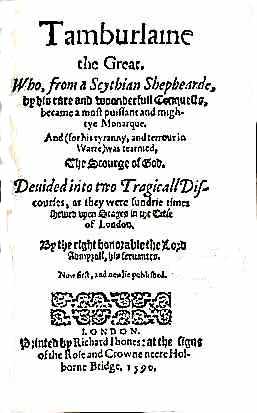
“My tailor.” Kit waved a hand over his expensive suit. “The printer for Tamburlaine.”
Marlowe’s Tamburlaine — a violent, complicated play — tells the story of a shepherd who becomes an emperor through, well, lots of unsavory behavior. By the time Matthew and Diana arrive in 1590, Marlowe’s play has been in print for three months... enough time, apparently, for the printer to come collect his debts. The play had apparently been performed, however, as early as 1587. The themes of Tamburlaine involve pride and power and the desire of one man to conquer everything and everyone. You can read Tamburlaine and watch a trailer for a 2014 production (including a few great scenes) below:
Enjoying our real-time reading posts? Let us know by e-mailing us at chamomileandcloevcast@gmail.com, by tweeting us @chamomilenclove, or by joining our Facebook group, the Clovers.
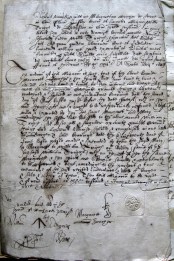
My handwriting was a disaster. It looked nothing like what I’d seen of the chemist Robert Boyle’s neat, rounded script or that of his brilliant sister, Katherine. I hoped that women’s handwriting in the 1590’s was far messier than it was in the 1690’s.
As you might imagine, students of history often have to learn to decipher different writing styles in order access primary resources. The study of historical writing styles is called paleography.
There are a number of great resources for those interested in increasing their knowledge of old writing styles. First, you might like to check out Muriel St. Clare Byrne’s article, “Elizabethan Handwriting for Beginners.” You could also check out St. Andrews’ Read Me! tutorials on deciphering fourteenth through sixteenth century script. The British National Archives maintains a great series of documents (and a game!) to try your hand at reading old manuscripts.
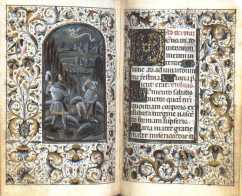
Book hand.
In SON, Diana uses a quill and ink to inscribe her name in her new book. Quills are specially-prepared feathers from large birds, such as geese or swans. Quills must be shaped and sharpened in order to write properly; an unprepared feather won’t hold sufficient ink, nor will its point deliver the kind of precise, well-shaped letters necessary to write in secretary or italic hand. If you felt inspired, you could buy yourself a quill and ink set and learn to write in secretary hand. This will prepare you either for a sixteenth century timewalk or for a new career in forging manuscripts. Very useful indeed.
Discussions with Francoise about my wardrobe revealed my ignorance of common names for ordinary colors. “Goose-turd green” was familiar to me, but the peculiar shade of grizzled brown known as “rat hair” was not.
As we discussed yesterday, the strict observance of England’s sumptuary laws meant that only certain people in Tudor England wore certain fabrics, garments, and colors.
For example,
None shall wear any cloth of gold, tissue, nor fur of sables: except duchesses, marquises, and countesses in their gowns, kirtles, partlets, and sleeves; cloth of gold, silver, tinseled satin, silk, or cloth mixed or embroidered with gold or silver or pearl, saving silk mixed with gold or silver in linings of cowls, partlets, and sleeves: except all degrees above viscountesses, and viscountesses, baronesses, and other personages of like degrees in their kirtles and sleeves”
Accordingly, Francoise potentially saved Diana from committing a terrible (and potentially criminal) faux pas. Elizabethans liked to describe color in peculiar ways. Some particular favorites uncovered in my research include:
Set your water to boil. Beat two egge yolkes. Add white wine and beat some more. When the water boils, set it to cool, then add the wine and egge. Stirre as it boils again, adding saffron and honey.
In her commonplace book, Diana makes note of a home remedy meant to banish headache. It sounds foul. It’s also historically appropriate.
Medicine in the 16th century was… basic. Most people tried to manage their health with diet in order not to get sick in the first place; unlike you and me, however, they didn’t necessarily rely on green vegetables and good hydration. Instead, many relied on the humorous theory of body fluids and health. This bizarre theory held that good health required a balance between the four humors — blood, yellow bile, phlegm, and black bile. As you might have noticed, the colors of these humors correspond with the four colors of the stages of alchemy. As the Renaissance thinking went, your temperament was determined by an excess of one humor or another. Accordingly, you were supposed to eat foods that neutralized this humor and encouraged balance. This fascinating article from Shakespeare & Beyond tells you all sorts of things about eating according to the theory of the humors. Notably, the article does not tell you what to feed mischievous, jealous daemons or arrogant vampires.
See you on November 4 in Chapter 4 of Shadow of Night!
Enjoying our real-time reading posts? Let us know by e-mailing us at chamomileandcloevcast@gmail.com, by tweeting us @chamomilenclove, or by joining our Facebook group, the Clovers.


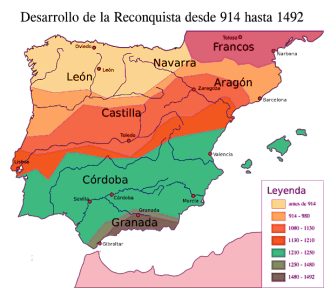 The emir, known to the Spanish as Boabdil, capitulated and began waging war. Boabdil later tried to defect and repel the Spanish, but it was too late. Historynet.com reports this uncomfortable anecdote of the surrender of Granada:


 According to
 Elizabeth stayed ahead of this turmoil by employing spies and by playing a very peculiar game — so long as she could be seen attempting to broker a marriage with a Catholic prince, she bought herself time and insurance against assassination by Catholic loyalists. Despite his Protestant loyalties,



 Chamomile & Clove