Real Time Reading, Uncategorized

Real-Time Reading – 27 September – Chapter 10

chloe-ridgway-196738Chloe Ridgway

Chapter 10

While Matthew’s brooding in Scotland, Diana resumes her ordinary routines in Oxford. She runs, she drinks tea, she studies – and she’s surrounded by creatures.

“A bewitched book.” Sarah’s voice was keen with interest. “Was it a grimoire?” She was an expert on grimoires, and her most cherished possession was the ancient volume of spells that had been passed down in the Bishop family. 

In this chapter, Diana mentions that Sarah is an expert on grimoires. A grimoire is a   textbook of magic containing spells, recipes, instructions, and other lore. They appear all over history and popular culture – there’s a grimoire in Wicked, there’s one in Buffy, there are dozens in Harry Potter… but according to the Guardian, there are real ones, too.

There were nine additional voice-mail messages on my mobile. All of them were from Sarah and reflected an escalating concern about what her sixth sense told her was happening in Oxford. 

Diana often mentions that Sarah has a sixth sense. She attributes this to Sarah’s witchiness, but there is some scientific evidence of a sixth sense – it’s just not what you think it is. The sixth sense in humans may be related to proprioception, or the body’s awareness of where it is in space. Otherwise, there’s not a lot of science behind witchy traits like seeing the future.

When she’s stumped, Diana plays a jigsaw puzzle game in her head. She claims it isn’t magical… but we know better. Puzzles originated in the 1760s as an educational tool.

My fingers itched as if hundreds of insects were crawling under the skin. Tiny sparks of blue-green were arcing between my fingertips, leaving traces of energy as they erupted from the edges of my body. I clenched my hands and quickly sat on top of them. 

This was not good. Like all members of the university, I’d sworn an oath not to bring fire or flame into Bodley’s Library. 

When the Tenth Knot went to Oxford, they discovered that you can actually buy a tote bag with the Bodelian reader’s oath inscribed on it. 

In her research, Diana discusses the “Verse on the Threefold Sophic Fire.” Alchemical poetry is a very real thing. The rather dubious-looking “Alchemy Website” has a nice collection.

b907422fc021f0133a2dfa479ea698f7
Alchemical Elements

 There are some collected alchemical references on Pinterest, also of rather dubious origins. I take no responsibility for anything you find.


It was a note from the warden, summoning me for a drink before dinner.

In my rooms I considered calling his secretary and feigning illness to get out of the invitation. My head was reeling, and there was little chance I could keep down even a drop of sherry in my present state. 

In this chapter, Diana goes to Professor Marsh’s rooms for sherry. This tradition is one of many unique to Oxford. For example, Oxford students take their exams in sub fusc wearing carnations. 

Here is the Daemons Discuss episode on Chapter 10. The All Souls  Podcast on Chapter 10 is here. We discussed Chapter 10 in Episode 5 – “Friends.” 

See you in Chapter 11!

xoxo

Cait

 

Real Time Reading, Uncategorized

Real-Time Reading – 26-29 September – Chapter 9

rab-fyfe-84787Chapter 9 

Pulling up to what had been the back entrance of an old hunting lodge, where rough brown stone stood in sharp contrast to the creamy stuccoed front, he climbed out of his Jaguar and lifted his bags from the trunk.

Deb says that the inspiration for Hamish’s hunting lodge is Chatelherault, in Hamilton, Scotland. The estate is described as a “folly

swalow-s_nest_architectural_folly_between_yalta_alupka_ukraine_photo_wiki,” which is the architectural term for an building constructed primarily for decoration. Once upon a time, people had a penchant for throwing up fake temples and such on their properties – they built towers and palaces, pyramids and obelisks. I am particularly fond of the Swallow’s Nest folly in the Ukraine.

Personally, I adore that every character in the AST has a special scent. Hamish’s particular scent – lavender and peppermint – is one I feel like I can imagine without much effort. In herbalist lore, mint is apparently associated with money and healing. Lavender is for protection, longevity, and peace.  Mint also has a mythology, which I didn’t know before today – it’s associated with Minthe, a wood nymph loved by Hades. Out of jealousy, Persephone changes Minthe into a crawling plant. Hades remembers Minthe by making the plant smell sweet when crushed underfoot. Charming? Not especially. The name for lavender may come from the Latin lavare, meaning “to 

daiga-ellaby-154935.jpg

wash,” but it could also come from livere, which means “blueish.” 

In this chapter, we learn that Hamish suspects that Matthew is mating. Wolves mate for life, but only the alphas of the pack mate – apparently, this keeps population numbers down. 

Hamish suggests that the manuscript might contain the secret of the philosopher’s stone, sought by alchemists for the ability to transform base metals into gold and purify the human spirit. The Atlas Obscura has a great article on the philosopher’s stone and the man who claimed to have successfully created the stone, Nicholas Flamel. Sound familiar? That’s because he’s a minor character in Harry Potter.

If you’d care to try your hand at Wild Mushroom Soup with Sherry, the dish that Jordan serves Matthew and Hamish, you can find a recipe on Sur le Table. If you prefer peanut butter and banana sandwiches, I can help with that, too.

You can find the Daemons Discuss ep on Chapter 9 here, and the All Souls Podcast ep here. Deb’s post about Hamish reveals that he was a surprise for her – and we’re very lucky to have him! We talk about Chapter 9 in our third episode, Lipstick on a Bat.

We’ll talk about Chapter 10 – which occurs simultaneously – tomorrow, on 27 September. See you then!

Love,

Cait


Real Time Reading, Uncategorized

Real-Time Reading – 25 September – Chapter 8

mitch-rosen-145576Mitch Rosen

Chapter 8

Today’s reading takes us to yoga with Amira and to Matthew’s house at the Old Lodge. In the All Souls Real-Time Reading Companion, Deb states that the inspiration for the Old Lodge is Speke Hall, a National Trust property outside of Liverpool. You can watch video tours here,  here, and here. I can absolutely see Matthew and Diana in the house as I watch the video, and I am sure you can, too.

Clairmont grinned and steered me through a big wooden door propped open with an iron doorstop. I gasped. The outside was remarkable, but the inside was stunning. Miles of linenfold paneling extended in every direction, all burnished and glowing.

Diana describes “linenfold paneling,” a style of wood carving representing vertically folded linen. The style of carving became popular in Northern Europe in the 14th century. The “Tudor” style is the final stage of medieval architecture in England (1485-1603) and often refers to “prestige buildings.” The style is notable in part because it represents a departure from the fortified houses and castles of the previous era; the invention of gunpowder made such defenses obsolete, and the nobility wanted to have family homes designed around comfort and aesthetics as opposed to military defense. The Wikipedia article on Tudor architecture is actually quite good.

By the time we took to the floor for back bends and inversions, everyone in the room was dripping wet — except for the vampires, who didn’t even look dewy. Some performed death-defying arm balances and handstands, but I wasn’t among them. Clairmont was, however. At one point he looked to be attached to the ground by nothing more than his ear, his entire body in perfect alignment above him.

There is simply no topping the excellent article posted by Daemon’s Domain about Yoga in the All Souls Trilogy, so I won’t try. You can find that article here. Even Deb linked to it!

You can (theoretically) learn to perform Fallen Angel pose with this video. This article also offers several helpful tips for how to achieve the Fallen Angel. If any of you succeed, I would like to see photographic proof.

The All Souls Podcast covers Chapter 8 in Episode 9: Dipole moment. Daemons Discuss talks about yoga and the Old Lodge in Take 15! We talked about Chapter 8 in our third episode, Lipstick on a Bat.

You can chat with us about Chapter 8 by tweeting using the hashtag #ccalchemy or by tagging us (@chamomilenclove). We’d also love to hear from you at chamomileandclovecast@gmail.com.

We’ll talk more tomorrow as we travel to Scotland to meet Hamish.

XOXO,

Cait


Real Time Reading, Uncategorized

Real-Time Reading – 24 September – Chapter 7

aaron-burden-38413.jpgAaron Burden

Chapter Seven

After a fitful night of sleep –which she blames rather inexplicably on Matthew–Diana steps out into the morning fog of Oxford to row.

She runs into Matthew–literally–while walking back from the river with her eyes closed. She treats this as a continuation of the meditative act of rowing, though it would appear that the experts recommend that you conduct walking meditation with your eyes open. You are, after all, far less likely to run into a handsome vampire than a solid, unforgiving tree trunk.

Matthew invites Diana to share breakfast with him and she accepts. According to the Tenth Knot, the cafe Matthew frequents is based on Brown’s Café in the Oxford Covered Market. Should you be so inclined, the Tenth Knot has an entire AST Guide to Oxford for all of your fandom-related travel needs. Once inside, Diana orders a heaping plate of food–a decision that I heartily applaud. Her breakfast sounds just short of a full English, which includnew-browns-56a4318f5f9b58b7d0d5c871es a heart-stopping combination of eggs, bacon, baked beans, toast, mushrooms, roasted tomatoes, pudding (black and white), and potatoes. They’re fabulous… if you can get through one. If you like the occasional culinary excess, I strongly recommend the blog the Fry Up Police, whose sole stated mission in life is to shame gnarly breakfasts and celebrate the very, very sexy ones.

In this chapter, Matthew watches Diana make a very potent, very personal mug of tea. On Deb’s blog, she indicates that Diana’s tea-drinking rituals are part of her coping strategy for anxiety and stress. She gives links to Diana’s favorite teas, including the ubiquitous PG tips, Thé Des Impressionistes by Mariage Frères, and Organic India USA Tulsi Sweet Rose Tea.  I happen to prefer the Marco Polo blend by Mariage Frères, but Diana and I can certainly differ in our choice of tea.

Tea-drinking in England likely originated with King Charles II in the 1660s. Popularized by royalty, taxed out the wazoo by the government, and generally adored by the middle classes, tea eventually became a staple of the British diet. There is a UK Tea Council, whose website offers the following fantastic description of the history of tea in the UK:

Read about the exotic beginnings of tea in China and the Far East and in time how it was transported to the UK and America on the Tea Clippers.

Discover how tea was brought to England by a seventeenth century queen, and how important the tea trade was to the British East India Company, one of the most powerful commercial organisations the world has ever seen.

Learn how the phenomenal popularity of tea in the eighteenth century led to widespread smuggling and adulteration, and about the murderous lengths smugglers went to to protect their illegal trade.

Read also about the Boston Tea Party of 1773, which sparked off the American Revolution, and how rivalry between the English and the American tea traders in the nineteenth century led to the excitement of the Clipper races. And trace the social history of tea in Britain, from the early debates about its health-giving properties, to the rise of the tea bag, via the great tradition of the London Tea Auction and the role of tea in boosting morale in the World Wars.

Sign me up, y’all. Their website offers a very helpful counter for the number of cups of tea consumed in ther UK at this very moment.

Diana and Matthew’s discussion of science and philosophy taps into a broad and ongoing debate on which disciplines bring us closest to understanding the big questions of the universe. In the linked Guardian article, a scientist and a philosopher have just such a discussion about the ability of science or philosophy to answer such questions.

The All Souls Podcast discusses this chapter in Episode 8: The Fog Dissipates. The Daemons cover this chapter in Take 15!. Our episode on Chapters 7-9 is Episode 3 – Lipstick on a Bat.

If you’d like to get in touch, find us on Twitter at @chamomilenclove or e-mail us at chamomileandclovecast@gmail.com. See you in yoga class!

Best,

Cait

Real Time Reading, Uncategorized

Real-Time Reading – 23 September – Chapter 6

alexandra-kirr-322672.jpg

Chapter Six

In Chapter Six, we meet Miriam – whose putative history we’ll leave alone for a bit. To the extent that anyone finds this helpful, the name “Miriam” means rebellious in Hebrew. Miriam was a prophetess of the Hebrew Bible. Specifically, Miriam prophesies the birth of Moses and criticizes her father for divorcing his wife to avoid bringing children into the world. Hm.

The manuscript inside the next box was smaller than the last, but it contained interesting sketches of alchemical apparatus and snippets of chemical procedures that read like some unholy combination of Joy of Cooking and a poisoner’s notebook. 

In Deb’s post on Chapter Six and in the All Souls Real Time Reading Companion, she links alchemical manuscripts for us to browse and enjoy. Since she published the Reading Companion, one of her sources–the Getty Research Institute–started an exhibition on the Art of Alchemy.

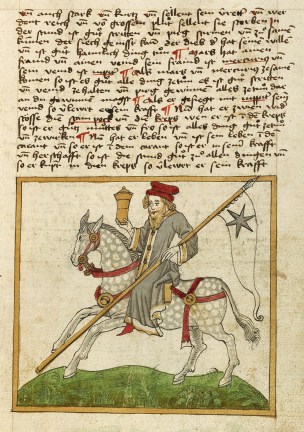
The Planet Mercury as a Doctor on Horseback
The Planet Mercury as a Doctor on Horseback, from Descriptions of Planets, Zodiacs, and Comets, about 1464 (The Getty Institute)

Because Diana mentions “Joy of Cooking,” you might also  be interested in Mariabella Charles’s Book of Cookery Recipes and Medical Cures (ca. 1678), also linked by the Getty Institute. The Getty also links to a fabulous video on the creation of pigments and how alchemy relates to the use of color in medieval manuscripts.  

My usual meal consisted of a twenty-minute break in the nearby bookstore’s second-floor cafe. I smiled at the thought of Miriam occupying herself during that time, trapped in Blackwell’s where tourists congregated to look at postcards, smack between the Oxford guidebooks and the true crime section. 

Blackwell’s is an Oxford landmark and tourist attraction in its own right.  They’ve been trading books since 1879. You can find the Guardian’s “Interview with a Bookstore” segment on Blackwell’s here.

For those of you who simply can’t resist the grisly, the gory, or the spooky, there’s apparently an entire subgenre of crime fiction devoted to occult murders. Perhaps Netflix consulted Peter Knox.

You can find the All Souls Podcast episode on Chapters 5-6 here. Daemon’s Domain covers Chapter Six in this episode.

We covered Chapters 5-6 in Episode 2 – Why So Angry?

If you’d like to get in touch, you can find us on Twitter @chamomilenclove or by e-mail at chamomileandclovecast@gmail.com.

See you in Chapter 7!

Best,

Cait