It’s new episode day! Today’s offering closes out our chapter discussions for Section III of Shadow of Night and offers our thoughts on how Section III — with its highs, its lows, and its oddities — fits in with the rest of the book and maybe the trilogy. We’ve got plenty to say (no surprise) and plenty to look forward to as we leave London for Prague.
We hope you’re enjoying the #RealTimeReading of #ShadowofNight. If you’d like to discuss those posts, the countdown to the release of A Discovery of Witches TV in the US, or anything else that suits your fancy, join us on our Facebook page, the Chamomile & Clove Clovers. You can also find us on Twitter @chamomilenclove or e-mail us at chamomileandclovecast@gmail.com.
Matthew vetoed all these suggestions and called on Widow Beaton, Woodstock’s cunning woman and midwife. She was poor and female — precisely the sort of creature the School of Night scorned — but this, Matthew argued, would better ensure her cooperation.
The term “cunning folk” generally refers to folk medicine practitioners across Europe. In England, the “cunning folk,” “wise women,” and “wizards” who supplied their communities with folk remedies in exchange for meals or other goods often escaped the scrutiny and persecution of “witches” during the same period; the common theory appears to be that cunning folk provided for a social good whereas witches brought ill-fortune and disaster. Shadow of Night takes place during a period after parliament outlawed “conjugations and witchcraft” in 1563. The law punished those who utilized “magic” and threatened both “witches,” who used magic for evil purposes, and the cunning folk who dispensed herbal remedies. During this period, Protestant theology condemned not just witches but any who used folk medicine that seemed “magical.” This apparently stemmed from a rejection of the mysticism and ritual of the Catholic Church as well as an inherent fear of evil folk wielding otherworldly power.
Because the popular thinking of the day did little to distinguish witchcraft from the craft of the cunning folk, the perception of a cunning woman in her community could change quickly based on (1) her effectiveness and (2) her perceived ill intent. In the book, Diana correctly (and justly) cautions Matthew that a witch’s safety depends on the goodwill of her neighbors. Given the historical context of Elizabethan England, it seems reasonable that the vulnerable Widow Beaton should attempt to divert suspicion away from herself and towards Diana.
“You think a historian can understand the tenor of the present moment better than the men living through it?” Matthew’s eyebrow cocked up in open skepticism.
“Yes,” I said, bristling. “We often do.”
“That’s not what you said this morning when you couldn’t figure out why there weren’t any forks in the house.” It was true that I’d searched high and low for twenty minutes before Pierre gently broke it to me that the utensils were not yet common in England.
The English word “fork” comes from the Latin furca, or “pitchfork.” According to a fascinating anecdote from a Brief History of the Fork, a fork arrived in Venice as a part of a noblewoman’s dowry in the 11th century.
Ancient forks
The Church criticized the woman for using the fork as an affront to God’s purpose for fingers. The fork was considered to be “feminine” and dangerous in Western Europe until approximately 1633, when Charles I declared the utensil to be “decent.” Curious for more on the history of cutlery? I enjoyed this article on the history of the fork, as well as this one.
“It is never too early for stoicism,” Kit replied severely. “You should thank me it’s not Homer. All we’ve heard lately is inept paraphrases of the Iliad. Leave the Greek to someone who understands it, George — someone like Matt.”
Although you wouldn’t know it from Kit’s behavior (because he is The Worst), George Chapman’s actually managed a successful English translation of Homer’s Iliad. Published in 1611, Chapman’s Iliad rejected direct translation in favor of taking the occasional poetic license with Homer’s text. For instance, as the University of Michigan notes, Chapman substituted “the invisible cave that no light comforts” for Hades.
The title page of the 1888 edition of Chapman’s Iliad. E-book available here.
Chapman fell somewhat into disfavor after his death — he apparently had a tendency to try and squeeze strict moral teachings where they didn’t belong, so 19th century critics dismissed him. If you look up Chapman’s Homer translations on Amazon, you get a rather glowing statement of his accomplishments:
George Chapman’s translations of Homer are the most famous in the English language. Keats immortalized the work of the Renaissance dramatist and poet in the sonnet “On First Looking into Chapman’s Homer.” Swinburne praised the translations for their “romantic and sometimes barbaric grandeur,” their “freshness, strength, and inextinguishable fire.” The great critic George Saintsbury (1845-1933) wrote: “For more than two centuries they were the resort of all who, unable to read Greek, wished to know what Greek was. Chapman is far nearer Homer than any modern translator in any modern language.”
You may have these translations for $30, if you like. It’s more than Kit could afford, that’s for sure. Speaking of which…
“Who are you in trouble with now?” he asked Marlowe, reaching for his wine. “And how much is is going to cost to get you out of it?”
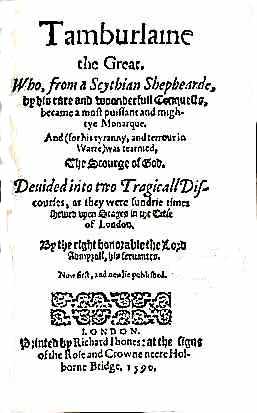
“My tailor.” Kit waved a hand over his expensive suit. “The printer for Tamburlaine.”
Marlowe’s Tamburlaine — a violent, complicated play — tells the story of a shepherd who becomes an emperor through, well, lots of unsavory behavior. By the time Matthew and Diana arrive in 1590, Marlowe’s play has been in print for three months... enough time, apparently, for the printer to come collect his debts. The play had apparently been performed, however, as early as 1587. The themes of Tamburlaine involve pride and power and the desire of one man to conquer everything and everyone. You can read Tamburlaine and watch a trailer for a 2014 production (including a few great scenes) below:
Enjoying our real-time reading posts? Let us know by e-mailing us at chamomileandcloevcast@gmail.com, by tweeting us @chamomilenclove, or by joining our Facebook group, the Clovers.
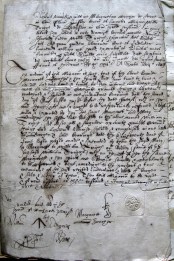
My handwriting was a disaster. It looked nothing like what I’d seen of the chemist Robert Boyle’s neat, rounded script or that of his brilliant sister, Katherine. I hoped that women’s handwriting in the 1590’s was far messier than it was in the 1690’s.
As you might imagine, students of history often have to learn to decipher different writing styles in order access primary resources. The study of historical writing styles is called paleography.
There are a number of great resources for those interested in increasing their knowledge of old writing styles. First, you might like to check out Muriel St. Clare Byrne’s article, “Elizabethan Handwriting for Beginners.” You could also check out St. Andrews’ Read Me! tutorials on deciphering fourteenth through sixteenth century script. The British National Archives maintains a great series of documents (and a game!) to try your hand at reading old manuscripts.
Book hand.
In SON, Diana uses a quill and ink to inscribe her name in her new book. Quills are specially-prepared feathers from large birds, such as geese or swans. Quills must be shaped and sharpened in order to write properly; an unprepared feather won’t hold sufficient ink, nor will its point deliver the kind of precise, well-shaped letters necessary to write in secretary or italic hand. If you felt inspired, you could buy yourself a quill and ink set and learn to write in secretary hand. This will prepare you either for a sixteenth century timewalk or for a new career in forging manuscripts. Very useful indeed.
Discussions with Francoise about my wardrobe revealed my ignorance of common names for ordinary colors. “Goose-turd green” was familiar to me, but the peculiar shade of grizzled brown known as “rat hair” was not.
As we discussed yesterday, the strict observance of England’s sumptuary laws meant that only certain people in Tudor England wore certain fabrics, garments, and colors.
For example,
None shall wear any cloth of gold, tissue, nor fur of sables: except duchesses, marquises, and countesses in their gowns, kirtles, partlets, and sleeves; cloth of gold, silver, tinseled satin, silk, or cloth mixed or embroidered with gold or silver or pearl, saving silk mixed with gold or silver in linings of cowls, partlets, and sleeves: except all degrees above viscountesses, and viscountesses, baronesses, and other personages of like degrees in their kirtles and sleeves”
Accordingly, Francoise potentially saved Diana from committing a terrible (and potentially criminal) faux pas. Elizabethans liked to describe color in peculiar ways. Some particular favorites uncovered in my research include:
Set your water to boil. Beat two egge yolkes. Add white wine and beat some more. When the water boils, set it to cool, then add the wine and egge. Stirre as it boils again, adding saffron and honey.
In her commonplace book, Diana makes note of a home remedy meant to banish headache. It sounds foul. It’s also historically appropriate.
Medicine in the 16th century was… basic. Most people tried to manage their health with diet in order not to get sick in the first place; unlike you and me, however, they didn’t necessarily rely on green vegetables and good hydration. Instead, many relied on the humorous theory of body fluids and health. This bizarre theory held that good health required a balance between the four humors — blood, yellow bile, phlegm, and black bile. As you might have noticed, the colors of these humors correspond with the four colors of the stages of alchemy. As the Renaissance thinking went, your temperament was determined by an excess of one humor or another. Accordingly, you were supposed to eat foods that neutralized this humor and encouraged balance. This fascinating article from Shakespeare & Beyond tells you all sorts of things about eating according to the theory of the humors. Notably, the article does not tell you what to feed mischievous, jealous daemons or arrogant vampires.
See you on November 4 in Chapter 4 of Shadow of Night!
Enjoying our real-time reading posts? Let us know by e-mailing us at chamomileandcloevcast@gmail.com, by tweeting us @chamomilenclove, or by joining our Facebook group, the Clovers.
Welcome to the Real-Time Reading for Shadow of Night! Over the next couple of months, we’ll be sharing tidbits and observations from each chapter of SON as they happen in the book. The RTR is a great opportunity to spend some time musing on the book and its intricate details as they unfold in real time. Without further ado, let’s journey into 1590 with Matthew and Diana!
Chapter 1
We arrived in an undignified heap of witch and vampire.
In Chapter 1, Matthew and Diana step from Sarah and Em’s hop barn in 2010 New York into Matthew home in 1590, the Old Lodge. We first visited the Old Lodge in Chapter X of A Discovery of Witches.
Tipping my head back, I saw the ceiling — thickly plastered, coffered into squares, with a splashy red-and-white Tudor rose picked out in gilt on each recess.
“The roses were obligatory when the house was built,” Matthew commented drily. “I can’t stand them.”
At Matthew’s words, the young man dropped the paper to the table and pivoted, joy lighting his face. I’d seen that face before, on my paperback copy of Christopher Marlowe’s The Jew of Malta.
“Putative Marlowe portrait.” 1585. Held by Corpus Christi College, Cambridge.
Diana likely refers to this alleged portrait of Christopher Marlowe, discovered by workmen in Corpus Christi College in 1953. Those who say that the portrait represents Marlowe point to his putative motto (quod me nutruit me destruit), his attendance at Corpus Christi on or about the date of the work, and the apparent age (21?) of the sitter. Detractors claim that the sitter’s costume is too fancy and would have violated England’s sumptuary laws and that Marlowe–notoriously short on cash–never could have afforded the luxury of a portrait. In the world of All Souls, I simply assume that Matthew paid for both the doublet and the portrait because he couldn’t help but humor Kit.
As a side note, the sumptuary laws of England are a fascinating topic for another time — they played a significant role in maintaining the strict Elizabethan social hierarchy and told every class of society what they could and could not wear. Speaking of class, status, and hierarchy…
“Why no beard? Have you been ill?”
OMG, you guys.
When we recorded our first SON episodes, I hadn’t done the research for these posts and therefore didn’t yet know that beards were a Big Deal in Elizabethan England. Did you know that the lack of a beard was associated with class, masculinity, and virility? The Elizabethan construct of masculinity used the beard as a token of manhood and a sign of strength separating women from men. (See Fisher, Will. The Renaissance Beard: Masculinity in Early Modern England. Renaissance Quarterly, Vol. 54, No. 1 (Spring 2001)). Elizabethan beards came in many shapes, styles, and colors, and there was apparently a market for prosthetic beards. Elizabethans also associated some beard shapes with professions, like the cathedral beard or the glover’s beard.
Elizabethans associated smooth cheeks with “dubious masculinity” and there is a theory that the strict performance of gender in the Elizabethan era stemmed from the existential challenge Elizabeth I’s reign posed to a patriarchal society. (See Dolan, Frances. “Gender and sexuality in early modern England” in Gender, Power, and Privilege in Early Modern Europe, Munns, J., and Richards, P., eds. (2003)). My whole point being that I believe that the beard gag running through the first few chapters of SON is essentially one long challenge to Matthew’s virility and social status and that it’s maybe a really intelligent penis joke that also has layers of meaning for the gender politics of SON and how Diana sharpens and complicates all of these gendered questions by bringing her 2010 sensibilities into the world of 1590.
It’s pretty good, guys.
Chapter 2
I asked Francoise a number of questions during the complicated process. Portraits of the period had led me to expect an unwieldly birdcage called a farthingale that would hold my skirts out at the hips, but Francoise explained that these were for more formal occasions.
Ah, the bum roll.
As you might have gathered from this chapter, Elizabethan women wore many, many layers of clothing. Elizabethan outfits often comprised multiple pieces that could be re-arranged and matched, such as bodices and sleeves. The average Elizabethan woman wore nine separate garments for formal dress, including smock, stockings, corset, farthingale and/or bum roll, petticoat, kirtle, forepart, partlet, gown, and sleeves. Everything under the petticoat gives structure to the outer garments and creates a fashionable silhouette on which to layer the more valuable and decorative outer garments.
The farthingale Diana expects came to England via Spain, where the same garment is called a verdugado. Made of wood, the farthingale holds the skirts out in a pleasing bell or cone shape. The bum roll achieved a similar effect by using rolls of fabric to hold the skirts away from the body. Historians first found evidence of the bum roll in the accounts of Elizabeth I’s wardrobe from 1580. If you’d like to make a bum roll of your own, you may want to check out these instructions.
We’ll pick up on Chapter 3 of SON tomorrow, November 2. In the meantime, Deb’s post on Chapter 1 of SON can be found here. We covered Chapters 1-3 of SON in Episode 20, Elizabethan Vacation. Our friends at Daemons Discuss covered Chapters 1-2 in Take 26! The One with the Boys.
Follow us on Twitter at @chamomilenclove for real-time reading posts and join our Facebook group, the Clovers, for more in-depth discussion.
Today’s episode, “The Symbolism Buffet,” covers Chapter 23 of Shadow of Night — a chapter full of joys, challenges, and contradictions. We talk about hard things (Diana’s miscarriage, Matthew’s interference in Diana’s personal growth) and great things (COORRRRRRRAAAAAAAA, the forespell, Diana learning to take up space) and leave the chapter with Diana entering a new and glorious phase in her life as a witch. It’s a long episode, but we think this chapter deserves it.
You can join the conversation about this episode (and all of the others!) by becoming a member of our Facebook group, the Clovers. You can also e-mail us at chamomileandclovecast@gmail.com or follow us on Twitter at @chamomilenclove.







 Chamomile & Clove